
Should I Tell Patients My Pricing Before the Consultation or Wait? (Why Pre-Framing the Price and Collecting Payment by Phone Closes More Cash-Pay Patients)
There are two quiet decisions that change a cash-pay clinic’s close rate more than any script: when you reveal the price, and when you collect the payment. Most clinics reveal the price at the very end of the consult and collect when the patient comes in—and both of those defaults cost them patients.
The clinics that close best do the opposite. They pre-frame the price on the phone before the consult, and they take payment the moment the patient says yes. This is the FAQ on why, drawn from a women’s-health practice that grew its monthly bookings from 10 to 25 over three months by tightening exactly this part of the process.
Should I tell prospects my pricing before the consultation or wait until I present the plan?
Tell prospects the monthly investment range before the consultation.
Don’t wait until the end of the visit to introduce the price.
When patients arrive at the review of findings without any idea what the program costs, providers must overcome both the clinical discussion and the surprise of an unexpected price.
As a result, closing the program becomes much harder.
Pre-framing removes that obstacle before the consultation even begins.
One simple approach is to compare the monthly investment to the payment on a nice car.
That reference point gives patients a familiar frame of comparison and allows them to arrive already comfortable with the general price range.
Importantly, you’re not quoting an exact figure before building the treatment plan.
Instead, you’re sharing a realistic range so nobody feels surprised later.
Patients who continue booking after hearing that range have already qualified themselves financially.
Those are exactly the people you want sitting in the consultation.
This approach is a key part of an effective patient acquisition process because it qualifies prospects on price early.
Consequently, the consultation can focus on care rather than cost.
How do I get cash-pay patients to pay for the program over the phone instead of waiting until the visit?
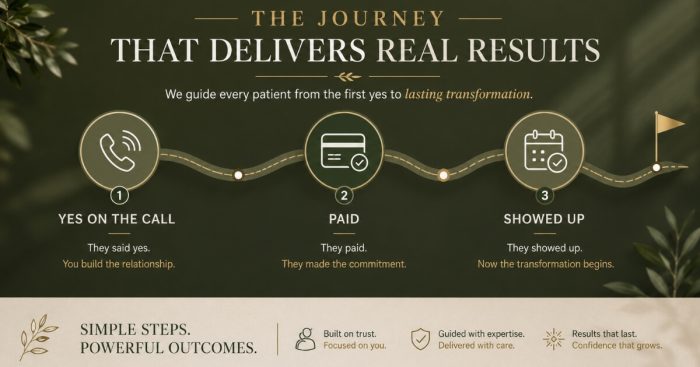
Collect payment over the phone as soon as the patient commits.
Don’t postpone payment until the in-person appointment.
Patients who pay immediately are much more likely to follow through.
For example, one clinic collected $899 over the phone from two patients for an initial labs-and-consult package.
After paying, both patients voluntarily drove to the office to pick up their testing kits.
In each case, payment came first and attendance followed naturally.
More importantly, collecting payment immediately almost eliminates the risk of no-shows.
Once patients have invested financially, they become significantly more committed than someone who has simply reserved a spot on the calendar.
The process itself is straightforward.
When the prospect says yes, collect the payment during that same phone call.
Avoid telling patients you’ll “take care of it when you come in.”
That delay creates unnecessary space for doubt and second thoughts.
Instead, convert intent into commitment while motivation is at its highest.
Why does pre-framing the price make the close easier at a cash-pay clinic?
Pre-framing works because surprise is one of the biggest obstacles to a successful close.
By introducing the investment earlier, you remove that surprise completely.
Otherwise, patients experience two major decisions at exactly the same moment.
They must first process the diagnosis and then immediately react to the price.
Naturally, that combination creates additional resistance.
Pre-framing separates those conversations.
The price discussion happens during the initial phone call while expectations are still being established.
Later, the consultation can focus entirely on the patient’s findings and the treatment plan.
By the time patients review the recommendation, the investment is no longer new information.
Instead, it feels expected.
Clinics that consistently pre-frame pricing often describe the review-of-findings appointment as a confirmation rather than a negotiation.
As a result, providers spend less time overcoming sticker shock and more time discussing care.
The close becomes easier not because the investment changed, but because the surprise disappeared.
This strategy also fits naturally within a functional medicine & longevity clinic marketing approach.
High-consideration patients want time to process important financial decisions, and unexpected pricing often causes them to hesitate.
Should I use a higher-priced tier as an anchor to sell my main program?
Yes.
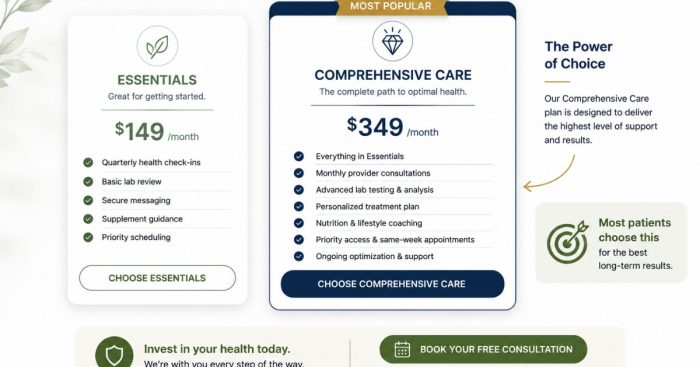
Positioning a higher-priced tier next to your target program makes the target option feel much more reasonable.
For example, one clinic offers a roughly $1,599-per-month tier specifically to make its $899-per-month program feel like the practical middle choice.
The higher-priced option doesn’t need to become your best-selling package.
Instead, its primary purpose is to reset the patient’s perception of value.
Both programs can share the same overall structure.
For instance, each might include a six-month commitment with individualized add-ons.
As a result, patients perceive the primary difference as the level of service rather than an entirely different buying decision.
When you combine anchoring with pre-framing, the higher investment is introduced first.
Then the target program feels considerably more approachable.
Best of all, anchoring costs nothing to implement.
Once it’s in place, it begins influencing decisions on the very next consultation.
How long should a high-ticket cash-pay consultation take, and should I allow flexibility?
Aim for a structured one-hour consultation.
At the same time, allow flexibility for the complex cases that genuinely need more time.
Ideally, about 90% of consultations should finish within the hour.
A clear structure keeps the visit focused.
When providers set the agenda at the beginning, they guide the conversation efficiently while showing patients that their time is respected.
However, rigid time limits can sometimes cost you a sale.
For example, one consultation ran about 20 minutes longer because a patient brought a distracting family member into the room.
That extra time ultimately helped the provider close a $7,000 program.
The lesson is simple.
Default to a one-hour consultation.
Then extend the visit only when the situation clearly justifies the additional time.
Set expectations at the beginning, follow the schedule most of the time, and remain flexible when flexibility creates a better outcome.
A consultation that balances structure with empathy consistently converts better than one that’s either overly rigid or completely open-ended.
When should I follow up with a new patient after they sign up?
Wait about one week before the first follow-up.
Calling the next day is usually too soon.
For example, one clinic originally contacted patients the day after signup to confirm they had created their portal account and watched the onboarding video.
Instead of feeling supported, many patients felt rushed because they hadn’t yet had time to get organized.
Giving patients about a week creates a much better experience.
By then, they’re more prepared to ask questions and complete the next steps.
As a result, the follow-up feels helpful instead of intrusive.
After that initial check-in, build a series of automated touchpoints throughout the first several months.
Those touchpoints can include:
- Follow-up consultations
- Refill reminders
- Scheduled check-ins
- Follow-up intake forms
The goal is to support patients consistently without overwhelming them.
In other words, match your communication cadence to the patient’s real onboarding experience rather than your own eagerness to follow up.
That same level of thoughtful care should continue long after the initial sale.
FAQ’s About Pre-Framing Price and Collecting Payment by Phone
Should I front-load all the testing before the consult too?
Yes.
Front-loading laboratory work and functional testing shortens the sales cycle while helping patients reach treatment sooner.
When all testing is complete before the review of findings, patients can begin care immediately instead of waiting several more weeks for results.
Consequently, they experience faster progress and are more likely to generate referrals.
Front-loaded testing also complements pre-framed pricing.
Patients already understand the investment and arrive with objective data, allowing the consultation to focus entirely on the treatment plan.
What if a patient pushes back on hearing the price before the consult?
Present the investment range as a courtesy rather than a barrier.
Explain that you’re sharing it to respect the patient’s time and avoid unexpected surprises later.
Most people appreciate understanding the general investment before committing an hour to the consultation.
Meanwhile, those who decline solely because of the price range were rarely going to become patients.
Although you may lose a small amount of low-intent volume, you protect valuable provider time for patients who are far more likely to move forward.
What’s a healthy cost to acquire a new cash-pay patient?
The answer depends on the value of your program.
However, the most important metric is whether your acquisition cost allows you to scale profitably.
For example, one clinic reduced its cost per lead from roughly $200 to about $30–35.
As a result, its customer acquisition cost landed around $386 during the first month.
The long-term goal was to reduce that number by another $100 before increasing advertising spend.
Track customer acquisition cost—not just lead volume—because CAC tells you whether your marketing is ready to scale.
How fast can tightening the sales process move my bookings?
Often, improvements happen quickly because they affect the leads you already have.
For example, one clinic increased monthly bookings from 10 in August to 16 in September and then to 25 in October.
During the same period, website leads also increased from 60 to 80.
Those gains came from tightening three parts of the process:
- Pre-framing the investment
- Collecting payment by phone
- Front-loading laboratory testing
As those improvements compounded, booking performance continued to improve alongside lead growth.
What’s the next step?
If your providers feel like they’re fighting an uphill battle at the end of every consultation, the issue usually isn’t the provider or the investment.
Instead, it’s the timing.
Pre-frame the monthly investment during the initial phone call.
Then collect payment the moment the patient commits.
Next, use a higher-priced tier as an anchor, and complete laboratory testing before the consultation.
Each step removes friction before it can become an objection.
During a strategy call, we’ll review your current new-patient call flow and consultation process.
Then we’ll identify exactly where to move the pricing conversation and payment collection so more consultations convert into patients.
It’s the same sales-process strategy behind an HRT clinic we grew from $1M to $4M a year.