
Should I Source Hormones From a Compounding Pharmacy or a Generic Supplier? (How Your Sourcing Decision Quietly Sets Your HRT Pricing and Margin)
Most hormone clinics treat sourcing as a back-office decision and pricing as a front-office one. In reality, they are the same decision. Where you source your hormones—a generic supplier with a public retail price or a compounding pharmacy you order from as a provider—quietly determines how much you can charge, how exposed you are to price-shopping, and how much margin you ultimately keep. This FAQ explains how to make that decision intentionally, based on a strategy call with a clinic charging about $165 per month that discovered it was leaving most of its margin on the table.
Should I source hormones from a compounding pharmacy or a generic supplier for my cash-pay clinic?
For most cash-pay hormone programs, a compounding pharmacy is the stronger default.
Why?
Because it supports premium pricing while reducing price-shopping.
Generic medications often anchor patients to a low retail price they can easily find online.
When you dispense a standard generic medication, the same product may sit on a pharmacy shelf for roughly $30.
Patients naturally ask why your program costs several hundred dollars each month.
Compounded medications work differently.
They are:
- Provider ordered
- Customized
- Not directly comparable to retail pharmacy products
That changes the conversation.
Instead of comparing the price of a medication, patients focus on the quality of the care they receive.
The additional cost of compounding is often modest.
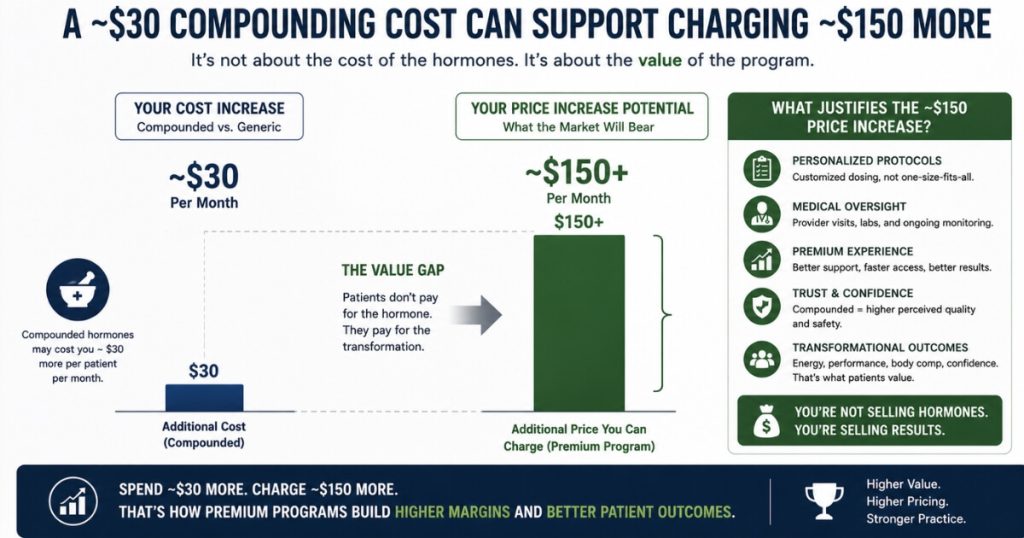
In many cases, it adds approximately $30 to your product cost while supporting significantly higher pricing.
Generic sourcing is not inherently wrong.
It can serve patients who genuinely need a lower-cost option.
The mistake is allowing generic sourcing to become the accidental reason your pricing remains low.
If you are building a premium men’s hormone clinic marketing and TRT program, your sourcing strategy should support the price you want to charge instead of quietly limiting it.
Why does sourcing generic hormones make it harder to charge a premium for HRT?
Generic medications come with publicly available retail prices.
Patients can easily look them up.
That creates a low price anchor before they ever evaluate your program.
Estradiol provides a simple example.
A clinic may purchase it for only a few dollars.
Patients may see retail prices around $30 at a pharmacy.
Once they discover that number, the conversation shifts.
Instead of evaluating:
- Clinical oversight
- Monitoring
- Access
- Ongoing care
they begin comparing the cost of the medication itself.
The medication was never the primary product.
The relationship and care program were.
When patients can compare your exact product against a retail shelf price, you unintentionally give them a reason to negotiate.
Premium pricing works best when there is no direct public comparison.
That is not about hiding information.
It is about avoiding unnecessary price anchors for a care relationship that delivers far more value than the medication alone.
A generic-only program eventually competes on the one number you never want patients focusing on.
How does using a compounding pharmacy let me charge more for hormone therapy?
Compounded medications are provider ordered, customized, and unavailable as standard retail products.
That removes the public price comparison.
It also positions the program as personalized care instead of a commodity purchase.
A compounding pharmacy prepares formulations that patients cannot simply buy off a pharmacy shelf.
That single difference changes the economics.
For example:
- Product cost may increase by roughly $30.
- Program pricing may increase by approximately $150.
The additional value comes from two factors:
- Higher perceived value
- No direct retail comparison
Compounding also reduces the likelihood that patients see your clinic as simply marking up medications.
Instead, they see a customized treatment program managed by a medical provider.
The important principle is this:
You are not marking up a pill.
You are providing a personalized care program that patients cannot comparison shop line by line.
That is one reason many established hormone clinics work with compounding pharmacies instead of relying entirely on generic medications.
What should my hormone membership actually cost given my real margins?
Price your membership according to market value—not simply your cost of goods.
Many successful cash-pay hormone clinics charge between $300 and $450 per month.
That pricing is common even when:
- Laboratory costs
- Medication costs
combine to well under $200 per patient.
Pricing solely from cost leaves significant profit on the table.
It also misunderstands how business margins work.
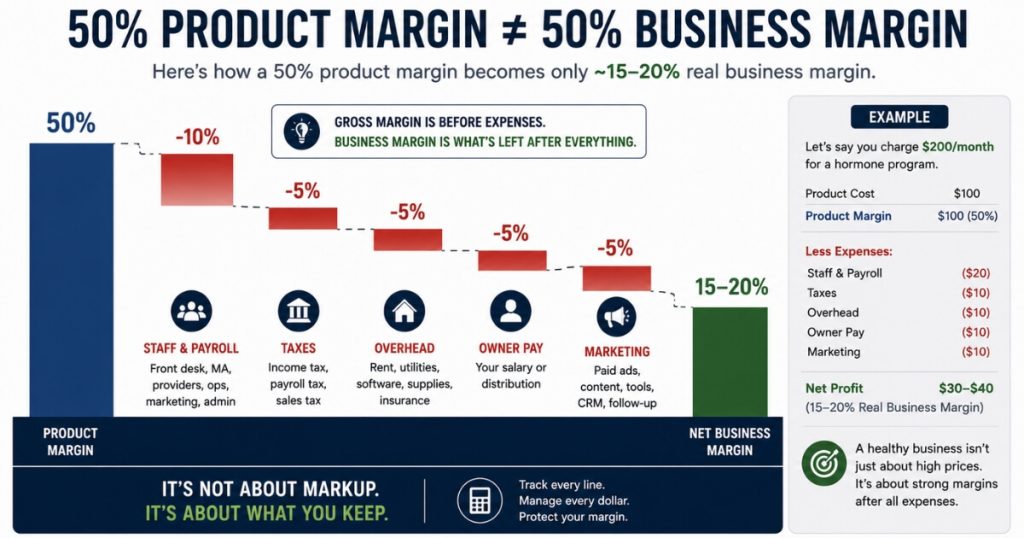
A 50% product margin is not a 50% business margin.
After accounting for:
- Payroll
- Rent
- Taxes
- Staff
- Owner compensation
- Overhead
your actual business margin may fall to only 15% to 20%.
Underpricing does more than reduce profit.
In some cases, it causes clinics to lose money while appearing profitable.
Instead:
- Price according to market value.
- Compare your pricing with similar clinics.
- Make sure your sourcing strategy supports that pricing.
This is also why memberships outperform à la carte hormone pricing.
Patients are paying for the ongoing relationship—not individual medications.
That is exactly how an HRT clinic we grew from $1M to $4M a year built recurring revenue through memberships rather than medication markups.
Why don’t patients just price-shop my hormones the way they shop everything else?
Most patients do not know what hormone medications actually cost.
They also have no easy way to determine wholesale pricing.
More importantly, they are paying for much more than the medication itself.
Patients are really purchasing:
- Provider expertise
- Ongoing monitoring
- Convenience
- Clinical oversight
- Long-term care
Those benefits do not have a simple retail price they can search online.
That is why many hormone clinics successfully charge $300 or more each month with relatively little resistance.
The problem begins when clinics create the price comparison themselves.
Dispensing a generic medication with a publicly available retail price gives patients a direct comparison point.
Instead, keep the conversation centered on:
- Care
- Access
- Expertise
- Ongoing management
When you source medications in a way that avoids creating a retail price anchor, patients rarely focus on shopping around.
Patients comparison shop commodities.
They rarely comparison shop trusted provider relationships—unless the clinic accidentally turns itself into a commodity.
Should I sell single hormone or weight-loss injections to compete on price?
No.
Low-priced injections attract bargain shoppers.
Those patients rarely become long-term members.
Offers such as “$99 skinny shots” often produce patients who disappear after the first month.
Similar low-cost promotions have produced the same pattern.
They generate interest.
They rarely generate retention.
Single-injection offers also create another problem.
They teach patients to think about treatment one injection at a time.
That is exactly the pricing mindset you want to avoid.
Instead, build your business around programs and memberships.
The ongoing care should become the primary value—not the individual dose.
If you want straightforward pricing inside a membership, use clean, predictable pricing tiers.
For example:
- One flat price for each dosage tier.
- Simple increases as dosage changes.
- Consistent monthly membership pricing.
Avoid building the business around loss-leader injections that primarily attract your lowest-value patients.
FAQ’s About Compounded vs. Generic Hormone Sourcing
Is it legal and compliant to use a compounding pharmacy for hormone therapy?
Yes, provided you work with a licensed compounding pharmacy and prescribe within the applicable regulations.
Compounded hormones and related preparations are widely used in cash-pay clinics.
However, the regulatory landscape continues to evolve.
That includes rules surrounding:
- 503A compounding pharmacies
- 503B outsourcing facilities
Compliance should never be treated as a one-time task.
Instead, make it an ongoing part of your operations.
The same principle applies to other customized formulations, including those commonly discussed in peptide therapy clinic marketing.
Stay in close communication with:
- Your compounding pharmacy
- Legal counsel
- Compliance advisors
That helps ensure your clinic stays current as regulations change.
Can I offer both a generic and a compounded option?
Yes.
Many clinics successfully offer both.
A two-tier pricing strategy can work very well when it is intentional.
For example:
- A generic program serves price-sensitive patients.
- A compounded program becomes the premium offering.
The important point is that the generic option should be a deliberate value tier—not your default.
This approach allows you to serve different patient needs without anchoring every patient to the lower retail price.
Choose your pricing strategy intentionally rather than defaulting to generic medications simply because no one planned the sourcing strategy.
How do I raise prices on existing hormone patients without losing them?
Focus on adding value instead of simply increasing the price.
Existing patients usually remain because they value the relationship—not because they found the lowest monthly fee.
Introduce higher pricing for new patients first.
Then transition existing patients over time.
Explain the increase by connecting it to meaningful improvements, such as:
- Better monitoring
- More provider access
- Compounded formulations
- Expanded support
Whenever possible, grandfather current patients for a period before moving them to the updated pricing.
Patients who value the relationship rarely leave over a reasonable increase that is clearly explained.
How do I add a second revenue stream beyond weight loss using hormones?
Convert existing weight-loss patients into hormone patients whenever appropriate.
Hormone patients typically remain with the clinic much longer.
One practical strategy looks like this:
- Enroll the patient in your weight-loss program.
- Continue treatment for several months.
- Offer complimentary or discounted hormone laboratory testing.
- Review the results.
- Introduce an appropriate hormone program when clinically indicated.
This approach creates two important benefits.
It reduces dependence on weight-loss services alone.
It also transforms a medium-retention patient into a long-term membership patient.
What’s the next step?
If your hormone membership is priced near the bottom of the market, the problem may begin much earlier than your pricing.
It often starts with your sourcing strategy.
Generic medications with visible retail prices quietly anchor patients to a commodity price.
Compounded, provider-ordered formulations allow you to price according to the value of the care you actually provide.
Choose your sourcing strategy intentionally.
Then price your membership according to:
- Market value
- Comparable clinics
- Your overall care program
—not simply your medication costs.
During a strategy call, we’ll review your:
- Current hormone pricing
- Medication sourcing
- Business margins
Then we’ll show you exactly how much room you have to improve pricing while maintaining patient retention.
It is the same process we used to help grow an HRT clinic from $1M to $4M per year through a recurring membership model rather than competing on medication price.