
What Should the Patient Journey Look Like in a 6-Month Functional Medicine Program? (Warm Handoffs, BAMFAM, and the Month-5 Renewal Talk)
Most 6-month functional medicine programs are sold well and then delivered by voicemail. The patient signs in an emotional high, gets a treatment plan — and then hears from the clinic at random until a renewal pitch appears out of nowhere in week 25. This is the journey structure we built with a functional medicine clinic to fix exactly that: a warm handoff inside 24 hours, no unscheduled touchpoints for six months, progress proven with data, and a renewal that doesn’t feel like a sale.
What are the stages of a 6-month program patient journey at a cash-pay clinic?
There are four stages:
- Discovery and consultation
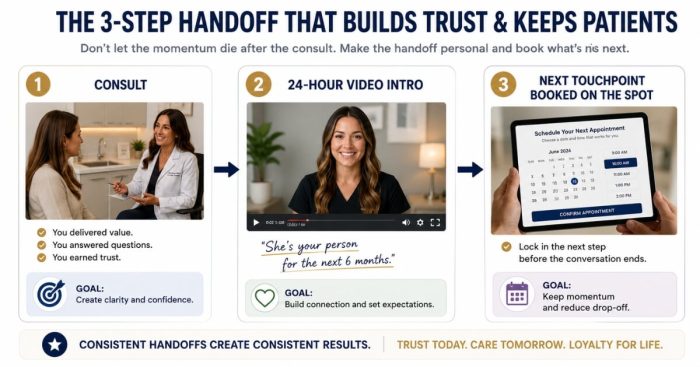
- A warm handoff within 24 hours
- Scheduled coaching touchpoints
- A continuation conversation beginning in month 5
The first stage is the initial experience.
It begins with a discovery call that creates the emotional breakthrough.
Then comes the provider’s initial consultation and treatment plan.
The second stage is the warm handoff.
Within roughly 24 hours, the patient is personally introduced to the patient-success coordinator who will guide the next six months.
The third stage becomes the delivery engine.
Patients move through a rhythm of scheduled coaching touchpoints.
Each conversation is prepared using the patient’s progress data.
The fourth stage takes place during months 5 and 6.
At that point, the coordinator leads the “what’s next” discussion using documented progress alongside the challenges that still remain.
This structure exists for one simple reason.
Retention is designed at enrollment.
It isn’t rescued at renewal.
Each stage naturally feeds the next.
That’s why clinics following this process renew patients into memberships instead of chasing people whose programs quietly expired.
It’s the retention side of the same discipline we bring to functional medicine & longevity clinic marketing.
Predictable structure consistently outperforms good intentions.
What is a warm handoff — and why does it need to happen within 24 hours of enrollment?
A warm handoff is a short, scheduled video call.
During that call, the person who sold the program personally introduces the patient-success coordinator as:
“She’s your person for the next 6 months.”
The details matter.
The call is scheduled.
It isn’t:
“She’ll reach out sometime.”
Instead, the provider or salesperson opens the conversation, introduces the coordinator by name and role, and then steps away.
Before the call ends, the coordinator schedules the patient’s next touchpoint.
As a result, the patient finishes enrollment week knowing:
- Exactly who owns their success
- Exactly when they’ll speak again
Why does this happen within 24 hours?
Because the emotional momentum from the discovery call fades quickly.
Someone who has invested more than $5,000 into a program and then hears nothing for ten days begins reconsidering the purchase.
The warm handoff transfers trust from the sales conversation to the delivery relationship while that trust is still fresh.
It also prevents one of the biggest failures in long-term program delivery.
Patients always know exactly who “their person” is.
What is BAMFAM — and why does it eliminate patient ghosting in long programs?
BAMFAM stands for:
Book A Meeting From A Meeting.
Every call ends with the next call already scheduled.
No more random voicemails.
Before adopting this structure, the clinic handled follow-up the way many clinics do.
The coordinator called whenever time allowed.
Voicemails were left.
Everyone hoped the patient would eventually call back.
After implementing BAMFAM, unscheduled touchpoints disappeared.
Every coaching session finishes by scheduling the next one.
As a result, no patient is ever simply “owed a call” that may or may not happen.
That one rule changes the experience for everyone.
Patients experience a guided journey instead of a subscription interrupted by occasional check-ins.
Meanwhile, coordinators stop spending hours making outbound calls that no one answers.
That’s why the clinic also changed its primary KPI.
Instead of measuring outbound attempts, they measure conversations held.
Activity that never reaches a patient isn’t retention.
It’s simply motion.
How do I prove progress to patients in the middle of a 6-month program?
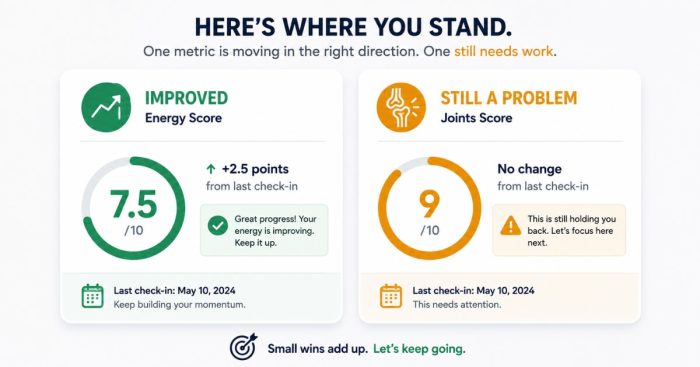
Use side-by-side outcome scores.
Specifically:
- MSQ
- PROMIS-29
Review them at month 3 and month 6 while explaining:
“Here’s where you’ve improved, and here’s what’s still not where you want it.”
The clinic already collected intake forms and module-by-module progress inside its patient academy.
The change wasn’t collecting more information.
It was actually using it.
Before every coaching session, the coordinator reviews:
- Academy progress
- MSQ scores
- PROMIS-29 scores
Then, during months 3 and 6, the provider walks through a side-by-side comparison with the patient.
For example:
- Symptom burden is lower.
- Energy is higher.
- Joint pain may still be a 9 out of 10.
That framework accomplishes two goals.
First:
“Here’s where you’ve improved.”
Patients often forget how poorly they felt at the beginning.
The data reminds them.
Second:
“Here’s what’s still not where you want it.”
That naturally identifies the next clinical opportunity.
If a patient’s joint pain still scores 9 out of 10, discussing regenerative medicine or peptides becomes an evidence-based recommendation rather than a sales pitch.
That’s also the compliant and credible way to increase revenue per patient through peptide therapy clinic marketing.
The recommendation comes from the data.
How do I renew 6-month program patients into a membership without a hard sell?
Start the continuation conversation during month 5.
Position the membership as the logical next step.
Not as a brand-new sale.
By month 5, the coordinator already has:
- Six months of documented progress
- A clear list of remaining concerns
At that point, the renewal conversation becomes straightforward.
The discussion naturally follows this structure:
- Here’s what we’ve improved.
- Here’s what still needs attention.
- Here’s how we’ll continue making progress.
Instead of selling one-off refills and hoping patients return, the clinic transitions patients into an all-inclusive recurring membership.
The membership includes:
- Hormones
- Peptides
- Weight-loss support
The plan is priced in the $400–450 per month range and includes member discounts on peptides and additional services.
The same thinking also shapes the front end for peptide and GLP-1 patients.
The clinic offers a paid consultation of approximately $149, which includes:
- Body composition testing
- Dose recommendations
- Protocol recommendations
- An explicit safety framework
Other clinics may recommend peptides without testing or provider oversight.
This clinic chooses not to.
They’re comfortable letting transactional peptide buyers go elsewhere because the business is built around long-term patient relationships rather than one-time sales.
Recurring membership becomes the compounding engine of a cash-pay practice.
What KPIs and meeting rhythms keep a patient-success role effective?
Measure conversations.
Not outbound calls.
Then transform the coordinator’s weekly one-on-one from an operations review into a strategy session.
Tracking outbound calls rewards voicemail.
Tracking conversations held rewards patient engagement.
That’s why conversations became the coordinator’s primary KPI.
It’s the number most closely connected to retention.
The weekly one-on-one with the clinic owner also changed.
Instead of reviewing only operations, the meetings now focus on higher-value discussions, including:
- Case reviews for at-risk patients
One standing strategy question:
“What cool thing are we giving patients this month?”
That question matters more than it appears.
Every patient interaction should provide something new.
For example:
- A fresh resource
- A new data insight
- A meaningful next step
Patients stay engaged when every touchpoint delivers value.
They quietly leave when “checking in” becomes the product.
The journey structure creates the scheduled conversations.
The fresh-value mindset makes each one worthwhile.
Clinics combining both approaches grow the way a functional medicine practice we work with did when its website leads rose 900% and inbound calls grew by 100+ per month in four months.
Acquisition fills the funnel.
The patient journey protects the revenue.
FAQ’s About the 6-Month Program Patient Journey
How soon after enrollment should the warm handoff happen?
Within about 24 hours.
The warm handoff is a short, scheduled video call where the seller or provider introduces the patient-success coordinator as:
“Your person for the next 6 months.”
The provider then steps away while the coordinator schedules the patient’s next touchpoint before ending the call.
What outcome forms should a functional medicine clinic use to track progress?
Use:
- MSQ
- PROMIS-29
Collect them:
- At baseline
- At month 3
- At month 6
If your clinic also operates a patient education academy, combine those assessments with module progress forms.
The side-by-side comparison makes improvement visible to the patient.
What should a peptide or GLP-1 consult cost at a functional medicine clinic?
This clinic charges approximately $149.
The consultation includes:
- Body composition testing
- Dose recommendations
- Protocol recommendations
- Provider oversight
- Required laboratory testing
The service is intentionally positioned against clinics recommending peptides without testing or supervision.
How much should an all-inclusive hormone and peptide membership cost?
This model is priced at approximately $400–450 per month.
It includes:
- HRT
- Hormone care
- Peptide therapy
- Weight-loss support
Members also receive discounts on peptides and additional services.
The goal is one long-term recurring relationship instead of multiple one-time purchases.
When should the renewal conversation start?
Begin during month 5.
Don’t wait until the week the program expires.
The coordinator leads the discussion using documented progress alongside the patient’s remaining concerns.
That makes continuing feel like the natural next step instead of another purchasing decision.
What’s the next step?
If your clinic sells 6-month programs but delivers them through random voicemails—or if renewal conversations feel like cold sales pitches to patients you haven’t meaningfully spoken with since month one—book a strategy call.
In 60 minutes, we’ll:
- Map your current patient journey from beginning to end.
- Identify where patient momentum breaks down.
- Design a better warm handoff, touchpoint schedule, and renewal structure for your program.