
ZocDoc as the “Gateway Drug” for Cash-Pay Telehealth Clinics — Direct Primary Care, ADHD, Weight Loss — and the Cross-Sell Up Into Hormone, Concierge, and Longevity Programs
Most cash-pay clinic owners look at ZocDoc and see a directory.
That’s the wrong frame.
ZocDoc is actually the starting point for patients who want faster telehealth care — and at this point, pretty much all of ZocDoc has evolved into telehealth.
If you offer a telehealth service, ZocDoc is the gateway drug.
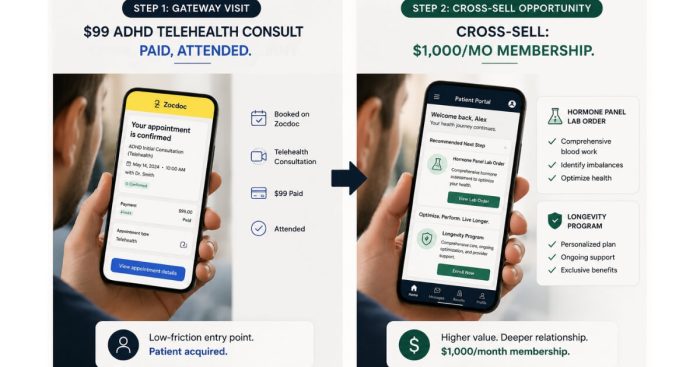
Direct primary care concierge, ADHD management, weight loss — patients are already on the platform looking, attendance rates are pretty good, the appointments are paid, and the real money is the cross-sell up into hormone, concierge, and longevity programs once you build the relationship.
After running every major patient-acquisition channel across 40 of the fastest-growing cash-pay medical clinics in the country, this is the FAQ on how ZocDoc actually works for telehealth — and when to skip it.
What Is ZocDoc, and Why Is It the “Gateway Drug” for Cash-Pay Telehealth Clinics?
ZocDoc is the directory and booking platform where patients go when they want a faster doctor’s appointment — and it has effectively become a telehealth-first platform.
That is why, for a cash-pay telehealth clinic, it functions as the gateway drug for new patient acquisition.
Anton’s framing is literal:
“ZocDoc is actually like the starting point for people who want faster telehealth care.”
And:
“Pretty much all telehealth, at least now, that’s what it’s evolved into.”
Why the Platform Works
The patient behavior is what makes ZocDoc work.
Someone:
- Needs an ADHD evaluation
- Wants a direct primary care visit
- Needs a weight-loss consult
…doesn’t want to wait three weeks for a primary care referral, opens ZocDoc, filters for same-week telehealth availability, and books.
The transaction is:
- Fast
- Paid up front
- Completed on the patient’s phone
For a clinic that has built a virtual servicing model, that’s a brand-new patient delivered through the front door at a CAC most paid platforms can’t touch.
Why the “Gateway Drug” Framing Matters
The phrase “gateway drug” matters because it tells you what the visit is actually for.
Anton’s question to any clinic he works with:
“If you offer a telehealth service, what’s the gateway drug of your telehealth service?”
The ZocDoc booking is not the destination.
It’s the entry point.
Your job at that first visit is to:
- Deliver a great virtual experience
- Build the relationship
- Set up the cross-sell
Because the real lifetime value is downstream of that first paid telehealth visit — not inside it.
Which Cash-Pay Telehealth Services Convert Best on ZocDoc (Direct Primary Care Concierge, ADHD, Weight Loss)?
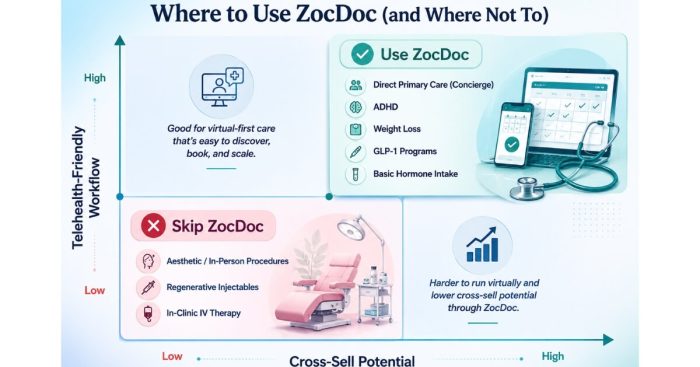
The three services that convert best on ZocDoc for cash-pay telehealth clinics are:
- Direct primary care concierge
- ADHD management
- Weight loss
Each one matches a patient who is already searching for faster virtual care and is comfortable paying out of pocket for the visit.
Direct Primary Care Concierge
Anton’s exact language:
“For direct primary care concierge care, a lot of people just want to see a primary care doctor.”
The patient sentiment is the moat.
The traditional primary care system:
- Three-week waits
- Rushed visits
- Insurance gatekeeping
…has created a cohort of patients actively looking for a faster alternative.
They open ZocDoc, see a same-day telehealth slot, and book.
If your clinic is set up to run a clean virtual primary care intake, you predictably acquire those patients.
ADHD and Weight Loss
Anton:
“If you are managing like a lot of ADHD patients or a lot of weight loss patients, this is actually a pretty good way to get new patients.”
Both verticals are inherently telehealth-friendly.
The workflow is:
- Intake
- Evaluation
- Prescription or program enrollment
- Monthly check-in
- Refill
Both also have patient populations already comfortable booking virtual care.
ADHD has moved heavily toward telehealth-native practices in the post-2020 environment, and ZocDoc captures patients who don’t want to wait six weeks for an in-person psychiatry intake.
Weight-loss patients in the GLP-1 era are similar:
They want to start — and they want to start this week.
The Common Pattern
All three services share:
- A telehealth-friendly workflow
- A solution-aware patient cohort ready to book
- A paid-up-front cash-pay price point
If your service has those three traits, ZocDoc is a fit.
If it doesn’t, see the last section.
How Does the ZocDoc Economic Model Actually Work for a Cash-Pay Telehealth Practice?
ZocDoc charges a per-booking fee.
For a cash-pay telehealth clinic, the economics work because:
- Attendance is high
- The visit is paid up front
- You make your money back on the first or second visit
- The cross-sell drives the long-term value
Anton explains it directly:
“The attendance rate’s pretty good and all the appointments are paid — you make your money back pretty quickly, actually.”
That single line is the whole CAC math.
Why the Economics Work
Compare ZocDoc to paid social.
With paid social, you:
- Pay per click
- Pay per lead
- Pay per scheduled appointment
- Still need a nurture sequence
On ZocDoc, the patient:
- Self-selected the platform
- Self-selected the appointment time
- Paid for the visit
- Shows up at high rates
The platform fee is real, but the cost per acquired paying patient is often competitive with — and sometimes better than — Meta or Google.
The Model Only Works if Two Things Are True
1. You Have a Real Virtual Servicing Model
That means:
- Same-week scheduling
- Intake forms completed before the call
- Efficient 20–30 minute virtual visits
2. Your Gateway Visit Pricing Is Intentional
Examples:
- $99 ADHD consult
- $149 direct primary care visit
Those prices are:
- Low enough to reduce booking friction
- High enough to cover the platform fee plus margin
The Cross-Sell Is the Real Business
The first visit is not where the real money is made.
The cross-sell math is what makes the entire model work.
The next two sections explain why.
What’s the Typical Attendance Rate on a ZocDoc Telehealth Appointment — and Why Does That Matter?
Telehealth attendance rates on ZocDoc are pretty good.
They are meaningfully better than the no-show rate on free discovery calls booked through paid social.
That is the single biggest reason the economics work for a cash-pay clinic.
Anton’s exact framing:
“The attendance rate’s pretty good and all the appointments are paid.”
Why Attendance Rates Are Higher
Two things are doing the work.
1. The Patient Paid for the Visit
The booking includes:
- A credit-card hold
- Or a full payment
Paid appointments always outperform free appointments on attendance.
2. The Visit Is Virtual
Virtual care removes friction such as:
- Traffic
- Parking
- Taking off work
- Childcare logistics
The patient clicks a link on their phone at the scheduled time.
The friction floor is extremely low.
Why Attendance Rate Matters Financially
Attendance rate is the conversion-rate multiplier hiding inside your CAC.
Example:
A clinic running paid ads at:
- $200 cost per scheduled appointment
- 50% attendance rate
…actually has a $400 CAC per attended visit before conversion.
A ZocDoc booking with:
- A similar platform fee
- An 85%+ attendance rate
…has a dramatically lower effective CAC than the headline fee suggests.
When modeling ZocDoc economics:
- Don’t only look at the platform fee
- Multiply by attendance rate
- Then layer in lifetime value after the cross-sell
How Do I Cross-Sell a ZocDoc Patient Up Into a Hormone, Weight-Loss, or Longevity Program?
You cross-sell a ZocDoc patient by treating the first telehealth visit as a relationship-builder, not a transaction.
Anton’s exact play:
“If you can just build the relationship with them and then upsell them, cross-sell them into your other stuff.”
The Mechanics
During the first ZocDoc-booked telehealth visit, the provider:
- Runs a clean intake
- Addresses the chief complaint
- Identifies the adjacent program that fits the patient
Examples:
- A weight-loss patient gets a hormone-panel offer
- An ADHD patient gets a longevity workup conversation
- A direct primary care patient gets a concierge upgrade
The cross-sell is not high-pressure.
It is a clinically appropriate next-step recommendation from a provider the patient already:
- Met
- Paid
- Trusted enough to book virtually
That’s a high-trust moment, and most clinics waste it.
The Flywheel
This is exactly the pattern:
…rides at scale.
The flywheel is:
- Telehealth-friendly gateway acquisition
- High-attendance first visit
- Relationship-building intake
- Cross-sell into higher-LTV programs
Examples include:
- Longevity
- Hormone
- Functional medicine
Acquired-once-spend-many is the only model that makes the unit economics of cash-pay telehealth work at scale.
ZocDoc fills the top of the funnel.
The cross-sell does the rest.
What Does the Patient-Relationship-First Playbook Look Like on ZocDoc?
The patient-relationship-first playbook means treating every booked visit as the start of a longitudinal patient relationship — not a one-off transaction.
Before the Visit
Send a portal intake form the patient completes on their phone.
That allows the provider to enter the visit with context so the experience feels personal, not generic.
During the Visit
The provider:
- Addresses the chief complaint in the first 10–15 minutes
- Uses the back half of the visit for relationship-building questions
Topics include:
- Sleep
- Energy
- Stress
- Labs
- Other health concerns
That second conversation is where the cross-sell opportunity surfaces organically.
After the Visit
Send a follow-up message within 24 hours containing:
- The visit summary
- The next-step recommendation
- An easy booking link for the adjacent service
The Mistake Most Clinics Make
Most clinics treat the ZocDoc visit as a one-and-done transaction.
They:
- Run the eval
- Send the prescription
- Close the chart
- Never follow up
Then they wonder why ZocDoc “doesn’t work.”
It works exactly as designed:
It gets you the patient.
What you do after the first visit is the entire business.
Treat the visit as the start of the relationship, build trust, follow up consistently, and the cross-sell happens predictably across the patient base.
When Should a Cash-Pay Medical Practice NOT Use ZocDoc?
A cash-pay medical practice should not use ZocDoc when:
- Its core services don’t fit a telehealth workflow
- There is no adjacent program to cross-sell into
- The practice isn’t operationally set up to absorb ZocDoc demand
Clear Disqualifiers
If your business is primarily:
- Botox
- Filler
- Lasers
- Body contouring
…ZocDoc is the wrong tool.
Those patients are:
- Product Aware
- Most Aware
They convert through:
- SEO
- GMB
- Brand searches
…not through a telehealth directory.
ZocDoc is also a poor fit for:
- Regenerative injectables
- In-clinic IV therapy
- Procedure-heavy in-person care
The platform-patient match isn’t there.
The Cross-Sell Requirement
If you offer telehealth but do not have:
- A hormone offering
- A longevity program
- A concierge upgrade
…then you are running gateway visits with no upgrade path.
The economics get thin quickly.
The Operational Disqualifier
This is the one most clinics miss.
ZocDoc patients arrive fast.
If your provider calendar cannot absorb same-week telehealth slots without disrupting in-person care, the patient experience breaks and the cross-sell never happens.
Before turning on ZocDoc, make sure:
- The telehealth slots are real
- The intake flow works on a phone
- Portal follow-up is automated
- A defined cross-sell exists
If those four are in place, ZocDoc is one of the most predictable cash-pay telehealth acquisition channels available.
If they’re not, fix operations first — then turn on the channel.
What’s the Next Step?
If you offer telehealth and you don’t have ZocDoc working as a gateway acquisition channel with a defined cross-sell into hormone, longevity, or concierge, you’re leaving the easiest unit-economics arbitrage in cash-pay marketing on the table.
The fastest unlock is:
- Auditing whether your virtual servicing model is ready
- Defining the cross-sell path before turning the channel on
- Treating every booked visit as the start of a relationship