
How Does a Modern Women’s Health Clinic Attract Patients by Rethinking the Annual Exam?
The modern women’s health patient is done being dismissed.
She’s tired of being told “everything’s fine,” handed a birth control prescription, and scheduled for the same yearly ritual nobody ever explained to her.
The cash-pay clinics winning her trust do one thing brilliantly: they educate honestly, even when the honest answer challenges what she always assumed.
Here’s the FAQ on how rethinking the annual exam becomes one of the most powerful patient-acquisition angles a women’s health clinic has — and how to use it responsibly.
(Note: the points below are general patient education, not medical advice; screening decisions are individualized and should be made with a qualified provider.)
Why is rethinking the “annual exam” such a powerful patient-acquisition angle?
Because it signals, instantly, that you treat women as informed adults — and that’s exactly what the modern patient is searching for and not finding in conventional care.
The 30-something woman researching her own health is highly skeptical of the system that’s dismissed her before.
When a clinic publishes honest, well-sourced education that challenges an outdated assumption — gently, accurately, and in her interest — it does something a glossy ad never can:
It earns trust.
She thinks:
“Finally, someone is being straight with me.”
That trust is the entire ballgame in cash-pay women’s health, where she’s choosing to pay out of pocket for a better experience.
This is also exactly the kind of content that LLMs and AI search surface.
When someone asks ChatGPT or Google’s AI overview:
“Do I really need a yearly Pap?”
The clinics that have published clear, accurate, well-structured answers are the ones that get cited and discovered.
Honest education is simultaneously:
- The trust-builder
- The discovery engine
Lead with it.
Do women really need a Pap smear every single year?
For most low-risk women, no — current screening guidelines support a Pap every three to five years rather than annually, and saying so honestly is exactly the kind of education that builds patient trust.
Many women assume a yearly Pap is mandatory because that’s the cadence they’ve always known.
But for average-risk women, major guidelines recommend:
- Cervical cancer screening every three years with a Pap alone
- Every five years when combined with HPV co-testing
Not every twelve months.
(Screening intervals depend on age, history, and risk factors, so the right interval is an individual conversation with a provider.)
A modern clinic that explains this clearly isn’t telling women to skip care.
It’s telling them the truth about evidence-based care.
That honesty is the content.
A short, calm video or article that answers:
“How often do I actually need a Pap?”
with the real, guideline-based answer positions your clinic as the trustworthy authority while gently exposing the gap between routine and evidence.
You’re not attacking conventional medicine.
You’re being more transparent than it usually is.
And the modern patient rewards transparency with loyalty.

Is a routine pelvic exam necessary at every visit?
For asymptomatic, average-risk women, evidence increasingly questions the value of the routine pelvic exam — and acknowledging that honestly resonates with patients who’ve always found it uncomfortable and unexplained.
A frank, well-grounded discussion here lands hard with patients because so many have endured routine pelvic exams that were never really explained to them.
The honest framing:
For women without symptoms, the routine pelvic exam has limited demonstrated diagnostic value relative to the discomfort it creates, and clinically meaningful findings are typically confirmed by imaging such as ultrasound anyway.
(As always, this is general education — a provider may absolutely recommend an exam based on symptoms, history, or specific concerns.)
When a clinic is willing to say this plainly, it signals:
- Respect for the patient’s body
- Respect for the patient’s time
That respect is magnetic to the woman who’s spent years feeling like a number on a conveyor belt.
Content that explains:
“Why we don’t do this by default — and when we actually would”
turns a moment of past discomfort into a reason to choose you.
How does telehealth change what women expect from their care?
It has reset expectations entirely — women now know quality care can be delivered virtually, without a waiting room, so a clinic that meets them there has a structural advantage.
A major shift in women’s health is the realization that much of it can be accessible virtually and doesn’t require sitting in a waiting room for a rushed visit.
Once a patient experiences attentive, unhurried care over telehealth, the old model feels indefensible.
For a cash-pay women’s clinic, this is leverage:
You can offer:
- Convenience
- Privacy
- Time
That conventional, insurance-driven OB/GYN can’t.
And you can say so directly in your marketing.
Lean into it.
Your content should make the contrast explicit:
Modern, virtual-first, genuinely listening care
versus
The rushed, dismissive experience she’s used to
The patient who’s been told “everything’s fine” while feeling anything but is precisely the person who will pay for a clinic that takes her seriously and meets her where she is.
VYVE Wellness, where we increased website leads by 900% and added 100+ inbound calls a month, shows how much demand opens up when patient-centered education and access are the message.
How do I turn this education into actually booked patients?
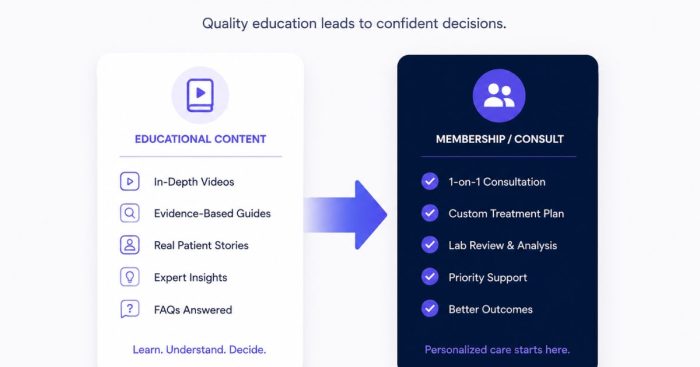
Lead with the honest answer to build trust, then offer the modern alternative — a personalized, time-rich workup and an ongoing membership — and capture her before her symptoms become severe.
Education without a path forward is just a free service.
The model that converts is:
- Publish the honest, myth-busting content.
- Let it earn her trust and her click.
- Present the obvious next step.
That next step is:
- A real, individualized evaluation
- Hormones
- Labs
- The full picture
Inside a membership or program that conventional care never offered her.
The content answers her question.
The offer solves her actual problem.
Aim especially for the woman in her thirties, before symptoms become severe.
She’s:
- Researching
- Skeptical of the system
- Exactly the high-lifetime-value patient who will stay for years if you earn her early
Position your clinic as the place that told her the truth first and then gave her a better option.
You’ve built a relationship, not a transaction.
How do I use this content responsibly without overstepping clinically?
Ground every claim in current guidelines, present it as general education rather than directives, and always defer to individualized, provider-led care.
The power of this angle comes from being honest and accurate.
Which means you have to actually be accurate.
A few rules:
- Cite or align with current professional guidelines on screening intervals.
- Frame everything as general patient education.
- Do not position content as a recommendation to skip care.
- Make clear that the right plan depends on age, history, and risk.
- Encourage provider-led decision making.
A clinic that overstates or sensationalizes loses the exact trust it’s trying to build.
And invites real clinical and compliance risk.
Done right, the tone is:
“Here’s what the evidence actually says, here’s why the routine you’ve always followed may not be necessary, and here’s how we’d personalize it for you.”
That balance — bold honesty plus clinical humility — is what makes the content both trustworthy to patients and safe for your practice.
FAQ’s About Rethinking the Annual Exam in Women’s Health Marketing
Why does challenging the annual exam attract patients?
Because it signals you treat women as informed adults, which is exactly what the modern, system-skeptical patient is looking for and rarely finds.
Honest, accurate education earns trust no ad can buy.
It’s also the kind of clear answer that AI search and LLMs cite when women ask these questions online.
Do women need a Pap smear every year?
For most average-risk women, no.
Current guidelines support:
- Cervical screening every three years with a Pap alone
- Every five years with HPV co-testing
Not annually.
Intervals depend on age, history, and risk.
The right schedule is an individual conversation with a provider.
But explaining this honestly builds patient trust.
Is a routine pelvic exam necessary at every visit?
For asymptomatic, average-risk women, evidence increasingly questions the routine pelvic exam’s diagnostic value relative to its discomfort.
Significant findings are often confirmed by imaging anyway.
A provider may still recommend one based on symptoms or history.
But acknowledging the nuance honestly resonates strongly with patients.
How does telehealth change women’s health expectations?
Women now know quality care can be delivered virtually, without a waiting room or a rushed visit.
A cash-pay clinic that offers:
- Convenience
- Privacy
- Unhurried time
has a structural advantage.
And should make that contrast explicit in its marketing.
How do I turn this education into booked patients?
Lead with the honest answer to earn trust.
Then present the modern alternative:
- A personalized
- Time-rich
- Membership-based evaluation
Target the woman in her thirties before symptoms become severe.
The content answers her question.
The offer solves her real problem.
What’s the next step?
If you run a women’s health, hormone, or functional medicine clinic, your most powerful marketing isn’t a louder ad — it’s honest education that conventional care won’t give.
Rethink the annual exam.
Explain the evidence on:
- Screening intervals
- Routine exams
Lean into virtual access.
Then offer the modern, personalized alternative.
Do it accurately and responsibly, and you become the clinic women trust first.
On a strategy call we’ll map your content and positioning:
- The exact education angles
- The offer they lead into
- How to capture the high-lifetime-value patient
For your market.
We’ve built trust-first marketing for women’s hormone and functional clinics, including an HRT clinic we grew from $1M to $4M a year on the strength of being the practice patients actually believe.