
Monthly Membership vs. 6-Month Program for Women’s Hormone Clinics: The Pricing Anchor That Lets You Sell Both
Almost every women’s hormone clinic owner we work with hits the same wall around month nine: the four- to ten-month “programs” are great for cash flow, but growth flatlines because Beth at the front desk is quoting a $5,000 lump sum on the first phone call and the prospective patient hangs up to “think about it.” Switching to a monthly membership feels scary — you’re afraid of patients ghosting at month three. Here is how to keep the commitment, keep the cash flow, and convert more leads. Real numbers from a real client conversation.
Should a Women’s Hormone Clinic Sell a 6-Month Program or a Monthly Membership?
A women’s hormone clinic should sell a monthly membership as the default offer and use the four-to-ten-month “program” as an anchored prepayment option that the patient can choose for a small discount.
Monthly memberships convert more new leads on the phone because Beth is quoting “$800 per month, starts with labs” instead of “$5,000 for six months.”
For commitment, you keep the patient on rails by financing the prepayment through Care Credit (so the patient owes Care Credit, not you) or by quoting an annual term with a small pay-in-full discount.
You get the conversion benefit of a monthly number, the commitment benefit of a long horizon, and you stop financing your own patients.
How Does a Monthly Hormone Membership Compare on Revenue to a 6-Month $5,000 Program?
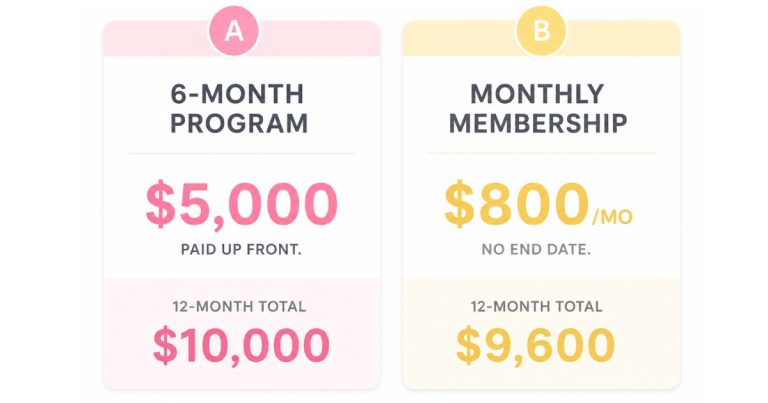
A monthly hormone membership at $800 per month produces almost identical six-month revenue and substantially more annualized revenue than a $5,000 six-month program — provided the patient stays past month seven, which is the whole point of hormone care.
A $5,000 six-month program prepaid is $833 per month equivalent.
At $800 per month with monthly billing, six months equals $4,800 (a $200 discount versus the prepaid program — so if you raise the membership to $850 per month, you are at parity).
And every month the patient stays past month six is pure additional revenue you would not have collected on a one-shot program.
For our client doing roughly $60,000 per month in revenue from a single provider, that compounds.
As Anton walked through with the founder on the call:
“If you charge $800 a month for your program, and you saw four a day, five days a week, that is $16,000 a week, $64,000 a month in membership revenue. If you met with everybody every month.”
How Do You Stop Hormone Patients From Canceling at Month Three?
You stop hormone patients from canceling at month three by selling them on a long time horizon, financing the commitment through a third party like Care Credit, and structuring the conversation around a lifestyle change rather than a fix-this-problem-once transaction.
As one of our women’s hormone clients told us:
“Patients get started with their practice because they are at a point in their life where they need to make a lifestyle change for the rest of their life. This is not about just fixing the problem you have now. This is making sure it never comes back.”
Sell that frame, and a 12-month commitment starts feeling short to the patient, not long.
The patient is in it.
Care Credit then holds the financial commitment so a patient who tries to bail in month three is fighting Care Credit, not you.
Our client switched to Care Credit specifically for this reason and removed the awkward “I want out” conversation from the doctor’s chair.
What Is the Right Anchor Price to Position a Women’s Hormone Monthly Membership?
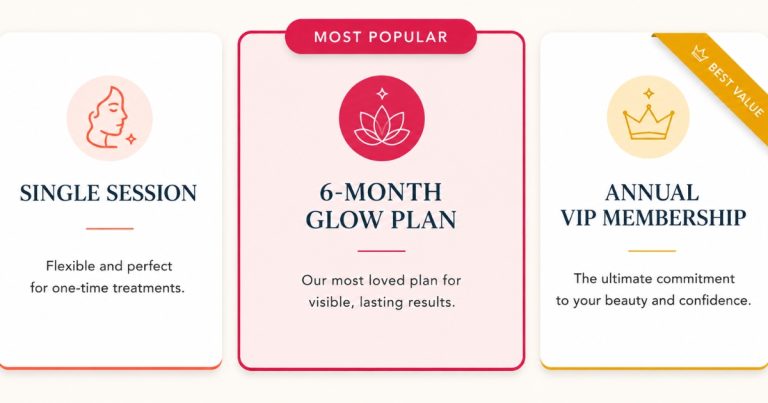
The right anchor price to position a women’s hormone monthly membership is an annual tier — typically $9,000 to $10,000 paid in full with a 10% discount — sitting one tier above your six-month option.
The annual sits in the menu so the patient comparing options says, “I will do six months.”
The same trick that makes a $1,599 tier sell more $899 memberships in functional medicine works in women’s hormones.
As Anton explained on the call:
“Even if they take it, great. If not, they are most likely going to take the six-month. Like, $850 a month for the year, or if you pay in full up front using Care Credit, you get a 10% discount.”
You are still setting the time horizon at twelve months, you are still offering a discount to pay up front, and you are not financing it yourself.
For a deeper look at how three-tier anchored pricing scales a women’s-hormone-leaning clinic, see how a longevity and functional medicine clinic increased website leads 900% and added 100+ inbound calls per month in just four months — the anchor structure is what makes the membership math hold.
Why Does Quoting “$5,000 for Six Months” Lose Women’s Hormone Leads on the Phone?
Quoting “$5,000 for six months” loses women’s hormone leads on the phone because the prospective patient hears the lump sum, mentally compares it to the price of a used car, and asks for time to “think about it.”
Time to think about it is where leads die.
The Super Bowl truck-ad analogy from the call:
“If Ford and GMC ran truck ads during the Super Bowl that said new GMC Sierra $79,000, do you think they would get as many people to come to the dealership as if they said as low as $499 a month?”
Same buyer, same actual transaction value, completely different conversion rate.
Beth’s job on the first call is to reduce friction to the first appointment, not to defend the price.
Quote a monthly number; let the doctor close the long-term commitment in the consult.
How Should a Women’s Hormone Clinic Structure the First Phone Call to Maximize Bookings?
A women’s hormone clinic should structure the first phone call so the new patient coordinator quotes pricing in this order:
- The upfront initial-labs-and-consult fee — typically $300 to $899 — that gets the patient on the calendar
- The monthly membership starting price after the initial consult
- The long-term horizon (six to twelve months) framed as a lifestyle commitment, not a contract
Compare two scripts.
The losing script:
“It’s $5,000 for the six-month program plus the $300 consult.”
The winning script:
“We get started with $300 for your initial labs and consult. After that, your monthly membership investment will be in the range of $650 to $1,200 per month depending on which package fits — your provider helps you choose at the consult.”
We have run this exact change with a Sarasota functional medicine clinic.
Same lead volume, same conversion percentage at the consult, but bookings climbed from 16 in September to 25 in October because Beth’s pitch on the phone got simpler and more digestible.
The same change works for women’s hormones because the sales psychology is identical.
When Should a Women’s Hormone Clinic Add a Second Provider?
A women’s hormone clinic should add a second provider after three consecutive months of $100,000 or more in revenue from a single provider.
Below that threshold, the additional provider’s fully loaded compensation eats the margin you were trying to free up.
Above that threshold, the founding provider can step into a true CEO role and start setting the systems, marketing, and pricing strategy that compound into the next $1M of revenue without burning the founder out.
As Anton said on the call:
“Three months over $100,000 would make me think that’s a good idea.”
For a model of what owner-removed scale looks like in practice, see how an HRT clinic we grew from $1M/year to $4M/year in four years built 250 active members at $1,000 per month and removed the owner from day-to-day delivery.
That is what the membership-plus-anchor model unlocks at the back end.
What Should a Women’s Hormone Clinic Do This Week to Copy This Pricing Model?
A women’s hormone clinic that wants to copy this pricing model should do four things this week:
- Rewrite the new-patient-coordinator phone script so the first quote is a monthly number, never a lump sum
- Add an annual-membership tier as the anchor on every printed and verbal pricing layout
- Move all prepaid programs off in-house financing and onto Care Credit so commitment is held by a third party
- Train the front desk to quote the monthly-investment range during the first call, before the patient comes in for the consult
If you want help building the script, structuring the tiers, and rolling out Care Credit on the back end, that is exactly the work we do every day for cash-pay practices.