
Why One $600 Patient Is Worth More Than Twelve $50 Appointments
Here’s a piece of clinic math worth sitting with: to generate $600 in revenue, you could book twelve $50 appointments—or you could get one patient to do lab work and a consult. Both produce the same $600. But they are not the same business. One is a treadmill; the other is a foundation. Here’s the FAQ on why building your clinic around fewer, higher-value patients beats chasing low-ticket volume.
Why is one $600 patient better than twelve $50 appointments if the revenue is the same?
Because the revenue is the only thing that’s the same—everything else about serving twelve low-ticket patients is harder, more expensive, and less durable.
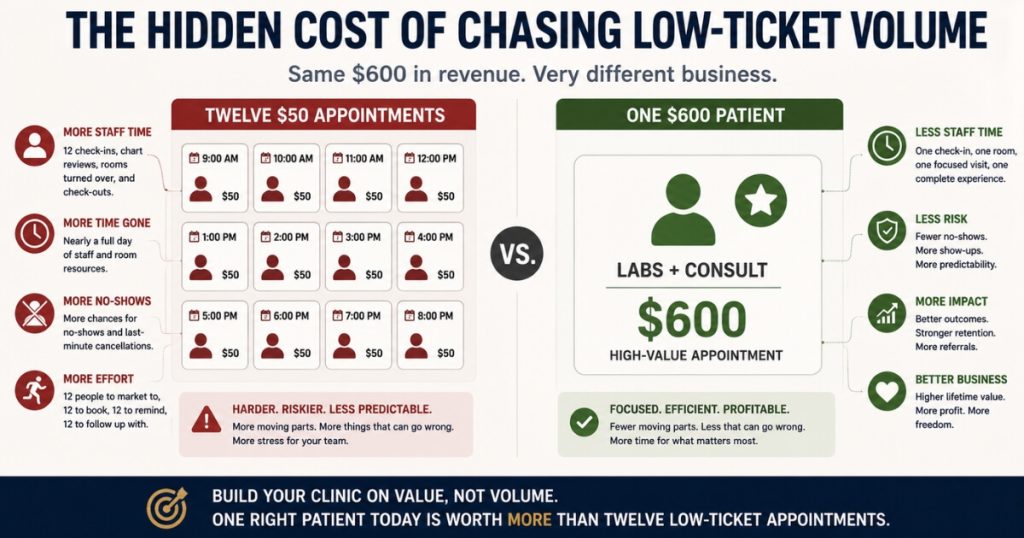
The math that sparked this is simple: to make $600, you either run twelve $50 “healthy strategy sessions,” or you get a single patient to start with lab work and a consult. Same top-line number.
But twelve appointments means:
- Twelve people to market to
- Twelve people to book
- Twelve reminder sequences
- Twelve chances for a no-show
- Twelve times the staff time
- Twelve times the room usage
One higher-value patient means a fraction of the acquisition effort and overhead for the identical revenue.
When a clinic we work with did this math and switched its funnel and sales process toward the higher-value path, the conclusion was obvious—it’s simply a better model.
This is one of the most important reframes in running a profitable cash-pay clinic. Volume feels like progress because the schedule looks full, but a full schedule of low-ticket visits can be less profitable and far more fragile than a lighter schedule of high-value patients.
Building around patient value is central to a sustainable patient acquisition strategy.
What’s the hidden cost of chasing low-ticket appointments?
The effort, overhead, and no-show risk multiply with every appointment—so twelve small visits quietly cost far more to deliver than one larger one.
Every appointment carries fixed costs regardless of its price:
- The marketing to generate it
- The staff time to book and confirm it
- The room and provider time to deliver it
- The risk it no-shows
Stack twelve of those to earn $600 and you’ve multiplied all of it twelvefold.
The low-ticket model looks busy and feels productive, but much of that activity is cost, not profit. You’re working twelve times as hard for the same money, and each of those twelve is also twelve times as likely to produce a no-show that wastes a slot entirely.
There’s an opportunity cost too. Every hour your team spends servicing $50 visits is an hour not spent attracting and converting the high-value patient who would have paid $600—or far more over time.
Low-ticket volume doesn’t just cost more to deliver; it crowds out the better business you could be doing instead.
Doesn’t more patients always mean more growth?
No—more of the wrong patients can actually slow you down, while fewer of the right ones compound.
It’s tempting to equate patient count with growth, but the number that matters is revenue and profit per patient over time, not raw headcount.
A clinic with 500 low-ticket, one-and-done patients can be less valuable and harder to run than one with 150 high-value patients on ongoing programs.
The second clinic has:
- More predictable revenue
- Lower acquisition cost per dollar earned
- A team that isn’t drowning in volume
Growth isn’t about seeing more people. It’s about building more value per relationship.
This is why the highest-performing cash-pay clinics deliberately design for value over volume.
We helped a longevity and functional medicine clinic, VYVE Wellness, dramatically increase its leads and inbound calls but the durable growth came from attracting patients into higher-value programs, not just adding more low-ticket visits.
How does a high-value patient compound over time?
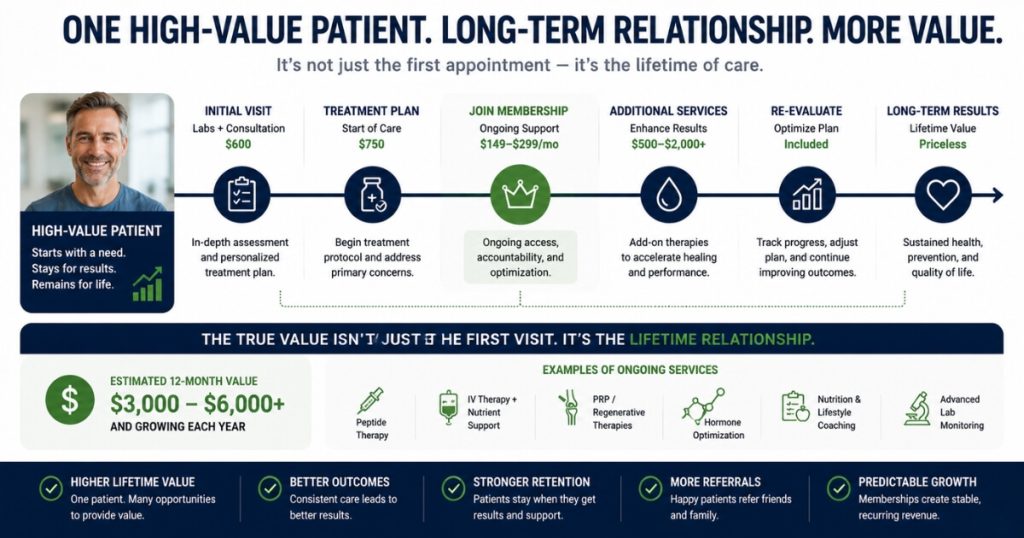
Because a patient who starts with labs and a consult is on a path to a program, a membership, and additional services—while a $50 visit usually ends at $50.
The $600 lab-and-consult patient isn’t worth $600. They’re worth the beginning of a relationship.
That initial visit:
- Establishes need
- Builds trust
- Opens the door to an ongoing membership
- Creates opportunities for follow-up care
- Leads to appropriate additional services over months or years
The low-ticket visit, by contrast, typically starts and ends in the same transaction.
One is the front door to lifetime value; the other is a one-night stand with your clinic.
That’s where the real gap shows up.
An HRT clinic we grew from $1M to $4M a year runs roughly 250 active members paying around $1,000 a month. That base exists because the clinic attracts patients into high-value, recurring relationships rather than counting one-off visits.
Value compounds; volume just resets every month.
How do I shift my clinic toward higher-value patients?
Change the funnel and the sales process so you attract and convert patients into a real first step—like labs and a consult—instead of a cheap one-off.
The clinic that ran this math didn’t just decide to prefer high-value patients. It switched its funnel and sales process to produce them.
That means:
- Leading with an offer that starts a real clinical relationship (a lab-and-consult entry point, a program, or a membership)
- Training the team to present and sell that path
- Being willing to attract fewer, better-fit patients instead of the largest possible volume
That’s a trade most owners are nervous to make until they see the profit difference.
Practically, audit where your current patients enter. If most come in through a low-ticket door, you’ll get low-ticket patients.
Redesign the entry point around your highest-value service, and the patients you attract change accordingly.
This is the core of building a clinic around functional medicine & longevity clinic marketing and other high-LTV models.
FAQ’s About High-Value Versus Low-Ticket Patients
Why is one high-value patient better than several low-ticket ones?
Because the same revenue from twelve $50 appointments costs far more to deliver than from one $600 patient—twelve times the marketing, booking, reminders, no-show risk, and staff time.
One higher-value patient produces the same money with a fraction of the effort and overhead, and is far more likely to continue.
Doesn’t more patients mean more growth?
Not necessarily.
Revenue and profit per patient over time matter more than headcount. A clinic with fewer high-value patients on ongoing programs can be more profitable, more predictable, and easier to run than one drowning in low-ticket, one-and-done visits.
How does a high-value patient compound?
A patient who enters through labs and a consult is on a path to a membership, follow-up care, and additional services over time, while a $50 visit usually ends at $50.
The first is the front door to lifetime value; the second is a single transaction that resets to zero.
How do I attract higher-value patients?
Redesign your funnel and sales process so patients enter through a real first step—like a lab-and-consult or a program—rather than a cheap one-off, and train your team to present that path.
If most patients currently enter through a low-ticket door, that’s the kind of patient you’ll keep getting.
What’s the next step?
If your schedule is full but your profit isn’t, you may be running a high-volume, low-value model without realizing it.
Book a strategy call. In 60 minutes we’ll look at how patients enter your clinic, calculate what your visits are really worth, and map the funnel and offer changes that attract fewer, higher-value patients—so you make more while working less.
If it’s a fit, we’ll rebuild the funnel and sales process with your team.