
Why Are Google Ads So Expensive for Some Treatments at My Clinic? (Cost-Per-Click by Treatment)
Run Google Ads across a few different services and you’ll notice something strange: one treatment costs a few dollars a click and another costs $25 — at the same clinic, in the same town, on the same account. It’s not a mistake and it’s not your ad manager failing you. Cost-per-click is set by the market for each specific search, and treatments live in very different markets. Here’s the FAQ on why CPC swings so much by treatment, and what to do when a service is expensive to advertise.
Why are Google Ads so expensive for some treatments at my clinic?
Because cost-per-click is an auction set by demand and competition for each specific search term — and some treatments have far more advertisers bidding for far higher-value patients.
The price of a click isn’t something Google assigns.
It’s what the next advertiser is willing to pay for that exact search.
High-ticket, high-competition treatments draw deep-pocketed bidders, which pushes the click price up.
At one regenerative clinic we work with:
- “Peptides for joint pain” runs about $15 a click and as high as $25 to sit at the top of the page.
- “Hair restoration near me” carries a minimum bid around $6 and tops out near $25.
- Body contouring (“fun sculpting”) comes in around $4.66 a click.
Same account.
Wildly different click prices.
Each term has its own auction.
The takeaway isn’t “stop running ads.”
Instead, it’s that you have to know the click economics of each treatment before you fund a campaign, because a $25 click and a $5 click demand completely different funnels, offers, and margins.
Understanding this is foundational to effective pain management marketing and to any regenerative or high-ticket campaign.
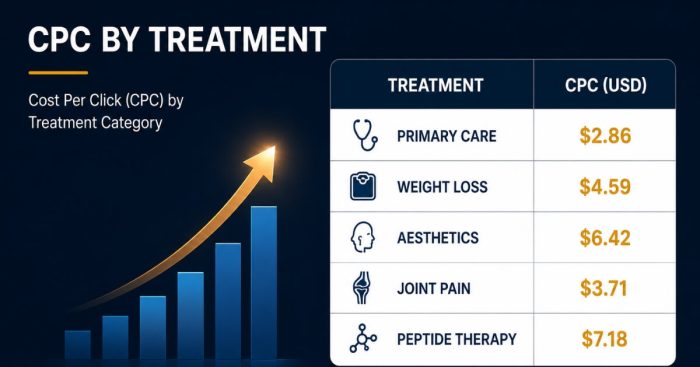
What’s a normal cost-per-click for regenerative and pain treatments?
There’s no single “normal” — it ranges from a few dollars to $25+ depending on the treatment’s competition and ticket size.
From real campaign data at a regenerative-pain clinic:
- Body contouring around $4.66 a click
- Hair restoration with a minimum bid near $6 and top-of-page closer to $25
- Peptides for joint pain around $15, up to $25 to hold the top spot
The pattern is consistent.
The more lucrative and contested the treatment, the more each click costs.
Aesthetic and commodity treatments tend to be cheaper per click.
Meanwhile, high-ticket regenerative and pain treatments that competitors are aggressively chasing tend to be the most expensive.
What matters isn’t memorizing these exact numbers.
Your market will differ.
Instead, internalize the spread.
When you budget a campaign, pull the actual CPC for your specific treatment and location first.
A campaign that’s perfectly profitable at $5 a click can lose money at $25 a click if your offer and conversion rate haven’t been built for that math.
The click price sets the rules of the game before you ever run an ad.
Why does the same clinic pay $4 for one treatment and $25 for another?
Because each treatment is a separate auction with its own competitors, patient value, and search intent — and those three things, not your account, set the price.
Three forces drive the gap:
- Competition: a treatment that twenty local clinics advertise costs more per click than one only you offer.
- Patient value: advertisers will pay $25 for a click that can become a $5,000–$20,000 patient, but not for one that becomes a $300 service.
- Intent: “peptides for joint pain” is a high-intent, ready-to-buy search, and high-intent terms are the most fought-over.
A cheaper treatment is usually cheaper because it’s less contested, lower-ticket, or lower-intent — not because your campaign is better.
This is why a blanket “Google Ads is too expensive” or “Google Ads is cheap” conclusion is useless.
The right question is always treatment-specific:
- What does it cost to acquire a patient for this service?
- Does the lifetime value support that cost?
A $25 click that reliably produces a $15,000 neuropathy patient is a bargain.
A $5 click that produces a $200 one-off can be a loser.
How do I lower my cost per click and cost per patient on expensive treatments?
Don’t fixate on the click price.
Drive down the cost per acquired patient by improving intent, offer, and conversion, and lean on cheaper channels where the auction is brutal.
When a treatment’s CPC is unavoidably high, you have several levers:
- Tighten your keywords to the highest-intent, ready-to-buy searches.
- Cut the broad, curiosity terms that burn budget.
- Sharpen the offer and the landing page so a larger share of those expensive clicks convert.
- Make sure your follow-up is fast and relentless.
At $25 a click, a jump from a 5% to a 10% conversion rate halves your cost per patient without touching the bid.
An expensive click that books and then no-shows is the most wasteful spend there is.
The bigger move is channel mix.
The most expensive auctions are exactly where you should lean on:
- SEO
- Google Business Profile
- Organic content
These channels capture the same high-intent patients without paying per click.
Organic-first growth is realistic even in high-ticket regenerative care.
And paid done right still scales.
Likewise, Elite Pain Doctors added $2,095,039 in revenue in 10 months.
However, it works because the funnel and follow-up justify the click price, not because the clicks were cheap.
What if there’s barely any search volume for my treatment in my area?
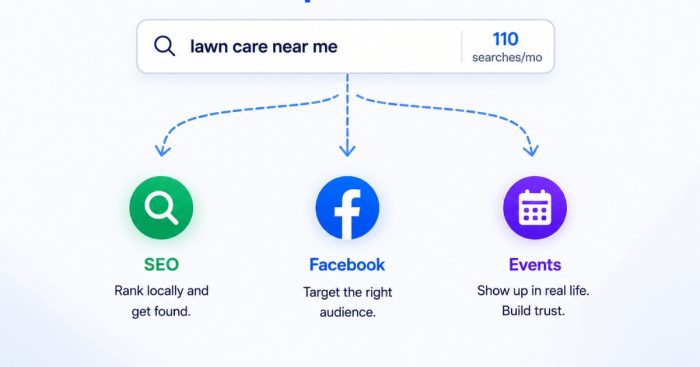
If almost no one is searching for it, ads aren’t the channel — you need demand-creation channels and SEO instead of search-capture.
Search ads only work when people are actually searching.
At the same regenerative clinic, “peptides for joint pain” had only about 10 searches a month in its North Dakota market — far too thin to build a paid search campaign on, no matter the click price.
When volume is that low, pouring money into Google search just means fighting a handful of competitors for a tiny pool of clicks at a high price.
That’s a losing setup.
In thin-search markets, shift to channels that create demand rather than capture it:
- Local events
- Educational content
- SEO
- Google Business Profile
The principle is to match the channel to how patients actually find that treatment in your market.
That’s the core discipline of building a patient acquisition system that fits your specialty and your geography instead of forcing every treatment through paid search.
FAQ’s About Cost-Per-Click by Treatment at a Cash-Pay Clinic
Is a high cost-per-click always bad?
No.
A high CPC is only bad if the patient’s lifetime value doesn’t support it.
A $25 click that produces a $15,000 regenerative patient at a healthy conversion rate is excellent.
A $5 click for a $200 one-off can lose money.
Always judge CPC against cost per acquired patient and LTV, never on its own.
Why does my ad manager’s CPC differ from online “average CPC” charts?
Because CPC is hyper-local and term-specific.
Generic average charts ignore your exact treatment, competitors, and city.
The only number that matters is the live CPC for your specific search terms in your market.
Pull that, not a national average.
Should I just bid lower to save money?
Bidding lower can drop you off the page entirely for high-intent terms, which wastes the campaign.
It’s usually better to keep competitive bids on your highest-intent keywords, cut the low-intent ones, and improve conversion so each expensive click works harder.
When should I use SEO instead of paid ads for an expensive treatment?
When the auction is expensive, when search volume is thin, or when you want durable, compounding traffic.
SEO and Google Business Profile capture high-intent patients without per-click costs.
Therefore, they are ideal for high-ticket regenerative and pain treatments where clicks run $15–$25.
How do I know if a treatment is worth advertising at all?
Check two things first:
- The live cost-per-click.
- The monthly search volume in your market.
High CPC with healthy volume can work if your funnel supports the math.
However, high CPC with almost no volume (like 10 searches a month) means choosing another channel.
What’s the next step?
If your Google Ads costs feel unpredictable across treatments, that’s because each treatment is its own auction.
The clinics that win pull the real CPC and search volume per treatment before they spend a dollar.
Then they match each service to the channel that actually fits it.
On a 60-minute strategy call we’ll review your treatment menu, pull the click economics for your specialty and market, and map which services to run on paid search versus SEO, social, or events.