
Why Does Every Cash-Pay Clinic Need a Membership Model? (The Recurring-Revenue Case in Real Numbers)
Every cash-pay clinic owner eventually faces the same pricing fork: charge the patient $5,000 upfront for the program, or charge $350–$500 a month for 10–12 months. Most owners pick the lump sum because it feels safer. It isn’t. The membership model wins on patient accessibility, cash-flow stability, refund risk, and what your clinic is ultimately worth — and the clinics that scale past seven figures almost all figure this out. Here’s the FAQ.
Why does every cash-pay clinic need a membership model?
Because the most valuable businesses are businesses with stable recurring cash flow.
Memberships are the answer to building that inside a clinic.
That’s the entire thesis, straight from our own playbook:
“The most valuable businesses are businesses that have stable recurring cash flow. Memberships are the answer.”
A clinic that sells one-off treatments starts every month at zero.
Then it hopes marketing refills the calendar.
A clinic with 100 members paying $400 a month starts every month at $40,000 before a single new lead comes in.
The providers are the same.
The services are the same.
The business is completely different.
We’ve seen that principle play out with 102 members enrolled in nine months, putting a floor under the month.
The benefits extend beyond revenue.
Memberships also make operations easier.
Scheduling becomes predictable.
Staffing becomes easier to plan.
Inventory and medication ordering stop being guesswork.
When you know exactly how many active members you’ll be serving next month, you can run the clinic like a business instead of reacting to whoever happened to book.
How does a membership lower the barrier for new patients to say yes?
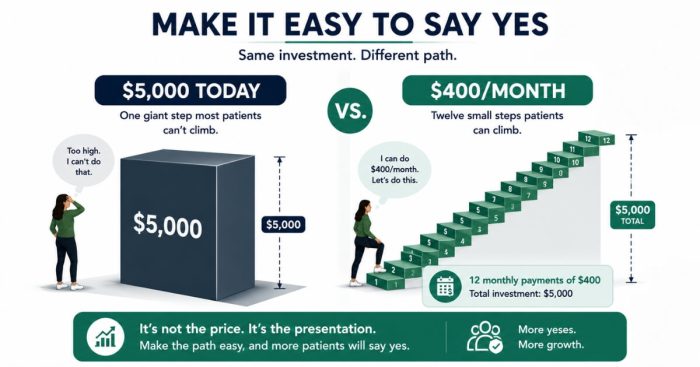
It turns one intimidating number into a manageable monthly payment.
A payment of $350, $400, or even $500 per month feels like a decision.
A $5,000 payment today feels like a committee meeting.
This is the part many clinic owners underestimate.
A membership doesn’t simply restructure your revenue.
It lowers the barrier for patients to begin treatment.
The patient who genuinely wants your program but can’t write a $5,000 check today isn’t a bad lead.
She’s a member you haven’t priced correctly yet.
At around $400 per month, the decision fits into a normal household budget discussion.
As a result, your front desk closes more of the leads your marketing has already paid to generate.
That’s why the membership model is just as much a patient acquisition strategy as it is a financial decision.
The cheapest way to gain more patients is often to stop losing the people who already said,
“I want this, but…”
during the pricing conversation.
Isn’t collecting $5,000 upfront safer than billing monthly?
No.
It’s actually the opposite.
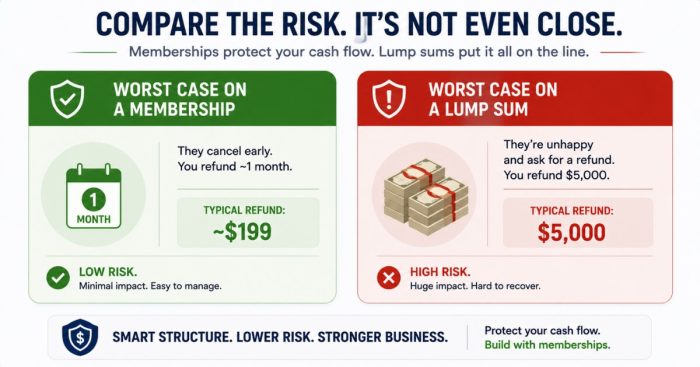
With a membership, your worst-case scenario is refunding approximately one month of service.
With a lump-sum payment, your worst-case scenario is refunding $5,000.
Here’s the reasoning directly from the source:
“I would rather charge them 350, 400, even 500 bucks a month for 10, 12 months. Worst case scenario, I only have to refund a month or so of service rather than have to refund or give back 5 grand.”
Many owners assume they’ll never face a chargeback, dispute, or refund request.
Even excellent clinics with outstanding outcomes eventually do.
Your billing structure becomes your protection.
Think of it as limiting your downside.
A patient who stops responding in month three of a membership has only paid for the care already received.
Your financial exposure is roughly one billing cycle.
A patient who paid $5,000 upfront and disputes the payment in month three creates a much larger problem.
That can become:
- A significant refund
- A payment processor dispute
- A mark against your merchant account
The membership model quietly reduces that risk every time someone enrolls.
What does a membership model do to my clinic’s value as a business?
It changes your revenue from something a buyer hopes will continue into something a buyer can actually count on.
Buyers pay more for predictable revenue.
When revenue restarts at zero every month, a buyer is purchasing your marketing engine and hoping it continues working.
When members renew month after month, a buyer is purchasing continuity.
It’s a subscription business that happens to practice medicine.
The same principle applies long before you ever sell the clinic.
Banks become more comfortable.
Partners gain confidence.
Planning future growth becomes much easier.
Next quarter’s revenue is largely known in advance.
The growth ceiling also changes.
That kind of compounding is extremely difficult to achieve with one-off treatments.
Every month of transactional revenue resets back to zero.
Memberships continue stacking.
Transactions do not.
How should I structure my clinic’s first membership?
Start with the source math.
Charge approximately $350–$500 per month over an initial term of 10–12 months.
Price the membership so the total monthly payments roughly equal, or slightly exceed, what the lump-sum program would have cost.
The mechanics matter.
Your membership should:
- Bill automatically to a card on file
- Clearly define what’s included each month
- Specify visit frequency
- Outline lab cadence
- Include medication management
- Explain messaging access
- Put the initial commitment in writing
Your exact monthly price depends on your specialty and the services included.
A full-service concierge hormone program can support $1,000 per month.
A leaner program often fits comfortably within the $350–$500 range from the source playbook.
One important warning from experience:
Don’t launch with seven different membership tiers.
One clearly defined membership that your front desk can explain in two sentences will outperform a pricing page that requires a legend.
Complexity hurts enrollment.
Simple pricing remains one of the most overlooked parts of effective medical practice marketing.
Which treatments actually fit a membership model — and what if mine are one-off procedures?
Any care that’s ongoing fits naturally into a membership.
That includes:
- Hormone therapy
- Functional medicine
- GLP-1 weight loss
- Direct primary care
Even procedure-based clinics can build memberships around the care before and after treatment.
Recurring-care specialties are the most obvious fit.
Patients need monthly medication, periodic labs, and ongoing adjustments.
The membership simply matches the billing to the care that’s already happening.
Procedure practices—such as regenerative medicine, aesthetics, or surgery—can build the membership around the maintenance layer.
That includes:
- Follow-up visits
- Adjunct therapies
- Ongoing monitoring
- Priority access after the procedure
The procedure becomes the entry event.
The membership becomes the long-term relationship.
The test is simple.
If your patients benefit from seeing you more than once, some version of a membership belongs in your clinic.
If your model truly ends after one visit with no follow-up value, fix that first.
That’s a much bigger issue than pricing.
FAQ’s About Adding a Membership Model to a Cash-Pay Clinic
What should a cash-pay clinic membership cost per month?
The working range from our playbook is $350–$500 per month on a 10–12 month initial term for a typical program.
Meanwhile, full-service concierge hormone care can support $1,000 per month at the strongest clinic we’ve published numbers on.
Price according to your services and your market.
The recurring revenue matters more than the exact monthly amount.
Is monthly billing riskier than collecting the full program fee upfront?
No.
On a monthly membership, your worst-case refund exposure is roughly one month of service.
On a $5,000 lump-sum payment, your worst-case scenario is refunding—or having disputed—the entire amount.
Chargebacks and refund requests happen even at excellent clinics.
Monthly billing automatically limits that downside.
Won’t a membership slow down my cash flow compared to lump sums?
During the first few weeks, yes.
A $5,000 payment today produces more immediate cash than $400 this month.
However, by month three or four, stacked recurring payments begin overtaking one-time revenue.
Unlike lump-sum programs, membership revenue doesn’t reset to zero on the first day of every month.
Stability compounds.
Lump sums don’t.
What happens if a member cancels partway through the term?
With a written 10–12 month initial term and automatic monthly billing, an early cancellation usually costs you no more than the current billing cycle.
The patient has already paid for the care delivered.
Your refund exposure remains about one month.
The rest of your membership base continues unaffected.
Do memberships only work for hormone clinics?
No.
Hormone and HRT clinics provide the clearest example because the care naturally occurs every month.
However, recurring memberships also work for:
- Functional medicine
- GLP-1 weight loss
- Direct primary care
- Procedure practices through maintenance and follow-up memberships
If patients benefit from ongoing care, a membership fits.
What’s the next step?
If your clinic still sells everything as one-off treatments and lump-sum programs—and your revenue graph looks like a heartbeat monitor instead of a staircase—book a strategy call.
In 60 minutes, we’ll map:
- Which services should become memberships
- What your monthly pricing should be
- What your recurring revenue base could realistically look like 12 months from now
Predictable revenue is buildable.
It starts with the billing structure.