
Why Isn’t My Concierge or Cash-Pay Clinic Collecting Payments — Even With a Full Schedule?
Cash-pay medicine is supposed to fix the collections headache, not create a new one. Yet one concierge practice we work with had a provider seeing six to eight patients a day, fully booked — and collecting roughly four hundred dollars over a two-week pay period.
When we pulled the payment report, there were 222 outstanding payment requests sitting uncollected and over ten thousand dollars a month in unrealized charges. The clinic did not have a tool problem. It had a “nobody made payment required” problem.
Here is the FAQ on why cash-pay and concierge clinics quietly under-collect — and the locked, automated billing system that closes the gap.
Why Isn’t My Cash-Pay Clinic Collecting Payments Even With a Full Schedule?
Almost always, it is because payment is optional in your process, not because your software is broken.
Patients book, get seen, and leave without ever being required to pay.
In the practice above, the booking system could attach a payment form to an appointment. However, completing it was never required, so it never locked anyone out of the visit.
As a result, the provider saw a full schedule of six to eight patients a day and collected about $400 in two weeks.
The diagnosis was blunt: this is not a tool problem, it is a “they just don’t know they need to do this” problem. The capability existed. The requirement did not.
That is the pattern at most under-collecting cash-pay clinics.
The technology is fine. What is missing is a process that makes payment a mandatory, unskippable step — and a team that has been trained to enforce it the same way every single time.
Until payment is required, a busy schedule simply means more unpaid visits.
How Do I Make Patients Pay Before Their Appointment at a Concierge Practice?
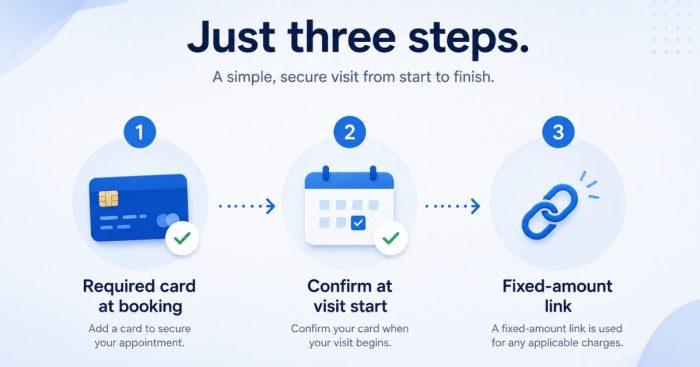
Make the payment method a required, locking step in the booking flow, and have staff confirm at the start of every visit that the pay link has been completed before care continues.
The fix has two halves.
First, the technical half: configure booking so a card or payment is mandatory before the appointment is confirmed — not an optional attached form the patient can ignore.
Second, the human half: the provider or front desk says, at booking and again at the start of the visit:
“You’ve got a link to pay, and that needs to be paid before we continue.”
That sentence, said every time, is what turns a soft request into a collected payment.
Importantly, this is not about being aggressive. It is about removing the moment where an unpaid visit can slip through.
When payment is the gate to the appointment rather than an afterthought to it, the collections problem largely disappears on its own.
What’s the Best Way to Automate Recurring Membership Billing for a DPC or Concierge Membership?
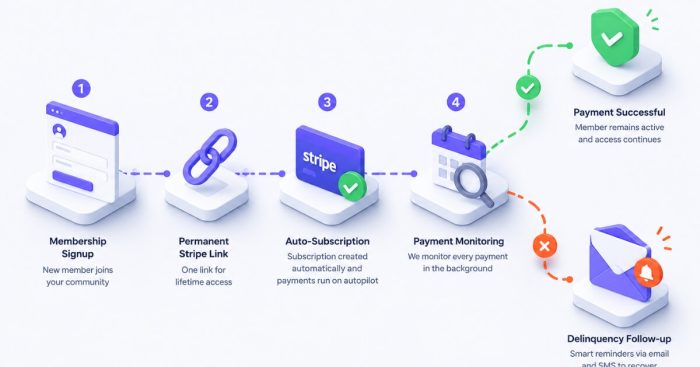
Build fixed-amount permanent payment links through your CRM connected to Stripe, so enrolling in the membership auto-subscribes the patient — and you never ask them to type in their own dollar amount.
The clinic set this up in GoHighLevel on the same Stripe account already linked to everything else:
- A fixed permanent link for the $400-a-month family membership that auto-enrolls the patient into a recurring subscription.
- Fixed links for one-off charges.
The principle behind it is small but critical: never make a patient enter the amount they owe.
Asking someone to type “$400” into a payment field is friction that produces errors and excuses. Instead, send a link with the number already set.
Additionally, running everything through one platform means the reminders, payment requests, and delinquency follow-ups are automated instead of manual.
A recurring hormone or concierge membership only protects your cash flow if the billing behind it actually runs on its own — the same discipline that lets an HRT clinic we grew to 250 active members at $1,000 a month run predictable recurring revenue.
How Should I Handle a Pile of Unpaid Balances That Has Already Built Up?
Run a dedicated recovery sprint.
Pull the full payment report, identify every unpaid appointment, and block an entire day to contact each patient and resend the payment request.
When the Emerald Coast team pulled their report, there were 222 outstanding payment requests.
Of those, only two had an actual problem (one a recurring card issue). The rest were simply never collected.
The assignment was concrete:
Go back to every one of those patients, contact them, send the payment request, and make sure they pay.
That is a full day of work, so it has to be blocked on the calendar as its own task, not squeezed between appointments.
The reason it matters is simple.
Uncollected balances are not lost money yet — they are recoverable money that decays the longer you wait.
A one-time recovery sprint converts a large portion of that 222-request backlog into cash. It also surfaces the handful of genuine card problems so you can fix them individually.
Should I Tie My Provider’s Pay to How Much They Collect?
Yes.
Paying a provider regardless of collections becomes unsustainable fast because you end up with a full schedule and an empty deposit.
The math is unforgiving.
With over $10,000 a month in unrealized charges, the practice was, in one partner’s words, “bringing in $14,000 a month to get two” — not sustainable.
The blunt rule that fixed it: a provider is not getting paid unless they are collecting money, because you have to collect cash to get paid. That is not a punishment; it is aligning the incentive with the only thing that keeps the lights on.
More importantly, when provider incentives are tied to revenue collection, the entire practice operates differently. The same focus on accountability, operational discipline, and predictable cash flow helped us grow a pain practice where we lifted monthly revenue by $40K+ and cut insurance dependence in half.
Furthermore, tying compensation to collections changes behavior at the exact moment it needs to change — at booking and at the start of the visit.
The provider is the one who can say:
“This needs to be paid before we continue.”
When their pay depends on it, that sentence gets said every time.
How Do I Migrate Stored Patient Credit Cards to a New Payment Processor?
You usually cannot copy them.
Most systems only expose the last four digits, so plan to re-collect cards rather than transfer them.
The realistic migration path is to move everything into one CRM-and-Stripe setup and send patients an automated message:
“We’re switching payment systems. Please add a new card on file.”
Because the old system only shows the last four digits of each card, there is no way to pull the full numbers over.
Instead, you collect fresh cards through the new flow.
The clinic deferred its bulk migration only because re-collecting card data takes labor and team bandwidth, not because it was technically blocked.
The sequencing lesson is equally important:
Settle on the system before you train the team on it.
Train staff once on the final workflow. Otherwise, you end up retraining them every time the process changes.
Decide the locked-billing setup first, then teach it.
FAQs About Collecting Payments at a Cash-Pay or Concierge Clinic
Does Cash-Pay Medicine Automatically Solve Collections?
No.
One concierge practice had a fully booked provider collecting about $400 over two weeks and 222 uncollected payment requests on file.
Cash-pay removes insurance billing, but it does not make patients pay on its own. You still need a process that requires payment before care.
How Do I Stop Patients From Leaving Without Paying?
Make payment a required, locking step at booking and have staff confirm it at the start of every visit before care continues.
The capability usually already exists in your software.
What’s missing is making it mandatory and training the team to enforce it identically every time.
What’s the Easiest Way to Bill a Recurring Membership Automatically?
Use fixed-amount permanent payment links through your CRM connected to Stripe, so signing up auto-enrolls the patient into a subscription.
Never make a patient type in their own amount.
Instead, send a link with the dollar figure already set and let the platform automate reminders and delinquency follow-ups.
What Do I Do About Months of Unpaid Balances?
Run a recovery sprint.
Pull the payment report, list every unpaid visit, and block a full day to contact each patient and resend the request.
Most uncollected balances are simply never-collected, not disputed. As a result, a focused day of outreach recovers a large share of them.
Should Provider Pay Depend on Collections?
Yes.
Paying a provider while $10,000+ a month goes uncollected is unsustainable.
Tying compensation to collected cash aligns the incentive and changes behavior at booking and visit start, where the provider can require payment before continuing.
What’s the Next Step?
If your cash-pay or concierge clinic has a full schedule and a thin deposit, the leak is almost certainly that payment is optional somewhere in your process.
Make it a required, locking step.
Move recurring billing onto fixed-amount CRM-and-Stripe links.
Run a one-time recovery sprint on the backlog.
Finally, tie provider pay to collections.
None of it requires new software — just a system the team runs the same way every time.
If you want someone to build that locked-billing system with you and clear the backlog, that is the conversation to book.
We will map your booking flow, your membership billing, and your collections process on the call.