
What Services Should a Med Spa Add to Increase Patient Lifetime Value?
Most med spas chase the next filler appointment and wonder why their lifetime value stays flat. The answer is not more aesthetic offers — it is recurring services.
The med spas that scale add hormone, GLP-1, peptides, and wellness programs on top of their one-off aesthetics, turning a $300 transaction into a multi-year relationship.
This is the answer-first guide to which services raise med spa LTV, how the right service mix attracts better-fit, higher-budget leads, and how to build an offer ladder that moves patients from a single Botox visit into recurring monthly care.
What is the single best service for a med spa to add to increase patient lifetime value?
Hormone therapy — HRT and TRT — is the single highest-leverage service a med spa can add, because it converts a one-time aesthetic buyer into a recurring monthly patient.
A filler or Botox patient comes back every three to four months at most.
However, they only return if they remember to book.
A hormone patient follows a maintenance protocol that bills every month. They come in for labs, follow-ups, and ongoing optimization.
As a result, they stay for years.
That is the difference between a $300 transaction and a multi-year relationship worth thousands.
Hormone is also the textbook high-LTV recurring cash-pay business, which is why it anchors almost every offer ladder we build in our med spa marketing engagements.
If you can only add one service, add hormone.
It offers the highest combination of recurring revenue, retention, and demand among the aesthetic-adjacent audience you already serve.
After all, the patient who came in for a wrinkle treatment is often the same person quietly wondering about energy, sleep, and weight.
Do recurring wellness services actually raise med spa LTV more than one-off aesthetic treatments?
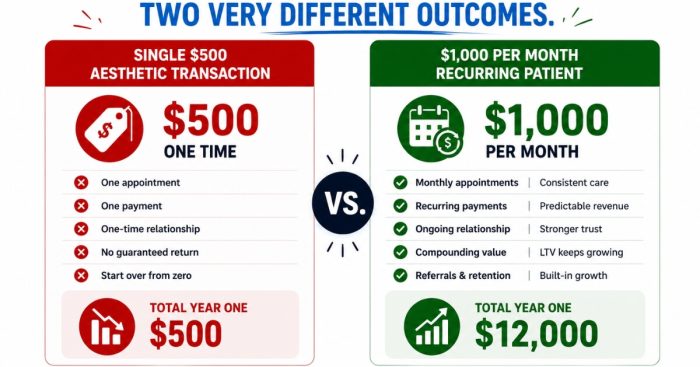
Yes, and it is not close. Recurring services bill on a schedule and create a reason for the patient to stay in your system month after month. Meanwhile, one-off aesthetics generate a strong front-end ticket but are episodic, and re-engagement is never guaranteed.
The math is straightforward.
- A $500 one-off aesthetic patient is worth $500 unless they rebook on their own.
- A $1,000-per-month membership patient is worth $12,000 in a year.
- Over a longer tenure, that value climbs significantly higher.
That is the entire game of lifetime value.
Stop counting transactions and start counting months.
We have seen this play out at Eternity Health Partners, where the recurring model carried 250 members paying $1,000 per month — a base of predictable revenue that no volume of one-off aesthetic appointments could match.
None of this means you abandon aesthetics.
Filler, Botox, lasers, and body contouring still pull the lead in.
In fact, they remain some of the most searched-for and impulse-friendly offers on your menu.
The point is simple:
- Aesthetics are the front end.
- Recurring services compound lifetime value on the back end.
Which specific services should a med spa add to build a high-LTV service mix?
Layer recurring high-LTV services on top of your existing aesthetic menu in this rough order: hormone therapy (HRT/TRT) first, then GLP-1 and medical weight loss, then peptides, then IV therapy and wellness drips, then longevity and functional-medicine programs.
Hormone and GLP-1 have the broadest demand and the strongest monthly recurring economics.
Therefore, they should be your first two additions.
Peptides fit naturally alongside hormone programs.
Additionally, they appeal to the same wellness-minded patient who is already committed to a protocol.
IV therapy is a low-friction recurring add-on.
Consequently, it keeps patients walking back through the door between larger appointments.
Longevity is the premium tier.
While it attracts fewer patients, it generates higher tickets and multi-month protocols that can run well into five figures.
The principle is simple.
Keep your one-off aesthetics as the front door.
Then add recurring services as the rooms patients move into once they are inside.
You are not replacing your menu.
Instead, you are deepening it so a patient has somewhere to go after the first visit instead of disappearing until they happen to want filler again.
How does offering more services actually attract better leads — not just more of them?
Because the menu itself is a filter. When you list TRT, peptides, longevity, and hormone alongside your aesthetics, you start drawing inquiries from patients who self-identify as wellness-minded, higher-intent, and higher-budget.
We watched this firsthand at a clinic that added recurring service options.
Almost immediately, it changed the lead mix.
Within a short window, they had separate leads asking specifically about:
- Peptides
- TRT
- Longevity
- Additional TRT services
They also received a first-ever longevity inquiry that booked directly into a five-figure protocol.
The clinic’s own read was simple.
Just offering the option for people was making the difference.
They were not generating more filler leads.
Instead, they were surfacing an entirely different, higher-value patient who had been there all along but had nothing to raise their hand for.
A broader recurring menu does not dilute your audience.
Rather, it pulls forward the better-fit, higher-LTV patients who were never going to inquire about a $300 aesthetic offer alone.
The patient who books the $13,000 longevity path is different from the one who books discounted Botox.
However, you only meet them if your menu speaks directly to them.
How do you build a med spa offer ladder that moves patients from one-off treatments to recurring revenue?
An offer ladder is a deliberate path from a low-friction front-end aesthetic offer up to high-LTV recurring programs — built so each rung is a natural next step rather than a cold pitch.
A simple offer ladder looks like this:
- Front door: Botox, filler, or a first-visit aesthetic offer.
- Bridge: Introduce lab work, a hormone consult, a GLP-1 conversation, or an IV add-on.
- Recurring core: Hormone, GLP-1, or a membership that bills monthly.
- Premium tier: Peptides, longevity, and functional-medicine protocols.
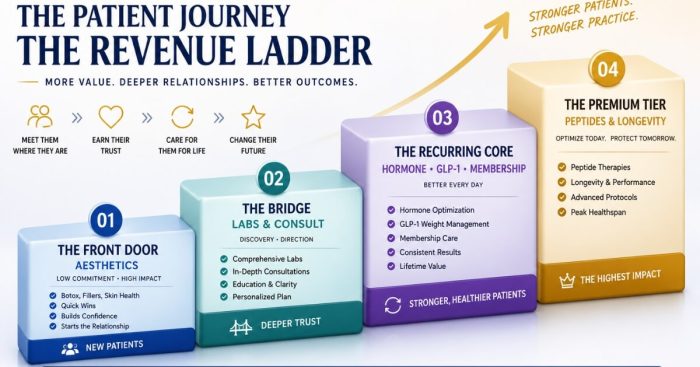
The ladder works because the patient already trusts you from the aesthetic visit.
Therefore, the move into recurring care feels like an upgrade rather than a sale.
This is exactly the multi-service model that drove NuLevel Wellness Medspa to $6.7M in revenue in one year across 3,727 new patients.
Aesthetics pulled the front-end demand.
Meanwhile, the recurring wellness and weight-loss services behind them compounded the lifetime value of every patient who walked in.
How do you market the new recurring services once a med spa adds them?
Use your aesthetics to pull leads through paid social, and use SEO and Google to capture the recurring-service searches where patients are already searching by name. Then make the cross-sell systematic.
TikTok and Facebook are the engines for front-end aesthetic demand.
That is where the filler, Botox, and body-contouring leads live.
Meanwhile, SEO and Google capture higher-intent recurring searches.
TRT, hormone therapy, weight loss, and GLP-1 are all things patients type by name.
Aesthetics fill the top of the funnel.
Search captures patients ready to start a recurring protocol.
Then close the loop internally.
Every aesthetic patient should be presented with the wellness menu.
Additionally, your follow-up should educate patients on recurring options.
Your reviews and content should also mention every service you want to be found for.
The mistake clinics make is adding services but never telling existing patients or the market that those services exist.
The menu only raises LTV if patients know it is there and your follow-up actually moves them up the ladder.
FAQ’s About Adding Services to Raise Med Spa LTV
What is the highest-LTV service a med spa can add?
Hormone therapy (HRT/TRT) is the highest-LTV service a med spa can add.
It turns a one-time aesthetic buyer into a recurring monthly patient on a maintenance protocol.
As a result, it becomes the single biggest lever on lifetime value.
GLP-1 and medical weight loss are a very close second because they carry the same recurring monthly economics with even broader demand.
How much can recurring services raise a patient’s lifetime value?
Dramatically.
A one-off aesthetic patient may be worth a few hundred dollars.
By contrast, a recurring membership patient paying $1,000 per month is worth $12,000 in a single year and far more over their tenure.
Eternity Health Partners runs 250 members at $1,000 per month — a recurring base no volume of single appointments could replicate.
Will adding wellness services hurt my aesthetic business?
No — it strengthens it.
Aesthetics stay the front door that pulls leads in.
Meanwhile, recurring services are the rooms patients move into afterward.
A broader menu also surfaces higher-budget, wellness-minded patients who were never going to inquire about an aesthetic offer alone.
As a result, your overall lead quality rises.
What order should a med spa add new services in?
Hormone first, then GLP-1 and medical weight loss, then peptides, then IV therapy, then longevity and functional-medicine programs.
Lead with the services that have the broadest demand and strongest recurring economics.
Then add premium tiers once the core is in place.
How do I get my existing aesthetic patients to try the new services?
Build an offer ladder.
Introduce the wellness side at the aesthetic visit.
For example:
- Labs
- A hormone consult
- A GLP-1 conversation
- An IV add-on
Then move the patient into a recurring program.
Because they already trust you, the next rung feels like an upgrade, not a pitch.
Systematic follow-up is what turns the new menu into actual recurring revenue.
What’s the next step?
If your med spa is doing strong aesthetic volume but your lifetime value is stuck, the leverage is in your service menu — not in another discounted Botox promotion.
Add hormone first.
Then layer GLP-1 and peptides behind it.
Next, build the offer ladder that moves patients from one-off treatments into recurring care.
Finally, market it so your existing patients and your market actually know it exists.
That is how med spas turn $300 transactions into multi-year relationships.
If you want someone to look at your current service mix, your offers, and your follow-up together — and map the exact offer ladder that will raise your LTV — that is the conversation to book.
We will pull the high-LTV service plan for your med spa on the call.