
What Is a Good Cost Per Lead for a Cash-Pay Medical Practice?
If you’ve heard a doctor say “I don’t care about cost per lead,” they’re either burning ad budget or running a clinic on borrowed time. Here’s how to reverse-engineer the only CPL that actually works at a cash-pay practice — starting from the program price, not the ad platform.
What is cost per lead (CPL) and why does it matter at a cash-pay medical practice?
Cost per lead is your total ad spend divided by the number of inbound leads that spend produces.
Because every other number in your funnel — booked appointments, attended consults, closed patients, and lifetime value — sits downstream of it, CPL directly affects profitability.
As a result, a clinic that doesn’t know its CPL is flying blind on every paid channel.
Many owners dismiss CPL because they treat it as a vanity number.
However, the right frame is different: CPL is the upstream lever that decides whether your program is profitable or whether you’re subsidizing every new patient with leftover cash from the patients you closed last quarter.
How do I calculate a target cost per lead for my cash-pay clinic?
Start at the end of the funnel and reverse-engineer backward.
First, take your program price, multiply by your gross margin, and that’s your profit ceiling per new patient.
Then, divide that number in half — that’s your maximum allowable Customer Acquisition Cost (CAC) if you want to “double your money” on the first transaction.
From there, work backward through each conversion rate in your funnel until you arrive at CPL.
Worked example, straight from the Real ADvice playbook:
- A $1,000 program at 70% margin equals $700 profit
- To double your money, max CAC = $350
- If your provider closes 70% of attended consults, you need 5 attended consults per $1,000 of ad spend
- At a 70% show rate, that requires 8.5 booked appointments
- At a 50% lead-to-booked rate, that requires roughly 20 leads
- $1,000 ÷ 20 leads = a target CPL of $50
What is a good cost per lead for a cash-pay HRT, TRT, or functional medicine clinic?
For a $1,000 program with 70/70/50 funnel conversion rates, the target sits around $50 per lead.
Meanwhile, for higher-ticket programs — $3,000–$10,000 HRT memberships, longevity packages, and regenerative pain — the math allows higher CPLs because each new patient is worth more lifetime revenue.
On the other hand, for low-ticket entry points (a $99 consult with no membership behind it), CPL has to be brutally low or the model never penciled in the first place.
The benchmarks to commit to memory:
- At $50 CPL the model holds
- At $75 CPL the model breaks
- At $100 CPL you’re paying the platform more than the patient is paying you
- At $10 CPL you have a home run — you can layer in nurture systems and squeeze even more value out of the same traffic
How does cost per lead translate into cost per acquired patient (CAC)?
Each funnel stage multiplies your effective cost per outcome.
As you walk it forward, you’ll see how a CPL miss compounds into a CAC catastrophe.
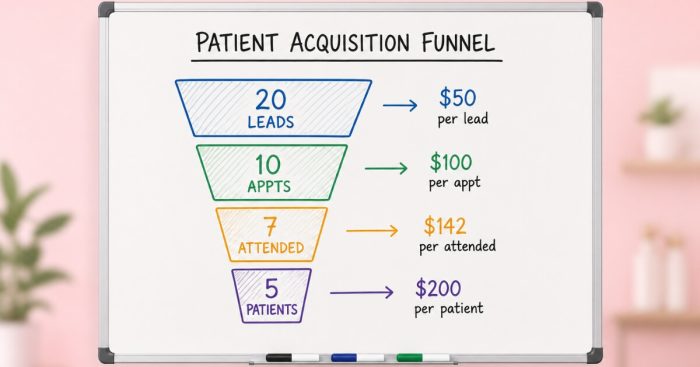
At a $50 CPL:
- $1,000 in spend buys 20 leads
- If 50% book = 10 appointments at $100 each
- If 70% show = 7 attended consults at $142 each
- If 70% close = 5 new patients at $200 CAC
Now run the same $1,000 at a $20 CPL:
- 50 leads
- 25 appointments
- 17.5 attended consults
- 12.25 patients at $81 CAC
As a result, the same ad spend creates 2.5× the patient flow at less than half the CAC.
Importantly, CAC isn’t independent.
Instead, it’s the CPL math compounded through every conversion step.
Therefore, when you cut CPL in half, your CAC drops by more than half because every downstream conversion rate is applied to a bigger starting volume.
What happens if my cost per lead is too high?
Two things break, fast.
First, your CAC blows past your “doubling money” threshold, which means every new patient you acquire is dragging the P&L down instead of building it up.
Second, the marketing team starts blaming “lead quality” and pours budget into more channels rather than fixing the math that’s already in front of them.
Inside “an HRT clinic Real ADvice grew from $1M to $4M with 250 active members paying $1,000/month”, the unlock wasn’t a new ad platform.
Instead, it was getting CPL inside the $50 envelope so the back-end membership math actually compounded.
Memberships only pencil out when the front-end CPL math holds — otherwise you’re funding lifetime value with negative-margin acquisition cost.
Understanding what a good cost per lead is starts with the economics of the offer, not the advertising platform. The same CPL can be wildly profitable for a high-ticket recurring-care program and completely unsustainable for a low-ticket one-time service. That’s why the best clinics reverse-engineer their target CPL from patient value before they ever launch a campaign.
What does the funnel math look like at $10 vs $50 vs $100 CPL?
Three side-by-side scenarios off the same $1,000 ad spend.
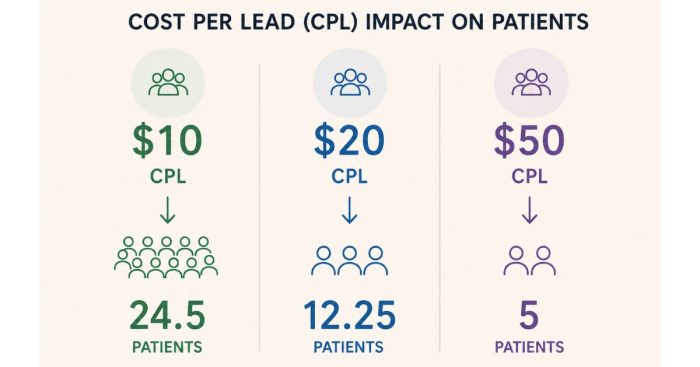
At $10 CPL you buy:
- 100 leads
- 50 appointments booked
- 35 attended consults
- 24.5 new patients at $40 CAC
At $20 CPL you buy:
- 50 leads
- 25 appointments
- 17.5 attended
- 12.25 new patients at $81 CAC
At $50 CPL you buy:
- 20 leads
- 10 appointments
- 7 attended
- 5 new patients at $200 CAC
However, push CPL to $75 and the model goes underwater.
Push to $100 and you’ve lit the ad budget on fire.
Because of that, a 5× swing in CPL (from $10 to $50) creates roughly a 5× swing in patient throughput off the identical dollar of spend.
Ultimately, CPL is a multiplier on every downstream number.
How do I lower my cost per lead at a cash-pay clinic?
Three levers, in priority order.
First, fix the offer — a no-brainer free or low-friction consult offer dramatically improves landing page conversion and drops CPL on the same ad creative.
Second, fix the targeting — geo-narrow to your driveable radius and exclude irrelevant audiences before scaling spend.
Third, tighten the funnel — a faster appointment-booking page, a callback that hits in under five minutes, and clearer next-step instructions shave dollars off CPL without changing anything in ads manager.
For SEO-driven clinics, the CPL math is even friendlier because the “ad spend” is content production, not media.
See how “Orthobiologics Associates generated $309,590 in cash-pay revenue in 10 months from organic-only traffic at a 79.4% lead-to-booked conversion rate” — zero paid ads, conversion math that paid ads would envy.
If you want Real ADvice to plug your numbers into the same funnel model and tell you exactly what CPL your program needs to hit,