
What Does an Office Manager Do at a Cash-Pay Medical Practice (And When to Hire One)?
The office manager is the first operational hire that actually gets a cash-pay clinic owner out of the day-to-day. Not a better front desk person — a different role entirely. Most owners delay this hire for years, keep routing every problem through themselves, and wonder why more marketing never turns into more freedom. Here’s the FAQ on what an office manager owns, how to know when it’s time, and the scorecard that tells you whether the hire is working.
What does an office manager do at a cash-pay medical practice?
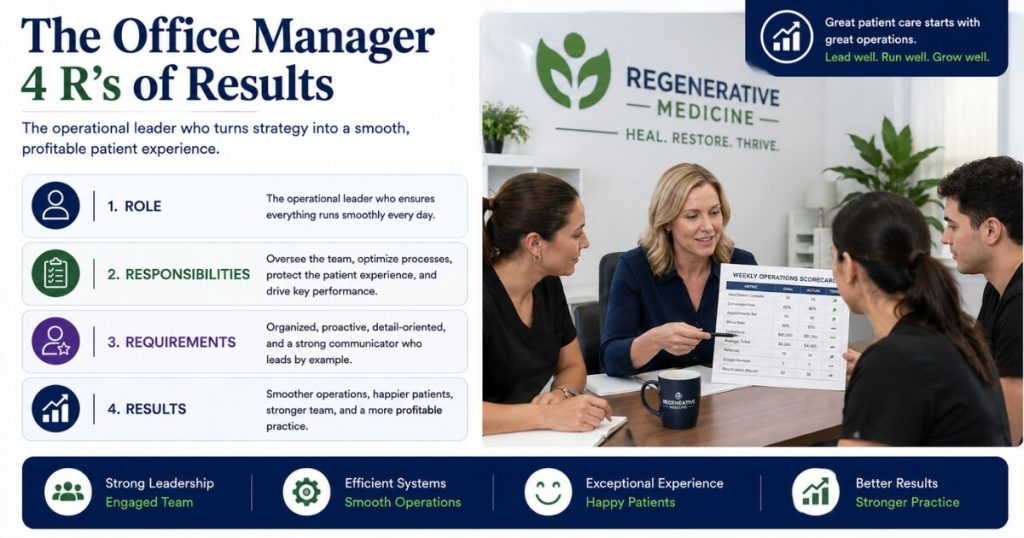
An office manager organizes and coordinates the administrative duties and office procedures that keep the clinic running without the owner — so the owner can stop being the operations department.
In practice, that means scheduling meetings and appointments with prospective patients, managing the owner’s calendar, ordering supplies and equipment, keeping the office condition and vendor relationships handled, greeting patients, and providing day-to-day leadership and administrative support to the rest of the team.
The job is to create and maintain a pleasant, drama-free work environment with high organizational effectiveness, clear communication, accurate tracking of key performance indicators, and a safe, well-run office.
The simplest way to understand the role: every recurring operational decision that currently lands on the owner’s desk should land on the office manager’s desk instead.
When that happens, the owner’s calendar opens up — and only then does additional marketing spend turn into additional revenue instead of additional chaos.
This is the same structural shift behind a medical practice marketing engine that compounds rather than burning the owner out.
What’s the difference between an office manager and a front desk lead?
The front desk lead runs the front desk.
The office manager runs the office — including the front desk.
This distinction is where most clinics get stuck.
Owners try to skip the office manager because they already have “a great front desk lead.”
But the front desk lead can’t fire the front desk, can’t hold a coworker accountable, and can’t make a vendor or staffing decision.
That is the entire reason the office manager role exists.
Without it, every problem the front desk can’t solve still routes straight back to the owner.
A front desk lead is an excellent individual contributor who answers phones, books patients, and keeps the lobby moving.
An office manager is a leader who owns hiring support, onboarding new staff, fielding employee questions, managing the schedule, coordinating with IT and vendors, making sure everything is invoiced and paid on time, and reporting the numbers up.
One executes.
The other owns the outcome.
When should I hire an office manager at a cash-pay clinic?
When the owner has become the bottleneck for operational decisions — usually somewhere between $50K and $150K a month in revenue.
The signal isn’t a revenue number on its own.
It’s the moment you notice that growth has stalled even though marketing is working, and the reason is that every staffing question, vendor issue, supply order, and scheduling conflict still needs you.
More leads at that point just produce more decisions you personally have to make.
The clinic doesn’t have a marketing problem.
It has a structural one, and the office manager is the first fix.
In the Real ADvice operational sequence, the office manager is hired first — before the patient coordinator, the marketing lead, or the clinical director — because the office manager is the role that frees the owner’s calendar.
The office manager was the load-bearing first hire that made the rest possible.
What should an office manager be responsible for day to day?
Three buckets: people, process, and reporting.
People
The office manager:
- Schedules meetings and appointments
- Provides general support to patients
- Assists in onboarding new hires
- Fields employee questions about office management, supplies, hardware, scheduling, and logistics
Process
The office manager:
- Organizes the office layout and orders stationery and equipment
- Maintains the office condition and arranges repairs
- Organizes office operations and procedures
- Coordinates with IT on all office equipment
- Ensures every item is invoiced and paid on time
Reporting
The office manager:
- Manages accurate and timely reporting of the numbers the owner reviews each week
The competencies that make this work are practical, not glamorous:
- Knowledge of office administration systems and procedures
- Proficiency in everyday office software and spreadsheets
- Familiarity with email scheduling tools and a CRM like GoHighLevel
- Excellent time management
- Strong attention to detail
- Strong written and verbal communication
- A creative mind that suggests improvements instead of just flagging problems
You are hiring an organizer who likes making things run better — not a clinical person who tolerates admin.
How do I measure whether my office manager is doing a good job?
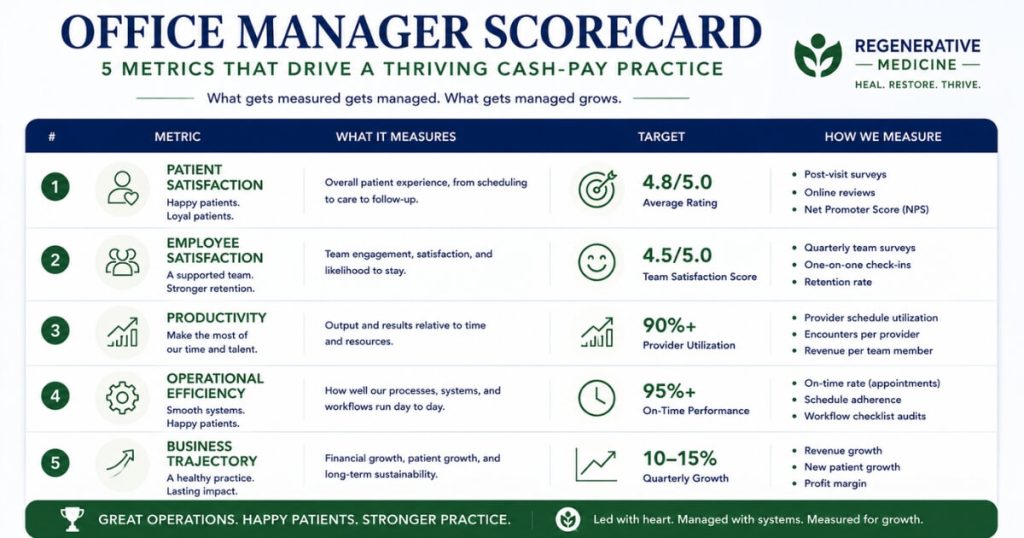
By five outcomes, reviewed regularly — not by how busy they look.
The office manager’s performance is judged on how well the office runs across five areas.
1. Patient Satisfaction
Are you consistently earning new five-star Google reviews and patient testimonials?
2. Employee Satisfaction
Is there a drama-free culture where the team genuinely likes working together?
3. Employee Productivity
Is each team member focused on moving the needle in their own responsibilities daily?
4. Operational Efficiency
Does the team feel unburdened because you’ve automated the low-value work, instead of bogged down by it?
5. Business Trajectory
Is the practice tracking toward growth at all times — and when it isn’t, is there a plan to get back on track?
Those five become the office manager’s scorecard.
When you can look at them weekly and see them holding or improving, the practice is healthy whether or not you’re in the building.
This is what lets an owner step back the way Dr. Joy Kong did — hiring additional doctors and scaling herself out of the day-to-day of the clinic while the operation kept running.
The owner who builds a patient acquisition system the team can run without daily oversight is the owner who eventually gets a business instead of a job.
FAQ’s About Hiring a Cash-Pay Clinic Office Manager
Is an office manager the same as a practice manager?
At a small-to-midsize cash-pay clinic, yes.
The titles are often used interchangeably.
The role owns the day-to-day running of the office: people, process, and reporting.
At larger groups the practice manager may sit above several office managers, but for most owner-operated cash-pay practices it’s one role.
Should my office manager handle marketing too?
No.
The office manager owns operations, not growth.
Marketing is a separate role hired after the office manager and patient coordinator are in place.
Stacking marketing onto the office manager is how clinics end up with ad spend climbing while operations quietly fall apart.
How much should I pay an office manager at a cash-pay clinic?
Pay for a leader, not a receptionist.
This is the person who gives you your calendar back.
The exact number depends on your market and the scope you hand them, but underpaying here is a false economy.
A cheap office manager who can’t actually hold the team accountable just sends every problem back to you.
Can I promote my best front desk person into the office manager role?
Sometimes — but only if they can lead, hold peers accountable, and own outcomes, not just execute tasks.
The skills that make someone a great front desk lead — warmth, speed, reliability — are not the same skills that make a great office manager: leadership, judgment, and accountability.
Promote for the second set, or hire for it.
What’s the first thing a new office manager should do?
Document the recurring decisions that currently route through the owner, then take them over one at a time.
The goal in the first 90 days is simple:
Every operational question that used to need you now has a written process and a person who owns it.
What’s the next step?
If you’re a cash-pay medical practice owner and growth has stalled because every operational decision still runs through you, the office manager is almost certainly your next hire.
Getting the role definition, the responsibilities, and the scorecard right is the difference between a hire that frees you and one that creates more work.
On a 60-minute strategy call we’ll map which operational role to hire first for your specific practice, what to document before the hire, and what the weekly scorecard should look like for your specialty.
If it’s a fit, we’ll help you build it with your team.