
Should a Weight-Loss Clinic Launch Google Ads and SEO at the Same Time?
The question almost every GLP-1 and weight-loss clinic owner asks at some point is whether to keep hammering on the website or to turn paid ads back on — as if it is one or the other. It is not. The clinics that grow fastest run Google Ads and SEO at the same time, because the two channels capture different buyers, pay back on different timelines, and make each other stronger. This is the field answer, pulled straight from launching weight-loss clinics that did exactly this — the sequencing, the budget split, what each channel actually does, and when each one starts producing booked patients.
Should a Weight-Loss Clinic Run Google Ads and SEO at the Same Time, or Sequence Them?
Run them at the same time. SEO is the channel you continue regardless, and Google Ads is layered on top of it the moment you need patients faster than organic can deliver — which, for a newer clinic, is immediately.
The reason this is not an either/or decision is that the two channels do different jobs. SEO builds a compounding asset: pages that rank, a Google Business Profile that earns reviews, and content that pulls in patients who research for weeks before they book. That asset takes time to mature, but once it does it produces the lowest-cost, highest-intent patients you will get.
Google Ads does the opposite job. It turns on this week and gives you a controllable flow of new patients while the organic asset is still indexing and climbing. One is a flywheel you are spinning up. The other is a faucet you can open today.
We see clinics talk themselves into waiting on ads “until SEO is working.” That is backwards. A weight-loss clinic that pauses paid acquisition while it waits for organic to mature is volunteering for a revenue gap that lasts months.
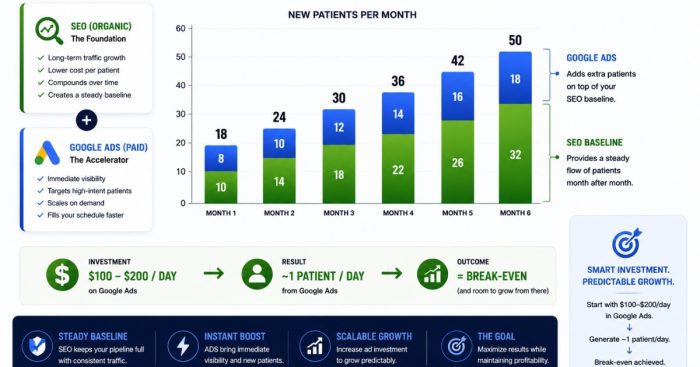
The same clinics that ran paid ads early were doing 70 to 80 new patients a month. The months they relied on organic and word of mouth alone, that number settled around 50. The faucet is what holds your patient count up while the flywheel gets going.
For a fuller map of which channels fit which cash-pay treatment, our med spa marketing hub breaks down the full stack.
How Much Should I Budget for Google Ads While SEO Ramps, and How Do I Split It?
Fund SEO as its own ongoing line item, then layer paid on top starting at $100 to $200 a day on a single Performance Max campaign. The ad budget is not carved out of SEO — it is additive.
The instinct is to start small, maybe $50 a day, to “test the waters.” We push clinics to start at $100 a day instead, because you get data and feedback faster and you optimize faster at the higher spend.
Performance Max needs a certain volume of conversions before the algorithm can learn who to show your ads to. Starve it, and you are paying for a slow, noisy ramp. One hundred to two hundred dollars a day is the range that gives the campaign enough signal to find your patients across search, display retargeting, and YouTube.
The math that makes this comfortable is the break-even. For a weight-loss clinic, the program LTV and the front-end cash ticket are high enough that roughly one new patient a day covers a $100-a-day spend. That means the question is not “can I afford this.” It’s “how many patients above break-even can I drive.”
Keep SEO funded the whole time — the website work continues regardless of what the ad account does. Treat the split as SEO baseline plus paid layer, never paid instead of SEO.
Why Pay for Google Ads if My Weight-Loss Pages Already Rank on SEO?
Because there is paid demand and branded-drug demand sitting above and beside your organic listing that your SEO pages cannot capture. Ranking number one organically does not mean you own the page.
Even when a clinic ranks at the very top of organic results, there is almost always a sponsored result sitting above it on the same search. That spot is only available through paid. If you are not bidding, a competitor is taking the click that lands before yours.
Owning the organic position and ignoring the paid position above it leaves money on the table on the exact search you already win.
The bigger reason is branded-drug search. Patients search by brand — in many markets they call every weight-loss injection “Ozempic” regardless of what they are actually prescribed. You cannot and should not rank a compliant SEO page for Ozempic, Mounjaro, or Wegovy. There is no white-hat or gray-hat way to do it organically.
But you can bid on those branded keywords in the ad account and route the click to a compliant GLP-1 landing page that never names a brand. Paid ads are the only legitimate path to that demand, and it is substantial.
Reltrutide-class terms now carry search volume comparable to semaglutide, and that demand keeps shifting. Ads let you chase it in real time while your SEO pages stay clean.
How Long Until SEO Starts Booking Patients, and What Does Google Ads Cover in the Meantime?
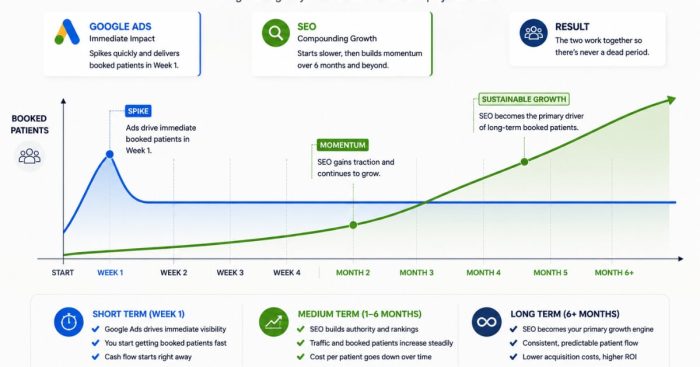
Plan for SEO to take months, even though a well-built site can rank far faster — and let Google Ads carry the patient count during that ramp.
The honest planning number for SEO is the industry average of about six months. That is the figure to budget your patience against.
A tightly constructed clinic site can beat it dramatically. One Minnesota weight-loss clinic we launched ranked number one for “medical weight loss” in a target city and booked an inbound patient off that exact page within twelve days of going live, with impressions climbing roughly 18 to 20 percent in the first stretch. But that speed depends on a clean sitemap, local business schema, genuinely distinct city-specific pages, and disciplined on-page work — it is the compressed timeline, not the default one.
Because the default is months, Google Ads is what keeps new-patient volume from sagging while organic climbs. The paid campaign produces booked patients in week one. The SEO pages produce them on a curve that bends up over the following quarters.
By the time organic is carrying real volume, you have a paid layer you can dial up or down at will and an organic asset that costs almost nothing per patient. Run them together, and there is never a dead period.
We have watched this exact pattern build multi-channel scale at NuLevel Wellness Medspa, where the combined channel stack helped add $6.7M in revenue in a single year.
What Has to Be True Operationally for Running Both Channels to Actually Pay Off?
One pipeline with source tagging, a compliant landing page, and fast follow-up. The channels do not fail on their own — they fail when the operation behind them cannot catch the leads.
Start with attribution. Every lead, whether it comes from an organic page or a paid ad, should flow into the same pipeline and be tagged by source. That is how you see, cleanly, how many new patients and how many bookings came from the website versus Google Ads — and how you decide where to put the next dollar. Without it, you cannot tell which channel is working, and you will defund the wrong one.
Then the landing page. Keep brand names and FDA-approved claims off it, lead with GLP-1 language and an outcome-based offer, and send opt-ins to a thank-you page with the scheduling link embedded. The ad shutdowns clinics suffer almost always trace back to naming semaglutide or tirzepatide on the page without LegitScript certification, or to FDA-approved verbiage.
Finally, follow-up: some leads book themselves off the thank-you page, but the front desk has to call the rest, fast. A strong booking rate is achievable — one clinic we work with converted 34 new leads into 22 bookings in a single month.
The channels generate demand. The operation converts it. Skip the operation, and you will burn budget and blame Google.
For how SEO-led growth compounds when the operation is dialed in, see VYVE Wellness, which grew leads roughly 900% through an SEO-plus strategy.
FAQ’s About Running Google Ads and SEO Together
How much should a weight-loss clinic spend on Google Ads while it waits for SEO to kick in?
Start at $100 to $200 a day on a single Performance Max campaign and judge it against your break-even, not against a vanity ROAS number. At a roughly $100-a-day spend, a weight-loss clinic typically breaks even on a single new patient per day, because the program LTV is high and the front-end cash ticket is real.
We deliberately do not start at $50 a day, because you get data and feedback faster and optimize faster at $100 a day — the algorithm needs enough conversions to learn.
Keep SEO funded in parallel at its own line item. The ad budget is not borrowed from SEO, it is layered on top. The website is something you continue regardless of what the ad account is doing, so the right framing is not Ads versus SEO — it is Ads now, plus SEO compounding underneath.
Why run Google Ads if my weight-loss pages are already ranking on SEO?
Because there is paid demand sitting above your organic listing that you cannot capture organically, and because branded-drug searches are off-limits to your SEO pages but biddable in the ad account.
Even clinics that rank number one organically watch a sponsored result sit above them on the same search. You also cannot rank a compliant SEO page for branded terms like Ozempic, Mounjaro, or Wegovy, but you can bid on those keywords in a paid campaign and route the click to a GLP-1 landing page that never names a brand.
Paid ads also turn on this week, while SEO takes time to index and climb, so ads cover the revenue gap during the ramp. The two channels capture different slices of the same intent rather than competing for it.
How long does SEO take to start booking weight-loss patients?
Industry average is about six months, but a tightly built clinic site can rank and book patients much faster than that. One Minnesota weight-loss clinic we launched ranked number one for medical weight loss in a target city and booked an inbound patient off that page within twelve days of going live, while overall impressions climbed roughly 18 to 20 percent in the first stretch.
That is the exception, not the rule. It takes a clean sitemap, local business schema, city-specific pages with genuinely different content, and on-page work to compress the timeline.
The honest planning number is still months, not weeks, which is exactly why you run paid ads alongside SEO instead of waiting for organic to mature.
What does the Google Ads landing page need so a weight-loss clinic does not get its ads shut down?
Keep brand names and FDA-approved claims off the landing page, lead with GLP-1 language and an outcome-based offer, and route opt-ins to a thank-you page with a scheduling link.
The shutdowns we have seen came from naming semaglutide or tirzepatide on the landing page without LegitScript certification, or from leaning on FDA-approved verbiage. You are allowed to say GLP-1, so the page sells a GLP-1 weight-loss program and the outcome — for example, helping people lose 15 to 20 percent of body weight in 90 to 120 days — without the regulated language.
After opt-in, send leads to a thank-you page with the SimplePractice scheduling link embedded. Some book themselves, the front desk calls the rest, and every lead flows into the same pipeline tagged Google Ads so you can see source-level performance.
Will running both channels at once cannibalize each other or waste budget?
No — they pull from different buyer behavior and different keyword pools, so they stack rather than overlap. SEO owns the long-term, lower-cost flow of patients who research for weeks and choose the clinic that shows up across pages, GMB, and reviews at the same time.
Paid ads own the immediate, controllable flow and the branded-drug and near-me searches your organic pages cannot or should not target.
The waste risk is not from running both. It is from running both without follow-up. If you cannot answer leads fast and you do not tag sources in one pipeline, you will burn cash and blame the wrong channel.
With clean attribution, you can see exactly how many new patients and bookings come from the website versus Google Ads, and fund each accordingly.