
What Are the Only Two Ways to Grow a Cash-Pay Medical Practice? (And How to Find Which One Is Your Bottleneck)
Strip away every tactic, tool, and guru framework, and there are really only two ways to grow a business: get new customers, or get your existing customers to spend more money with you. For a cash-pay clinic, that means lead generation on one side and nurture plus retention on the other. Most owners pour money into the first lever, while the second one — and the conversion chain between them — quietly leaks. Here’s how to think about both and find the exact step where your growth is stuck.
What are the only two ways to grow a cash-pay medical practice?
Get new patients in, or get the patients you already have to spend more and stay longer.
Every growth tactic you’ve ever heard of is one of those two.
Paid ads, SEO, referral programs, and community events all belong to lever one: new patient acquisition.
Memberships, follow-up protocols, reactivation campaigns, program upsells, and a better patient experience all belong to lever two: more revenue per existing patient.
When you know that, the noise gets quieter.
You stop asking, “Should we be on TikTok?”
Instead, you start asking, “Which lever is currently cheaper for us to pull?”
Both levers work at scale.
NuLevel Wellness added $6,708,600 in revenue in a single year on the back of 3,727 new patients from multi-channel paid ads — that’s lever one executed hard.
However, lever one is the expensive lever when the machinery behind it leaks.
That’s why the rest of this article is about what has to be true before you pull it.
What does my clinic need in place before spending money on new patient acquisition?
Four things, in order:
- Your offer
- Your ideal patient
- What exactly you’re selling
- Your patient lifetime value
Only then does lead generation make sense.
This is the sequence we teach every clinic.
The offer defines why a stranger would pick you over the clinic down the street.
The ideal patient defines who the ads should even reach.
Knowing what you sell — the program, the membership, the treatment plan, not just “a consult” — defines what a lead is actually worth pursuing.
Lifetime value is the number that makes or breaks the math.
A patient worth $400 once supports a very different ad budget than a member worth $1,000 a month.
Skipping this step is how clinics end up “testing” ads for six months with nothing to show for it.
The problem was never the ads.
Instead, nobody defined what a good patient was worth.
That definitional work is the unglamorous half of medical practice marketing that no platform tutorial covers.
What numbers do I need to know before spending money on lead generation?
Know the full chain.
If you spend this much money, you should know:
- How many leads you generate
- How many appointments get booked
- How many new patients you acquire
You also need the conversion rate at every step.
That’s the standard.
Not simply, “We get leads from Facebook.”
The chain is:
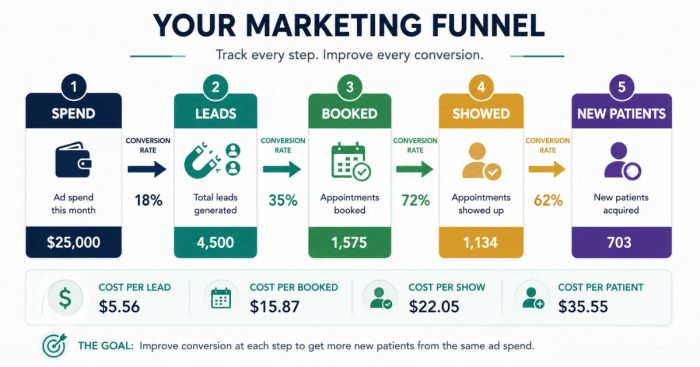
Spend → Leads → Booked → Showed → Converted to paying patient
That’s five numbers with four conversion rates between them.
When you can recite that chain for last month, you’re allowed to scale spending.
When you can’t, more budget simply buys you a bigger version of a leak you haven’t found yet.
This is also what makes marketing decisions boring — in the best way.
If a channel produces leads at a reasonable cost but only 8% of them book appointments, the channel isn’t the problem.
Switching platforms won’t fix it.
The conversion chain tells you exactly where the money dies.
Building that visibility is the core of a patient acquisition system that actually compounds.
Every inquiry gets tracked from the first click to the first payment.
As a result, the conversion rate at each step becomes a number on a dashboard instead of a feeling.
How do I find the bottleneck in my clinic’s growth?
Walk the conversion chain step by step.
Find the stage where the percentage collapses.
That stage — the constraint — is your growth problem.
Everything else is a distraction.
Every clinic’s chain has exactly one weakest link at any given time.
Do you have plenty of leads but very few booked appointments?
Then the constraint is speed-to-lead and phone handling, not marketing.
Are you booked solid but revenue is flat?
Then the constraint is your show rate or your offer’s price structure.
Do you have lots of one-time patients but very little recurring revenue?
Then the constraint is lever two because nobody built the nurture and retention machinery.
The discipline is fixing the constraint before adding fuel.
Doubling ad spend with a booking bottleneck only doubles the number of leads you waste.
It’s also the single most common way cash-pay clinics torch a marketing budget.
How do I get existing patients to spend more (the lever most clinics ignore)?
Keep them longer and give them a next step.
Lead nurture happens on the front end.
Retention and recurring programs happen on the back end.
The new patients you fought for with ad dollars are the most expensive patients you’ll ever acquire.
The cheapest revenue in the building comes from the patient who already trusts you.
That means implementing:
- Follow-up sequences for leads who didn’t book the first time
- Reactivation outreach for patients who went quiet
- Recurring membership programs that turn a one-time visit into a monthly relationship
Eternity Health Partners built 250 active members paying $1,000 a month while growing from $1M to $4M a year — that’s lever two doing compounding work that no ad budget can replicate.

Which growth lever should my clinic pull first?
Pull lever two first if you already have an existing patient base and a leaky conversion chain.
Pull lever one first only if you’re new or your retention machinery is already solid.
The logic is arithmetic, not philosophy.
Fixing a nurture or retention leak costs process and attention.
New patient acquisition costs cash.
It also pours that cash through whatever conversion chain you currently have.
An established clinic almost always gets a faster payback by tightening conversion and retention first.
Then it can scale acquisition into a system that keeps what it catches.
A brand-new clinic has nothing to retain yet.
It earns its way to lever two by pulling lever one while tracking the numbers from day one.
Get new patients in.
Keep them longer.
The clinics that consistently do both, in that order of repair, are the ones that stop plateauing.
FAQ’s About the Two Ways to Grow a Cash-Pay Practice
Should I just spend more on ads if I want to grow faster?
Not until you can recite your conversion chain:
- Spend
- Leads
- Booked appointments
- Shows
- New patients
You also need the conversion rate at every step.
Pouring more ad spend into a chain with a weak step only creates more wasted leads.
Find the constraint first.
Fix it.
Then scale your advertising budget.
What conversion numbers should a cash-pay clinic track?
Track five stages:
- Marketing spend
- Leads generated
- Appointments booked
- Appointments shown
- New paying patients
Also track the conversion rate between every stage.
If you know those numbers for last month, you can locate almost any growth problem in minutes.
What counts as lead nurture for a medical practice?
Lead nurture includes everything that happens between “lead came in” and “patient paid.”
That includes:
- Speed-to-lead phone calls
- Text follow-up sequences
- Email follow-up sequences
- Appointment reminders that protect show rate
- Reactivation outreach for leads or patients who went quiet
Nurture is the second growth lever applied before patients ever convert.
How do I increase patient lifetime value without raising prices?
Keep patients longer and give them a clearly defined next step.
Recurring membership programs, follow-up protocols, and reactivation campaigns all increase lifetime value by extending the relationship instead of increasing the invoice.
A patient who stays eight extra months is worth more than almost any price increase.
What if I don’t know my patient lifetime value yet?
Calculate it before spending another dollar on lead generation.
Use the average revenue generated across the patient’s entire relationship with your clinic, not just the first visit.
Lifetime value determines your allowable cost per new patient.
That number should guide every advertising budget decision.
What’s the next step?
If your clinic has been “doing marketing” but growth remains flat, the answer is almost never another platform.
Instead, it’s identifying which of the two growth levers is stuck and which step of your conversion chain is leaking.
That diagnosis usually takes about an hour when someone knows where to look.
Book a free strategy call.
We’ll walk through your numbers with you:
- Marketing spend
- Leads
- Bookings
- Shows
- New patients
We’ll also evaluate what your existing patient base could produce with real nurture and retention systems behind it.
You’ll leave knowing exactly which growth lever to pull first.