
What Should the First 13 Months of a Men’s Hormone (TRT) Membership Look Like? (The Month-by-Month Check-In, Refill, and Consult Map)
A TRT membership doesn’t churn at the cancellation button — it churns in the quiet weeks when a refill lapses, a lab never gets scheduled, and nobody at the clinic notices. This is the FAQ on the month-by-month patient journey a men’s hormone practice runs inside its CRM for the first 13 months of every membership: the welcome and check-in cadence, the 90/180/270/360-day refill loop, the 6- and 12-month consults, the week-6 review request, and the pipeline discipline that makes silent churn visible.
Why does a TRT membership need a mapped month-by-month journey?
Because hormone members interact with the clinic on a quarterly clinical rhythm — and any month without a planned touch is a month a member can silently disappear.
TRT economics are built on the refill cycle:
- Medication re-ups around day 90
- Medication re-ups around day 180
- Medication re-ups around day 270
- Medication re-ups around day 360
Alongside:
- A consult at the start
- A consult at month 6
- A consult at month 12
Between those clinical events sit long stretches where nothing forces the patient to think about the clinic.
The journey map fills every one of those months with:
- An owner
- An action
- A check-in
- A nurture email
- A refill reminder
- A staff task
so retention stops depending on the patient remembering to come back.
The map also changes who does the work.
Every item in the 13-month sequence is either:
Automation
- SMS
Assigned Staff Task
- Make sure client has ordered their refill
- Ensure labs and consult are scheduled
That’s the difference between a journey that exists in the owner’s head and one a team can run — the same systemization that powers an HRT clinic that grew from $1M to $4M a year with 250 members paying monthly.
What should happen in the first 60 days of a TRT membership?
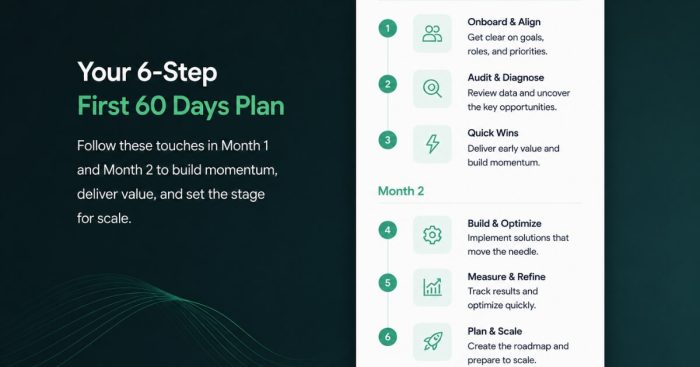
Five touches in month one — welcome SMS, a two-week check-in call, a labs-and-consult scheduling task, and the follow-up intake form — then the first follow-up consult, a six-week check-in, and the review request in month two.
Month 1
Month one sets the relationship:
- A welcome SMS the day the membership starts
- A personal call at two weeks to ask how the patient is doing
- A staff task to confirm follow-up labs and the first consult are actually on the calendar
Not assumed.
Confirmed.
The intake form for that follow-up consult goes out before the visit so provider time is spent on:
- The conversation
- Not the paperwork
Month 2
Month two is where the clinical and marketing journeys intersect.
The first follow-up consult happens.
A six-week check-in lands.
Then the SMS review request goes out.
The timing is deliberate.
Six weeks into TRT is when most men first feel the difference.
That makes it:
- The single best moment in the entire membership
- To ask for a Google review
Ask at week one and there’s nothing to say.
Ask at month six and the enthusiasm has normalized.
Week six is the peak.
How do you keep quarterly refills from lapsing?
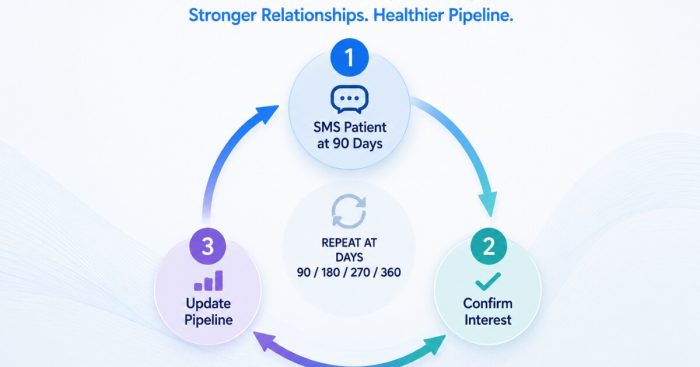
Run a three-step loop at every refill window: an upcoming-refill SMS to the patient, a staff task to confirm the order was placed, and a pipeline-stage update once it has.
The journey runs this loop at:
- Day 90
- Day 180
- Day 270
- Day 360
Step 1: Reminder
The SMS does the reminding.
Step 2: Human Verification
A staff task follows:
Make sure client has ordered their refill.
Step 3: Pipeline Update
The CRM pipeline stage updates only when the order is confirmed.
That last step is what makes churn visible.
Any member sitting in a refill stage past the window shows up on a list.
The clinic can chase the lapse the week it happens instead of discovering it at renewal.
This is order-by-order retention accounting.
A hormone member who misses one quarterly refill isn’t a billing hiccup.
He’s halfway out the door.
The pipeline view turns:
I think our members are fine.
into a count you can read every Friday.
When should consults and labs happen in year one?
Consults at month two (first follow-up), month six, and month twelve — with labs-and-scheduling tasks fired a month early, at months five and eleven.
Year-One Clinical Timeline
| Month | Action |
|---|---|
| Month 2 | First Follow-Up Consult |
| Month 5 | Labs + Scheduling Task |
| Month 6 | Six-Month Consult |
| Month 11 | Labs + Scheduling Task |
| Month 12 | Twelve-Month Consult |
The cadence on the map is deliberate about lead time.
The month-five task:
Ensure labs and consult are scheduled.
exists so the month-six consult happens on time with fresh bloodwork in hand.
Month eleven does the same for the twelve-month consult.
Each consult is preceded by its intake form so the patient arrives with:
- Symptoms documented
- Goals documented
- Questions documented
The 6- and 12-month consults are also the membership’s value-demonstration moments:
- Labs reviewed against baseline
- Protocol adjusted
- Progress made tangible
A member who sees his numbers move at month six has a reason to be there at month twelve.
That’s why the consults anchor the journey instead of floating wherever the schedule allows.
What keeps members engaged between clinical touchpoints?
A monthly educational nurture email, plus structured check-ins at two weeks, six weeks, 75 days, 120 days, and nine months.
The nurture email shows up in nearly every month of the map:
- Month 2
- Month 4
- Month 5
- Month 6
- Month 7
- Month 8
- Month 9
- Month 10
- Month 11
It’s the:
- Lowest-effort touch
- Highest-coverage touch
in the system.
The content focuses on:
- Hormones
- Optimization
- Lifestyle
- Adjacent services
arriving on a rhythm that keeps the clinic present without selling.
The structured check-ins happen at:
- 2 weeks
- 6 weeks
- 75 days
- 120 days
- 9 months
Each one creates an opportunity to catch:
- Side effects
- Scheduling friction
- Motivation dips
while they’re still small.
Notice what this cadence does to the patient’s experience.
In 13 months:
There is no month where the clinic goes silent.
That consistency is the felt difference between:
Commodity Care
A $150-a-month prescription
Membership Care
A membership a man keeps for years
It’s also the surface where cross-sells:
- Peptides
- Weight management
- Wellness add-ons
get introduced naturally inside educational content instead of as pitches.
What happens after month 12?
Month 13 flips to ongoing membership with check-ins — the renewal is a non-event because the journey never created a decision point to quit.
There’s no renewal cliff on this map.
The twelve-month consult:
- Reviews the year against baseline labs
The 360-day refill:
- Processes on the same loop as every previous quarter
Month 13 simply continues the cadence:
- Check-ins
- Nurture
- Refills
Members don’t re-decide to stay.
They just stay.
Because the journey never let the relationship go cold enough for:
Should I keep paying for this?
to become a live question.
That’s the LTV math hiding in an operations map.
The difference between:
- A TRT member who lasts 4 months
- A TRT member who lasts 24 months
isn’t the protocol.
It’s whether anyone noticed the missed refill in month 7.
Map the year.
Assign every touch.
Track every refill in the pipeline.
The membership compounds.
FAQ’s About the TRT Membership Patient Journey
What touchpoints belong in month one of a TRT membership?
Month one includes:
- A welcome SMS on day one
- A two-week check-in call
- A staff task confirming follow-up labs and the first consult are scheduled
- The follow-up intake form sent before that consult
When should a hormone clinic ask for a Google review?
Around week six.
The review request is timed with the six-week check-in, right when most men first feel the protocol working.
- Earlier and there’s nothing to review
- Later and the enthusiasm has faded to normal
How do you stop quarterly refills from lapsing?
Use a three-step loop:
- Upcoming-refill SMS
- Staff task confirming the order
- Pipeline-stage update on confirmation
Run the loop at:
- Day 90
- Day 180
- Day 270
- Day 360
When do consults and labs fall in year one?
- First follow-up consult in month two
- Six-month consult
- Twelve-month consult
Supporting tasks happen:
- Month five
- Month eleven
An intake form is sent before each visit.
How many nurture emails should the journey include?
Roughly one per month.
The map sends educational emails in:
- Month 2
- Month 4
- Month 5
- Month 6
- Month 7
- Month 8
- Month 9
- Month 10
- Month 11
so no month passes without the clinic showing up in the member’s inbox.
What’s the next step?
If your men’s hormone or TRT practice tracks memberships by billing status alone, you’re finding churn months after it happened.
Build the 13-month map in your CRM:
- Every month owned by a touch
- Every refill wrapped in the SMS-task-pipeline loop
- Consults anchored at 2, 6, and 12 months
- Labs teed up a month early
- A review request riding the week-6 high
If you want the journey built for your practice — automations, staff tasks, pipeline stages, and the nurture calendar — book a strategy call.
We’ll map your member lifecycle on the call and wire it into your medical practice marketing and patient acquisition systems.