
Should My Telehealth Clinic Spend Ad Money on Peptide Patients or Hormone Patients? (The LTV Math)
On a recent growth call with a telehealth clinic, the owners shared a stat that stopped the room: peptides and GLP-1s made up 70% of their revenue, hormones only 30%. Our advice was blunt — that ratio should be flipped. A hormone patient at $200–$300 a month stays two to three years and is worth $4,000–$5,000; a peptide protocol ends after 10–12 weeks. Here’s the full FAQ on where the ad dollars should go, how “peptides date TRT,” and the exact retention and upsell mechanics we mapped on the call.
Should I advertise for peptide patients or hormone patients?
Spend your ad dollars acquiring hormone patients and drive peptide patients organically — unless you’ve built a defined graduation path from one to the other.
The logic is pure lifetime value.
A hormone patient pays $200 to $300 a month and typically stays for two to three years.
That translates into roughly $4,000 to $5,000 in lifetime value, making them genuinely high-ticket even though no single invoice appears large.
A peptide patient, by contrast, purchases a protocol with a built-in ending.
Most peptide protocols run for 10 to 12 weeks before requiring time off.
As a result, even satisfied peptide patients reach a natural exit point every few months.
That’s why paying $50 to $150 to acquire a hormone patient is smart.
Paying the same amount for a one-cycle peptide buyer usually isn’t.
If your revenue mix resembles the clinic from our call — 70% peptides and GLP-1s with only 30% hormones and consults — the healthier version is the reverse.
Aim for 70% hormones and 30% peptides.
Peptides make an excellent front-end offer and a strong organic acquisition strategy.
However, they’re simply a rented patient unless something converts them into a long-term hormone member.
Why are peptide patients worth so much less than hormone patients?
Because the protocol itself schedules the cancellation.
However, they’re worth far more than their first cycle if you understand that peptides date TRT.
A typical peptide such as BPC-157 follows a 10-week protocol and then requires a mandatory break.
That means churn is built directly into the clinical calendar.
Every patient reaches a stopping point, and many never reorder.
That’s the downside.
The opportunity is what we’ve consistently seen across men’s clinics.
Patients who begin peptide therapy are often only nine to twelve months away from starting hormone therapy.
They’re already comfortable with injections, committed to optimization, and paying attention to their health metrics.
Peptides date TRT.
Hormones marry the patient.
That changes the strategic question.
Instead of asking, “Should I market peptides or hormones?” ask, “Have I built a structured path from the 12-week peptide patient to the three-year hormone patient?”
If the answer is yes, peptide acquisition becomes a feeder system.
If not, you’re paying to fill a leaky bucket.
Before spending another advertising dollar, fix your peptide therapy clinic marketing strategy.
How do I keep telehealth peptide patients from dropping off?
Add two human touchpoints — a dosing-and-administration call and a progress-and-results call — then bundle labs so the mandatory break becomes a checkpoint instead of a cancellation.
Telehealth peptide patients typically disappear at two predictable moments.
The first comes immediately after the medication arrives.
Many patients worry about dosing correctly, and some never even begin treatment.
The second comes when the 10- to 12-week protocol ends and they must decide whether to continue.
Fortunately, both problems are solved with structure.
A short dosing-and-administration conversation when the medication arrives helps patients begin confidently.
More importantly, it’s the type of personal service that differentiates your clinic from competitors who simply ship medication and disappear.
Near the end of the cycle, schedule a progress-and-results conversation.
Instead of ending with, “My protocol is finished,” the discussion becomes, “Here’s what we’ve measured, and here’s what comes next.”
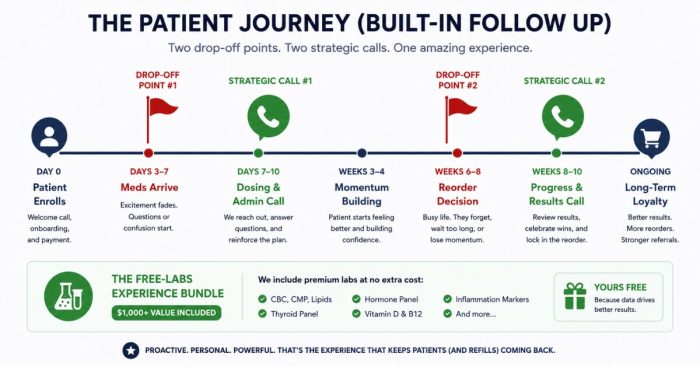
The lab bundle ties the entire process together.
On the call, we recommended offering complimentary blood work to patients who purchase two peptide cycles.
Once someone spends more than $1,000, providing baseline labs becomes an easy value-add.
Now the patient has objective data, the required rest period has a clinical purpose, and your next recommendation is based on measurable results rather than guesswork.
How do I graduate peptide patients into hormone therapy?
Diagnostic testing at around 90 days.
A roughly $100 lab draw becomes one of the easiest upsells in the clinic because the patient effectively sells themselves.
Here’s the framework we mapped.
The patient begins peptide therapy.
Baseline labs are completed, bundled once they reach the spending threshold.
Around 90 days later, they repeat those labs.
Now the progress conversation becomes obvious.
“Look at the progress you’ve made. Here’s what’s still holding you back.”
When a patient sees low free testosterone on their own lab report, persuasion becomes unnecessary.
As we explained during the call, lab results level the playing field.
Even an average coordinator can guide a productive conversation because the patient can clearly see the clinical evidence.
This is also why the lifetime value math ultimately favors clinics that offer both services.
Peptide therapy attracts optimization-minded patients.
The lab process systematically converts many of them into long-term hormone members.
An HRT clinic we work with runs 250 active members at $1,000 a month using exactly this type of membership-first model built around recurring care, ongoing testing, and long-term relationships.
That’s what the peptide patient ultimately graduates into.
How much should I budget for Google Ads on a hormone campaign — and what should I expect?
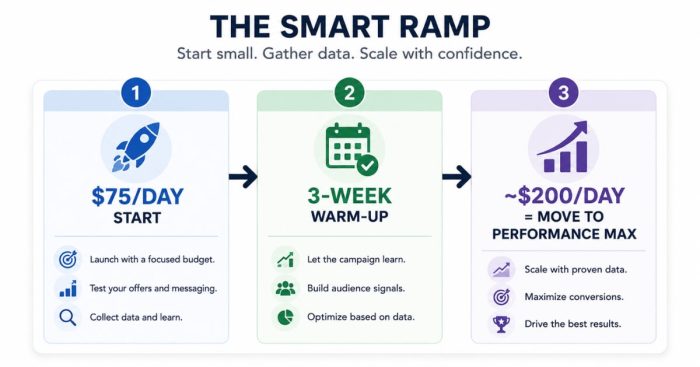
A minimum of $75 per day, a three-week warm-up period before judging results, and a move to Performance Max once spend reaches about $200 per day.
These recommendations come from live campaigns, not theory.
A comparable hormone clinic spends approximately $120 per day and books scheduled consultations for about $150 each.
On the peptide side, lead costs vary widely depending on keyword intent.
We’ve seen leads as low as $8 for “peptide therapy near me” and around $40 for other high-intent searches, compared with roughly $100 for colder keywords.
The ad account itself also needs time to learn.
You’ll usually receive leads sooner, but the algorithm needs about three weeks before performance becomes representative.
Avoid shutting down a campaign during week two simply because the data hasn’t stabilized yet.
Structure matters just as much as budget.
Don’t send paid traffic to your homepage.
You’re not running ads to a website — you’re running ads into a conversion funnel.
For women’s hormone campaigns, the framework we mapped was:
- Google Ads
- Symptom quiz
- Free discovery call
- Paid consultation
- Lab work
- Membership enrollment
Broaden the symptom quiz beyond a single issue so more people qualify to enter the funnel.
Then allow patients to book directly from the quiz results page to reduce drop-off.
What consult offer actually closes hormone patients?
A paid two-part assessment — consultation, labs, and follow-up consultation — priced around $349, followed by a three-tier treatment presentation.
The clinic on our call charges $349 for its optimization assessment.
That includes an initial consultation, laboratory testing, and a follow-up visit to review the results.
Realistically, they could charge considerably more.
Price isn’t the primary limitation.
Offer alignment is.
A cautionary example came from their own market.
A competing clinic sells an $8,300 six-month functional medicine program to women experiencing menopause.
Patients later told our client, “All I got from it was supplements.”
The advertising promised hormone solutions.
The offer delivered supplements.
Patients wanted medication.
Misaligned offers damage markets regardless of how well the ads are targeted.
The closing conversation also works better as a choice rather than an ultimatum.
The strongest process we’ve seen presents three treatment tiers after the assessment:
- A medication-focused protocol
- A mid-level combination program
- A supplements-and-lifestyle option
Instead of deciding yes or no, patients choose the option that best fits their goals.
Clinics using this structure consistently maintain average memberships around $700 per month.
In addition, offer an annual enrollment option with a meaningful discount—for example, “Save 20% when you enroll for the year.”
That’s a proven tactic from the men’s hormone clinic marketing playbook, and it works equally well for women’s hormone programs.
FAQ’s About Peptide vs. Hormone Patient Economics
What is a hormone patient worth to a cash-pay telehealth clinic?
Approximately $4,000 to $5,000 in lifetime value.
At $200 to $300 per month, most hormone patients remain active for two to three years.
That makes hormone patients high-value acquisition targets even though each individual monthly payment appears modest.
Why do telehealth peptide patients cancel?
Two predictable moments cause most cancellations.
The first happens immediately after medication arrives, when patients worry about administering the treatment correctly.
The second occurs when the 10- to 12-week protocol ends and they must decide whether to reorder.
A dosing-and-administration call at delivery and a progress-and-results conversation near the end of the cycle address both problems.
What does “peptides date TRT” mean?
Many peptide patients are only nine to twelve months away from beginning hormone therapy.
They’re already comfortable with injections and invested in improving their health.
Peptides are the short-term relationship.
Hormones become the long-term relationship.
Clinics that build a laboratory-based graduation process around the 90-day mark convert those patients systematically.
How long should I give a new Google Ads campaign before judging it?
At least three weeks while spending a realistic budget of $75 or more per day.
You’ll often see leads before then, but the account needs time to optimize before performance accurately reflects long-term potential.
Once daily spend approaches $200, begin expanding from Search into Performance Max using video assets.
What’s the next step?
If your telehealth clinic’s revenue depends heavily on peptides and GLP-1s while your hormone membership program remains underdeveloped, book a strategy call.
In 60 minutes we’ll calculate your actual lifetime value, map the peptide-to-hormone graduation path around the 90-day lab checkpoint, and design the quiz funnel and advertising budget that fit your market.