
How Do You Use a Symptom Quiz to Attract Women’s Hormone (HRT) Patients?
Women in perimenopause and menopause do not wake up wanting hormone replacement therapy.
They wake up exhausted by 2 PM.
And they feel frustrated that the scale will not move on the same clean eating that used to work.
Then, they fight brain fog at their desk and broken sleep at night.
And they quietly wonder if it is just stress, just age, or just them.
A symptom quiz meets her exactly there.
It turns a vague “something’s off” into a 60-second self-assessment that gives her a plan instead of guesses.
It also gives your clinic a qualified, high-intent lead who has just talked herself into wanting answers.
This is the field-tested playbook for building a women’s hormone quiz funnel that resonates with the women you want and books HRT consults — the hooks, the questions, the result page, and the follow-up that actually convert.
How long should a women’s hormone symptom quiz be?
Six to eight questions, completable in about 60 seconds — and you should say so on the ad and the first screen.
The whole promise of the funnel is speed and ease.
The winning ad language is blunt about it:
- “60 seconds, zero jargon, free”
- “One minute to stop guessing”
- “Most women finish in under a minute”
That promise is also the contract.
If she taps expecting a minute and you serve her a fifteen-question intake form, she abandons.
An abandoned quiz produces neither a lead nor a usable insight.
Every question past the eighth one quietly drops your completion rate.
Structure it as five or six symptom questions, one or two qualifiers, then the contact capture as the gate to her personalized result.
The qualifiers should usually be:
- Age band
- Primary goal
Resist the urge to make the quiz longer “to gather more data.”
If you feel that pull, it is a signal you are trying to run the consult inside the funnel.
That is the wrong job.
The quiz qualifies and captures.
The consult diagnoses.
Keeping it short is not a limitation.
It is the entire reason it converts.
For where the quiz fits among the other channels and offers a hormone clinic should be running, the broader picture lives in our guide to med spa and cash-pay clinic marketing.
What questions should a women’s hormone quiz actually ask?
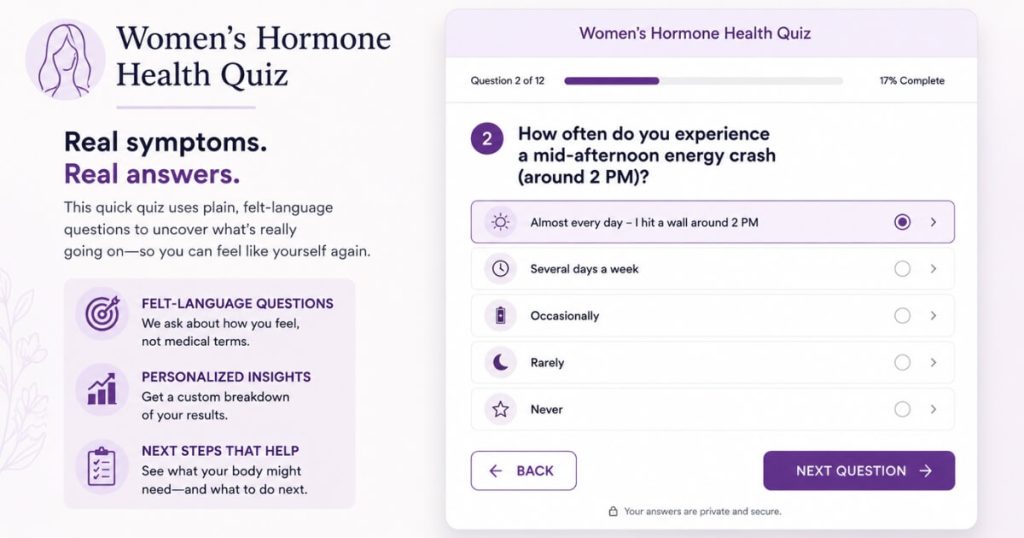
Ask about the symptoms she already feels and names herself.
That includes:
- Afternoon energy crashes
- Weight that will not move despite clean eating
- Broken sleep
- Mood swings
- Brain fog
- Cycle changes
- Low drive
These are the exact patterns perimenopausal and menopausal women describe in their own lives.
That is why the quiz feels like it was written about her specifically, rather than fired at a demographic.
The scripts that perform pull directly from this list:
- “Exhausted by 2 PM?”
- “Eating clean, moving daily… scale stuck?”
- “Mood swings + broken sleep + weird cycles?”
- “Reading the same email three times?”
- “Hair shedding, skin dry, rings tight?”
- “Craving sugar at night again?”
Each of those is a quiz question waiting to happen.
Phrase every item as a felt experience, never a clinical term.
“Do you hit a wall around 2 PM?” beats “Do you experience diurnal fatigue?”
She answers the first one instantly.
She stumbles on the second.
Add one age-band question, because 30–55 is the core perimenopause-to-menopause window.
That tells you whether HRT is even the right conversation.
Add one goal question too:
- Energy
- Weight
- Sleep
- Mood
That tells you what she came for.
Then capture name, email, and phone to deliver the result.
The symptoms do double duty.
They qualify the lead, and they become the exact language you mirror back in the result page and in every follow-up message.
What ad hook gets women to start a hormone quiz?
Lead with a symptom she feels and a reframe that it is not her fault.
“Eating clean, moving daily… scale stuck?” and “You don’t need more willpower — you need better inputs” outperform generic “Are your hormones balanced?” hooks for one reason.
They name the frustration and remove the shame in the same breath.
The women you want have spent years being told to try harder.
A hook that says the problem might not be her willpower at all stops the scroll because it contradicts what she has been blaming herself for.
“What if it’s not willpower at all?” is a pattern interrupt.
“If willpower isn’t working… measure first” is the bridge to the quiz.
The reliable structure is symptom plus relief:
- State the symptom.
- Promise clarity in 60 seconds.
The symptom might be:
- The 2 PM crash
- Brain fog
- Mood swings
- Weight that will not move
Match the hook to where she is on the awareness ladder.
Problem-aware women respond to raw symptom callouts.
Solution-aware women, who already suspect hormones, respond to:
- “Is it perimenopause or just stress?”
- “Thyroid? Estrogen? Cortisol? Start here.”
Proof-led women respond to:
- “10,000+ women took this quiz — get your plan”
- “See patterns doctors often miss.”
Identity hooks pull their own slice:
- “Moms: running on empty?”
- “Leaders: sharp at work, wiped at home?”
Test five to ten of these in parallel.
The winner is rarely the one you would predict.
And the cheapest leads almost always come from a hook you did not expect.
What should the quiz result page say to convert into a booked consult?
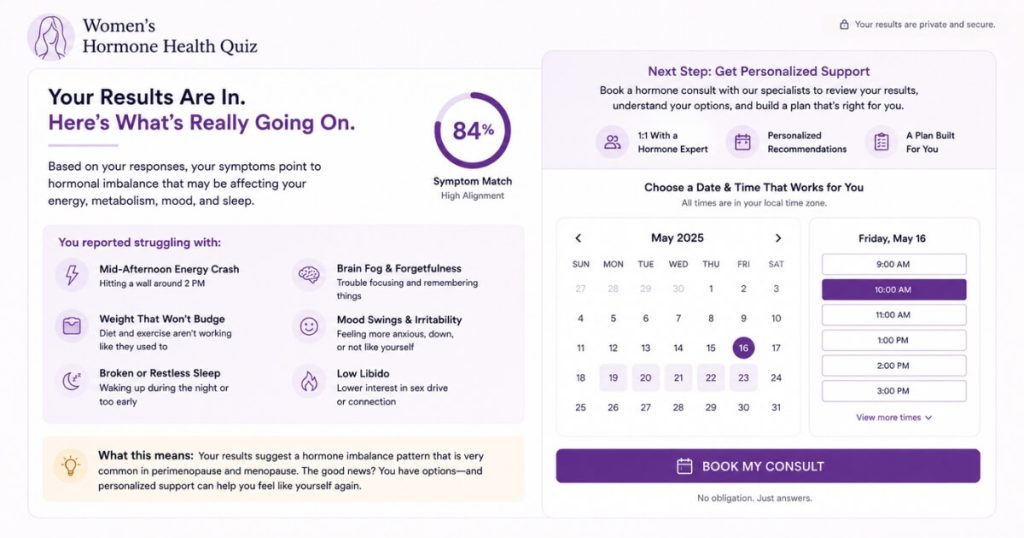
Mirror her symptoms back, name the likely pattern in plain language, and make the consult the obvious next step.
Not a hard sell.
The result page is where the lead becomes a patient.
The emotional job is captured in one line from the field scripts:
Give her “a plan, not guesses.”
Open by acknowledging exactly what she reported.
For example:
“You told us about the afternoon crashes, the broken sleep, and the weight that won’t budge.”
Then connect it.
Those patterns, together, commonly point to hormone, thyroid, or cortisol involvement.
And the only way to know for sure is to look at her specific picture.
That is the “measure first, then fix the right thing” reframe.
It carries the booking because she has just spent 60 seconds proving to herself that something is genuinely off.
Put a calendar directly on the result page.
Frame the offer as no-cost, no-pressure clarity:
“Free • No pressure • Just clarity.”
A free-labs or complimentary-consult offer keeps the momentum without triggering the defensiveness a hard pitch creates.
This is precisely the model that compounds into recurring revenue.
Eternity Health Partners built a hormone membership base of 250 members on the back of front-end funnels that turn symptom-aware women into long-term patients.
The quiz fills the top.
The membership math is what makes each booked consult worth chasing.
How do you follow up with quiz leads who don’t book right away?
Fast, by text and email, using her own quiz answers as the script.
The moment she finishes the quiz is the highest-intent moment she will ever have with your clinic.
And it decays by the hour.
The first follow-up should fire within minutes, while the symptoms she just reported are still front of mind.
Speed is not optional here.
It is the single biggest difference between a quiz funnel that books and one that leaks.
The good news is that the quiz already wrote your script for you.
Reference what she told you, specifically:
“You mentioned the 2 PM crash and trouble sleeping — those two together are worth 15 minutes to look at.”
That personalization is the entire reason a quiz beats a generic lead form.
Do not waste it on a template blast.
Run a short sequence over the first week:
- Same-day text
- Result-recap email
- Story or testimonial that matches her symptom cluster
- Gentle calendar nudge to close
For the weight-loss segment, use a “Sara did everything right” story.
For the mood-and-sleep segment, use an “Emma thought she was just stressed” story.
Most quiz leads who eventually book do not book on day one.
The follow-up is where the funnel actually earns its keep.
It is also where most clinics quietly throw away the leads they paid for.
Why does a symptom quiz convert better than a regular HRT landing page?
Because it lets her self-diagnose in her own words.
That builds belief in a way no landing page copy can.
A standard HRT landing page asks her to read your claims and trust them.
A quiz flips the dynamic.
It makes her actively recall and report her own symptoms.
By the final screen, she has convinced herself that something is off and that you understand it.
That micro-commitment is psychologically heavier than a click.
And it carries straight through to a higher booking rate.
She is not being sold.
She is being understood.
That is a far more durable foundation for a recurring, high-LTV hormone relationship.
It also hands you dramatically better leads to work.
Before the first call, you already know:
- Her age band
- Her primary goal
- Her exact symptom cluster
So your follow-up is sharper.
Your consult also opens warm instead of cold.
The compounding effect of a well-built funnel is real.
VYVE Wellness saw a 900% increase in leads once the front end was built to qualify and capture the right patients rather than just collect clicks.
The quiz is doing qualification, education, and rapport-building in 60 seconds that a landing page simply cannot.
That is why, for women’s hormone and HRT, it is the front-end offer worth building first.
FAQ’s About Women’s Hormone Quiz Funnels
How long should a women’s hormone symptom quiz be?
Six to eight questions, completable in about 60 seconds — and you should say so on the ad and the first screen.
The whole promise of the funnel is speed and ease:
“60 seconds, zero jargon, free.”
Every extra question past the eighth one drops your completion rate.
A half-finished quiz produces no lead and no insight.
Keep the symptom questions to five or six.
Add one or two qualifying questions, usually age band and goal.
Then put the contact capture at the end as the gate to the personalized result.
If you find yourself wanting a longer quiz, that is a sign you are trying to do the consult inside the funnel.
Do not.
The quiz qualifies and captures.
The consult diagnoses.
What questions should a women’s hormone quiz actually ask?
Ask about the symptoms she already feels and names herself.
That includes:
- Afternoon energy crashes
- Weight that will not move despite clean eating
- Broken sleep
- Mood swings
- Brain fog
- Cycle changes
- Low drive
These are the exact patterns perimenopausal and menopausal women describe.
So the quiz feels like it was written about her specifically.
Phrase each as a felt experience, not a clinical term.
“Do you hit a wall around 2 PM?” beats “Do you experience diurnal fatigue?”
Add one age-band question.
The 30–55 range is the core window.
Add one goal question:
- Energy
- Weight
- Sleep
- Mood
Then capture name, email, and phone to deliver the result.
The symptoms double as both qualification and the language you mirror back in the result and follow-up.
What ad hook gets women to start a hormone quiz?
Lead with a symptom she feels and a reframe that it is not her fault.
“Eating clean, moving daily… scale stuck?” and “You don’t need more willpower — you need better inputs” outperform generic “Are your hormones balanced?” hooks.
Why?
Because they name the frustration and remove the shame at the same time.
The strongest pattern is symptom plus relief.
State the symptom, then promise clarity in 60 seconds.
The symptom might be:
- 2 PM crash
- Brain fog
- Mood swings
- Weight that will not move
Match the hook to awareness.
Problem-aware women respond to symptom callouts.
Solution-aware women respond to:
- “Is it perimenopause or just stress?”
- “Thyroid? Estrogen? Cortisol? Start here.”
Proof-led women respond to:
- “10,000+ women took this quiz.”
Test several.
The winner is rarely the one you would guess.
What should the quiz result page say to convert into a booked consult?
Mirror her symptoms back, name the likely pattern in plain language, and make the consult the obvious next step.
Not a hard sell.
The result should feel like “a plan, not guesses.”
Acknowledge what she reported.
Then explain that those patterns commonly point to hormone, thyroid, or cortisol involvement.
From there, say the only way to know for sure is to look at her specific picture on a short call.
Put a calendar directly on the result page.
The reframe “measure first, then fix the right thing” carries the booking because she has just spent 60 seconds proving to herself that something is off.
Free labs or a no-pressure consult as the offer keeps the momentum without scaring her away.
How do you follow up with quiz leads who don’t book right away?
Fast, by text and email, using her own quiz answers as the script.
The quiz is the highest-intent moment she will have.
So the first follow-up should fire within minutes, while she still feels the symptoms she just reported.
Reference what she told you:
“You mentioned the 2 PM crash and trouble sleeping; those two together are worth 15 minutes to look at.”
That personalization is what separates a quiz funnel from a generic lead form.
Run a short sequence over the first week:
- Same-day text
- Result recap email
- Story or testimonial that matches her symptom cluster
- Gentle calendar nudge
Most quiz leads who eventually book do not book on day one.
The follow-up is where the funnel actually earns its keep.
Why does a symptom quiz convert better than a regular HRT landing page?
Because it lets her self-diagnose in her own words.
That builds belief in a way no landing page copy can.
A standard landing page asks her to read your claims and trust them.
A quiz makes her actively recall and report her own symptoms.
By the end, she has convinced herself that something is off and that you understand it.
That micro-commitment raises both lead quality and booking rate.
It also gives you better leads to work.
Before the first call, you know:
- Her age band
- Her primary goal
- Her exact symptom cluster
So your follow-up and consult are sharper.
The quiz is doing qualification, education, and rapport-building in 60 seconds that a landing page cannot.