
How Do I Scale a Regenerative Medicine Practice Beyond the Founding Doctor?
Most regenerative and stem cell practices are built on one person: the founding doctor’s name, reputation, and hands. That’s what got the practice to where it is — and it’s also the ceiling. When you’re the brand, the salesperson, and the provider, growth caps at your calendar, and the practice can’t be sold or stepped back from. This is the FAQ on how to scale a regenerative practice beyond the founding doctor — adding providers and building a brand that survives you, without losing the patient trust you spent years earning.
Why can’t I scale my regenerative practice past my own calendar?
Because the practice is built on you — your name, your reputation, your hands — and you can’t clone a calendar.
Every new patient wants the founder, so growth stops at the number of patients the founder can personally see.
This is the founder’s trap in regenerative medicine specifically: the field runs on trust and authority, and you built both around yourself.
Patients found you, watched your videos, read your reviews, and chose you.
That’s a strength that becomes a cap.
The same trust that drives demand also refuses to transfer to anyone else by default.
Add a provider and patients say “I’ll wait for the doctor.”
More marketing just lengthens your waitlist.
Breaking the ceiling means deliberately moving trust from you, the person, to the practice, the brand.
Then you move it to new providers under that brand.
It’s the same move Dr. Joy Kong made to become the #1 stem cell expert on YouTube, hire four additional doctors, and scale herself out of the day-to-day.
The authority became the clinic’s, not just hers, and the clinic could grow past her schedule.
How do I transfer patient trust from me to a new provider?
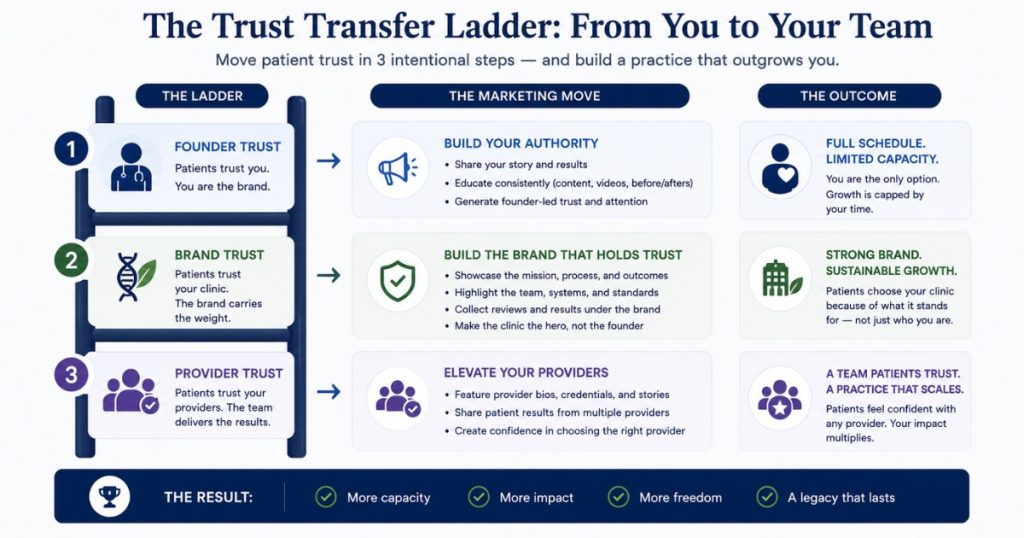
Gradually and on purpose: build the brand’s authority alongside your own, introduce new providers as extensions of your standard, and let patients meet the team through your content before they meet them in the room.
Trust transfers in steps, never in one announcement.
First, the brand has to carry authority independent of you.
That means content, reviews, and education that feature the practice’s philosophy and results, not only your face.
Second, new providers get introduced as people you personally trained and vouch for.
They should be framed as carrying your standard, so the patient’s trust in you becomes a bridge to them.
Third, warm handoffs.
The founder personally introduces a patient to the new provider for the next phase, so the patient feels passed to good hands rather than handed off.
The marketing has to support all three.
If every ad, video, and page is the founder alone, you’re reinforcing the trap.
Start featuring the team, the protocols, and the patient outcomes as the brand’s.
That way, a patient choosing the clinic is choosing the standard, not just the person.
When should a regenerative practice hire its second provider?
When the founder’s schedule is the constraint on growth and the operational base — front desk, intake, consult process, follow-up — is solid enough that a new provider inherits a working machine instead of chaos.
Hiring a provider too early, before the systems are built, just spreads the founder thinner.
They end up training, supervising, and fixing problems on top of seeing patients.
The right time is when demand reliably exceeds the founder’s capacity and the practice runs on documented processes.
That way, the new provider steps into defined patient flow, a proven consult, and a follow-up system, and can be productive quickly.
The hire order matters in regenerative specifically because the clinical reputation is the asset.
You protect it by hiring providers you can train to your standard.
You also protect it by keeping the founder as the keeper of “what good looks like,” even after stepping out of most rooms.
Quality is the brand.
A sloppy second provider can undo years of trust in a month.
How do I market a regenerative clinic so it doesn’t depend on my name?
Build the brand’s authority as a clinic, not a personality.
That means educational content about the conditions and treatments, patient outcome stories, and a recognizable practice identity.
Patients should choose the clinic’s reputation, not just the founder’s.
A founder-dependent practice markets the founder: the doctor’s videos, the doctor’s story, the doctor’s reviews.
A scalable practice markets the standard: how the clinic approaches knees, what its patients experience, why its process works, who its providers are.
The founder can still be the most visible figure.
Dr. Joy Kong stayed prominent while building a brand that featured the team and the science.
But the authority has to belong to the practice so it can be inherited.
Practically, that means content and pages that center conditions and outcomes over the founder’s face.
It also means reviews that mention the clinic and multiple providers.
And it means a brand presence strong enough that a new patient trusts the name on the door.
That’s the foundation of stem cell clinic marketing that scales — authority that lives in the brand, not just the founder.
What has to be in place before a regenerative founder can step back?
Documented clinical and operational processes, a trusted clinical lead, a brand that carries authority without the founder, and a metrics review that lets the founder stay in command without being in the building.
Stepping back isn’t walking away.
It’s replacing yourself one function at a time.
The consult process has to be documented so any trained provider runs it the same way.
The clinical protocols have to be written so the standard is reproducible.
The brand has to hold authority so demand doesn’t collapse when the founder is less visible.
And the founder needs a weekly or monthly numbers review to stay in control of quality and growth from a distance.
Get those in place and the founder can begin scheduling intentional absences.
A week, then a month.
See what breaks, fix it, and repeat.
That’s how a regenerative practice becomes a business that runs without the founder rather than a job that owns them.
It’s also what makes the practice sellable.
A buyer is buying continuity, not the founder’s hands.
Can a regenerative practice keep growing while the founder steps out of the schedule?
Yes — that’s the entire point, and it’s been done.
When authority lives in the brand and providers carry the standard, the practice can grow precisely because it’s no longer capped by one calendar.
The proof is the clinics that pulled it off.
Dr. Joy Kong built the #1 stem cell presence on YouTube, hired four additional doctors, and now runs a practice that operates without her in the daily schedule.
That is growth and founder-removal at the same time, not in tension.
The marketing that featured the team and the science is what made the trust transferable.
The founders who try to grow without doing this work hit the same wall every time:
More marketing, longer waitlist, same revenue ceiling, no exit.
The founders who build transferable authority and a provider team break through.
They end up with a practice worth far more than the sum of their own appointments.
If you want help mapping that transition, a medical practice marketing consultants conversation is where it starts.
FAQ’s About Scaling a Regenerative Practice Beyond the Founder
How do I scale a regenerative practice that’s built on my personal brand?
By deliberately transferring authority from you to the clinic brand, then to new providers.
Build content, reviews, and pages that center the practice’s standard and outcomes rather than only your face.
Introduce providers as people you trained to your standard.
Use warm handoffs so patients feel passed to good hands.
Dr. Joy Kong did exactly this — built the #1 stem cell brand on YouTube, hired four doctors, and scaled out of the daily schedule.
When should I hire a second provider at my regenerative clinic?
When your own schedule is the constraint on growth and your operational systems — intake, consult process, follow-up, protocols — are documented enough that a new provider inherits a working machine.
Hiring before the systems exist just spreads you thinner.
You end up supervising and fixing problems on top of seeing patients.
How do I keep patients from insisting on seeing only the founder?
Transfer trust in steps.
Make the brand carry authority independent of you.
Introduce new providers as extensions of your standard that you personally vouch for.
Have the founder do warm handoffs for the next phase of care.
When patients trust the clinic’s standard rather than only your hands, they accept other providers.
What has to be in place before a regenerative founder can step back?
Documented clinical protocols and consult processes, a trusted clinical lead, a brand that holds authority without the founder, and a regular metrics review.
With those, the founder can replace themselves one function at a time and schedule intentional absences to test what breaks.
That is also what makes the practice sellable.
Will scaling beyond myself hurt my regenerative clinic’s quality or reputation?
Only if you hire faster than you can train to your standard.
The clinical reputation is the asset, so the founder must stay the keeper of “what good looks like” even after stepping out of most rooms.
That means hiring providers you can train, documenting protocols, and reviewing quality on a rhythm.
Done right, scaling protects the reputation by making it reproducible instead of dependent on one person.
What’s the next step?
If your regenerative practice is built on your name and your hands, you’ve hit the founder’s ceiling.
Growth caps at your calendar, and the practice can’t run — or sell — without you.
The way through is to move authority from you to the brand, build a provider team that carries your standard, and document the processes so the clinic becomes a business instead of a job.
On a strategy call we’ll map your transition out of the bottleneck and benchmark it against Dr. Joy Kong, who became the #1 stem cell expert on YouTube, hired four more doctors, and scaled herself out of the day-to-day.
That way, your practice keeps growing while you step back.