
What’s the Right Offer to Launch a Hormone (HRT) Campaign With?
Most clinics launch their first hormone campaign with the weakest offer in the category: a free consultation.
It is the offer every competitor runs. It asks the prospect to give up time before they get anything of value. And it quietly attracts the least serious leads.
The clinics that actually fill their HRT calendars launch with a different structure entirely: a low-friction lead magnet on the front, a concrete intro offer behind it, and a follow-up system fast enough to catch the patient while the decision is still warm.
This is the offer-design playbook for an HRT launch, pulled straight from building these campaigns in the field.
What is the right offer to launch a hormone (HRT) campaign with?
A low-friction hormone quiz or symptom check as the front-end lead magnet, an actual intro offer behind it — not just a free consult — and instant follow-up.
That three-part structure is the offer that gets HRT patients in the door and onto the schedule.
The generic free consultation is the weakest offer in the category because every clinic runs it.
It also asks the prospect to commit time before they receive any value.
The offer that converts gives the prospect something useful for almost nothing: a two-minute hormone or symptom quiz that scores their results and tells them whether HRT is likely a fit.
The quiz is the offer.
It is easy to say yes to, it captures the lead before any sales conversation happens, and it qualifies them at the same time.
Behind the quiz, you put the real reason to book:
- Discounted or free baseline labs
- A first-month membership rate
- A low-cost initial consult with a credit-card hold
- A bundled welcome offer that makes the first visit feel like a deal rather than a sales pitch
The structure matters more than the size of the discount.
A clear front-end lead magnet, a concrete intro offer, and a follow-up system that contacts the lead within minutes will out-convert a bigger discount stapled to a vague free consult every single time.
For the broader picture of how this fits a clinic’s funnel, our med spa marketing framework lays out the surrounding strategy.
Should the HRT offer be a free consult, a lead magnet, or a paid intro visit?
Lead with a free lead magnet to capture volume, then route to a paid intro visit to filter for quality.
The free consult on its own is the worst of both worlds.
It is hard to convert because it asks for time without giving value.
It also attracts tire-kickers because there is no commitment on either side.
A free lead magnet like a hormone quiz pulls in the most leads at the lowest cost, because the offer is easy and the value is immediate.
A paid intro visit — a low-cost telehealth consult booked with a credit card — pulls fewer leads but far higher quality.
Anyone who puts a card down is serious.
The right answer is not to choose.
It is to stack them:
- The quiz captures everyone.
- The follow-up qualifies.
- The paid booking filters for the people who are ready.
That friction is a feature, not a bug.
We have seen a credit-card-required telehealth booking convert 320 leads into 40 paid consults in a single month.
That is roughly a 13 percent rate from lead all the way to a paid booking, which is strong precisely because money was being asked for up front.
A free-consult form might book a higher raw percentage, but the patients who book it are softer and show up at a lower rate.
Decide which problem you are solving — volume or quality — and design the offer ladder so the front captures and the back filters.
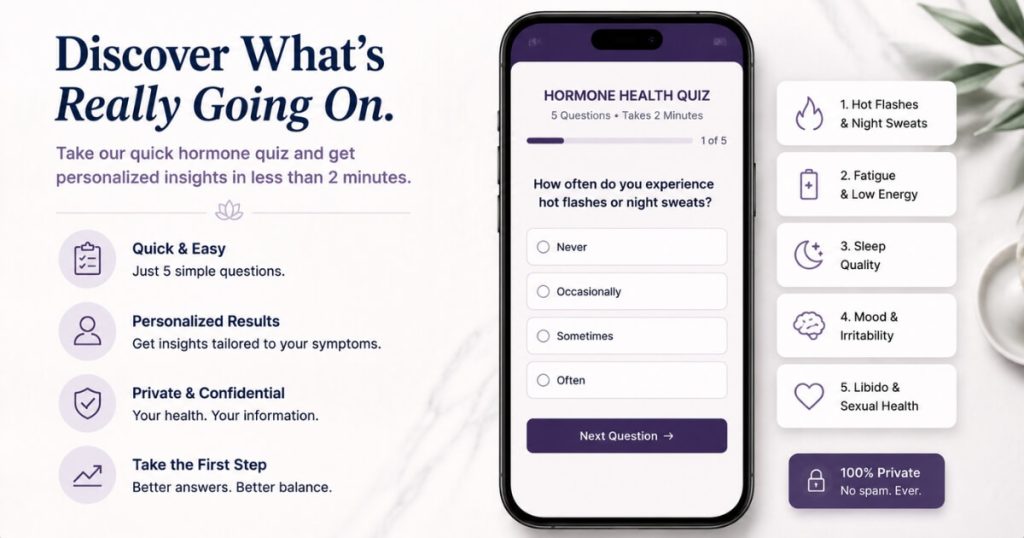
What does a good HRT lead magnet or hormone quiz actually look like?
A short symptom-based hormone quiz — five to eight questions about the patient’s actual experience — that scores the answers and frames HRT as the likely next step.
The quiz should ask about symptoms like:
- Hot flashes
- Fatigue
- Weight
- Mood
- Libido
- Sleep
The quiz speaks to the symptom, never the treatment.
This is the whole reason the quiz outperforms a direct offer.
A woman experiencing hot flashes and brain fog is problem aware, not product aware.
She knows something is wrong, but she is not searching for hormone replacement by name yet.
The quiz meets her where she is.
It mirrors her own symptoms back to her and makes the connection to HRT on her behalf.
By the time she sees her score, she has already concluded that she has a problem worth solving.
And your clinic is the one holding the answer.
Keep the form fields minimal:
- Name
- Phone
- Quiz answers
- At most, one optional convenience field like best time of day to be reached
Every extra field costs you completions.
The quiz should live on a dedicated landing page that only the ad links to.
Nobody else ever sees that page.
That single decision also makes attribution clean.
Anyone who fills out the form came from that specific ad, so the lead can be tagged with its source automatically.
The campaign can then be tracked by channel and state without complicated UTM gymnastics.
The cleaner the tracking, the faster you can tell which creative and which market deserve more budget.
How does the HRT offer connect to a membership or recurring program?
The intro offer is the front door; the membership is the house.
The entire point of the launch offer is to acquire a patient cheaply and convert them into recurring hormone care that compounds in lifetime value over years.
Hormone replacement is the textbook recurring high-LTV cash-pay business.
Patients stay on therapy for years, return for labs and dose adjustments, and refill on a schedule.
That economics is exactly what justifies spending real money to acquire the lead.
The first visit is not where you make your margin.
The membership is.
So the offer ladder runs:
- Quiz
- Intro visit
- Membership
Each rung exists to move the patient to the next.
The intro offer should be priced to remove friction on the first visit.
Then the consult should present the ongoing program as the obvious continuation of care rather than an upsell.
When the symptom relief is real and the relationship is built, the membership sells itself.
Clinics that have constructed the HRT membership model around this kind of front end have turned recurring hormone patients into serious annual revenue.
Our work with Eternity Health Partners and their HRT membership model generating $1.7M a year from SEO shows what the back end of this ladder can become.
The offer you launch with is only ever worth what it feeds into.
Why does speed-to-lead make or break the HRT offer?
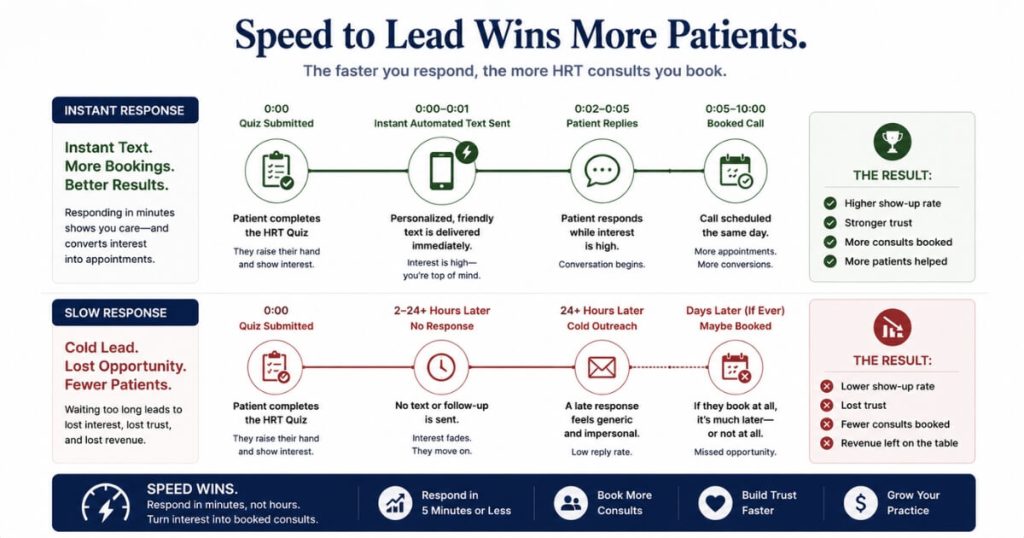
Because social leads are emotional, in-the-moment decisions, and the offer only works if you reach the prospect while their phone is still in their hand.
With hormone campaigns, minutes matter.
Not hours.
And certainly not the next business day.
Picture how the lead is actually generated.
Someone fills out a hormone quiz on TikTok during lunch, while decompressing, or in a spare moment of scrolling.
The emotional commitment to fixing their symptoms is live right then.
Contact them in that window and conversion is high.
That means an automated text should fire the second the quiz is submitted.
It should confirm that you have their results and ask whether they would prefer to schedule by text or by call.
Let them go back to their day, and that same lead goes cold remarkably fast.
The strongest offer in the world underperforms behind slow follow-up.
A modest offer with instant follow-up will beat it.
This is the part most clinics get wrong, and it is the most expensive mistake in the funnel.
Every paid campaign you run is leaving conversions on the table when speed-to-lead is the missing piece.
Not because the ads are bad.
Not because the offer is weak.
But because the lead was already gone by the time anyone called.
If real-time staffing or an outside team to man the phones is not in place yet, a best-time-of-day field on the form is a reasonable stopgap.
But understand that it caps your conversion.
The clinics that win build the follow-up engine first, then turn the ads up.
Which channel and budget should you launch the HRT offer on first?
TikTok is the lead channel for a women’s HRT launch.
Target women 45 and up who are engaged online shoppers, start around $50 per day per market, and scale once the cost per lead settles.
HRT for women overlaps heavily with the medspa-aesthetic audience that already lives on the platform.
Testimonial-style and symptom-story video creative outperforms polished brand ads here, because the prospect is responding to a feeling she recognizes, not a logo.
A real-world benchmark sets expectations.
An optimized women’s HRT campaign running at $100 a day produced leads at roughly $10 each after about four months of optimization.
But it started near $20 a lead at launch.
Expect a higher cost per lead early and budget for the optimization curve rather than judging the campaign in its first week.
Run separate campaigns per state or market so you can track and scale by location.
Target the driving radius around each clinic.
Then narrow the audience to engaged shoppers because they click and convert at a higher rate.
Layer the always-on hormone channels underneath the paid launch:
- SEO
- GMB
Those channels capture the product-aware patients searching for HRT by name.
That is a different and more ready buyer than the one you interrupt on TikTok.
We saw this whole stack compound at NuLevel Wellness Medspa, where we drove 3,727 new patients by pairing front-end paid demand with the search layer underneath.
Pick one lead channel.
Prove the offer.
Then go wide.
FAQ’s About Launching an HRT Campaign Offer
What is the right offer to launch a hormone (HRT) campaign with?
A low-friction hormone quiz or symptom check as the front-end lead magnet, an actual intro offer behind it — not just a free consult — and instant follow-up.
That is the offer that gets HRT patients in the door.
The generic free consultation is the weakest offer in the category because every clinic runs it.
It asks the prospect to commit time before they get any value.
The offer that converts gives the prospect something useful for almost nothing: a two-minute hormone or symptom quiz that scores their results and tells them whether HRT is likely a fit.
The quiz is the offer.
It is easy to say yes to, it captures the lead before any sales conversation, and it qualifies them at the same time.
Behind the quiz, you put the real reason to book:
- Discounted or free baseline labs
- A first-month membership rate
- A low-cost initial consult with a credit-card hold
- A bundled welcome offer
The structure matters more than the discount.
A clear front-end lead magnet, a concrete intro offer, and a follow-up system that contacts the lead within minutes will out-convert a bigger discount attached to a vague free consult every time.
Should the HRT offer be a free consult, a lead magnet, or a paid intro visit?
Lead with a free lead magnet to capture volume, then route to a paid intro visit to filter for quality.
The free consult on its own is the worst of both worlds.
A free consult is hard to convert because it asks for time without giving value.
It also attracts tire-kickers because there is no commitment.
A free lead magnet like a hormone quiz pulls in the most leads at the lowest cost because the offer is easy and the value is immediate.
A paid intro visit — a low-cost telehealth consult booked with a credit card — pulls fewer leads but far higher quality.
Anyone who puts a card down is serious.
The right answer is to stack them:
- The quiz captures everyone.
- The follow-up qualifies.
- The paid booking filters.
We have seen a credit-card-required telehealth booking convert 320 leads into 40 paid consults in a month.
That is about a 13 percent rate from lead to paid booking, which is strong precisely because money was being asked for up front.
What does a good HRT lead magnet or hormone quiz actually look like?
A short symptom-based hormone quiz — five to eight questions about the patient’s actual experience — that scores the answers and frames HRT as the likely next step.
The quiz should cover symptoms like hot flashes, fatigue, weight, mood, libido, and sleep.
The power of the quiz is that it speaks to the symptom, not the treatment.
A woman experiencing hot flashes and brain fog is problem aware, not product aware.
She knows something is wrong, but she is not searching for hormone replacement by name yet.
The quiz meets her where she is.
It mirrors her symptoms back to her and makes the connection to HRT for her.
Keep the form fields minimal:
- Name
- Phone
- Quiz answers
- One optional convenience field, like best time of day to be reached
Every extra field costs you completions.
The quiz lives on a dedicated landing page that only the ad links to.
That also makes attribution clean.
Anyone who fills it out came from that specific ad, so you can tag the source automatically and track the campaign without complicated UTM gymnastics.
How does the HRT offer connect to a membership or recurring program?
The intro offer is the front door; the membership is the house.
The whole point of the launch offer is to acquire a patient cheaply and convert them into recurring hormone care that compounds in lifetime value.
Hormone replacement is the textbook recurring high-LTV cash-pay business.
Patients stay on therapy for years, return for labs and adjustments, and refill on a schedule.
That economics is what justifies spending real money to acquire the lead.
The first visit is not where you make your margin.
The membership is.
So the offer ladder runs:
- Quiz
- Intro visit
- Membership
The intro offer should be priced to remove friction on the first visit.
The consult should naturally present the ongoing program as the obvious continuation of care, not an upsell.
Clinics that have built the HRT membership model around this kind of front end have turned recurring hormone patients into seven-figure annual revenue lines.
The offer you launch with is only worth what it feeds into.
Why does speed-to-lead make or break the HRT offer?
Because social leads are emotional, in-the-moment decisions.
The offer only works if you reach the prospect while their phone is still in their hand.
Minutes matter, not hours.
Someone fills out a hormone quiz on TikTok during lunch or while decompressing.
The emotional commitment to fixing their symptoms is live right then.
Contact them in that window and conversion is high.
Let them go back to their day and the same lead goes cold fast.
The strongest offer in the world underperforms if the follow-up is slow.
A modest offer with instant follow-up will beat it.
The ideal is an automated text the moment the quiz is submitted.
It should confirm you got their results and ask whether they would prefer to schedule by text or call.
Then a real human should follow up as fast as possible.
If real-time staffing is not in place yet, a best-time-of-day field is a reasonable stopgap.
But it caps your conversion.
Every paid campaign you run underperforms its potential when speed-to-lead is the missing piece.
Which channel and budget should you launch the HRT offer on first?
TikTok is the lead channel for a women’s HRT launch.
Target women 45+ who are engaged online shoppers.
Start around $50 per day per market and scale once the cost per lead settles.
HRT for women overlaps heavily with the medspa-aesthetic audience that lives on TikTok.
Testimonial-style or symptom-story video creative outperforms polished brand ads.
A real-world benchmark: an optimized women’s HRT campaign running at $100 a day produced leads at roughly $10 each after about four months of optimization.
It started near $20 a lead at launch.
So expect a higher cost per lead early and budget for the optimization curve.
Run separate campaigns per state or market so you can track and scale by location.
Target the driving radius around each clinic.
Then narrow to engaged shoppers because they click and convert at a higher rate.
Layer in Google, SEO, and GMB as the always-on hormone layer underneath the paid launch.
Those capture the product-aware patients searching for HRT by name.