
Why Doesn’t My Regenerative Medicine Website Convert High-Ticket Consults (And How Do I Fix It)?
Most regenerative and stem cell clinics don’t have a traffic problem — they have a conversion problem. Visitors land on the site, skim it, and leave without booking. A high-ticket regenerative patient is making a $5,000–$25,000 decision, and a website built like a brochure won’t carry that decision. This is the FAQ on why your regenerative website isn’t booking consults — and the page structure that did, including a clinic that converted leads to booked appointments at 79.4% with zero ad spend.
Why does my regenerative medicine website get traffic but not book consults?
Because the site is built to describe your services instead of helping a specific patient decide that you can fix their specific problem.
Traffic without consults almost always means the page is answering “what do you offer” when the visitor is asking “can you help my knee, and can I trust you with it.”
A regenerative or stem cell patient is not an impulse buyer.
They are weighing a multi-thousand-dollar, out-of-pocket decision.
Usually, they’ve already tried injections, physical therapy, or were told surgery was the only option.
Your website has to do three jobs in order:
- Prove the problem they have is one you treat every day.
- Prove your outcomes are real.
- Make booking a consult feel like a small, safe next step rather than a commitment to the whole treatment.
Most regenerative sites do none of these.
They lead with a hero image of a stock-photo doctor and a menu of acronyms (PRP, BMAC, exosomes) the patient can’t map to their own pain.
The fix is structural, not cosmetic.
The clinics that convert organic traffic into booked consults built their site as a patient acquisition system, not a brochure.
Every page is engineered to move a problem-aware patient one step closer to the calendar.
What page structure actually converts regenerative and stem cell consults?
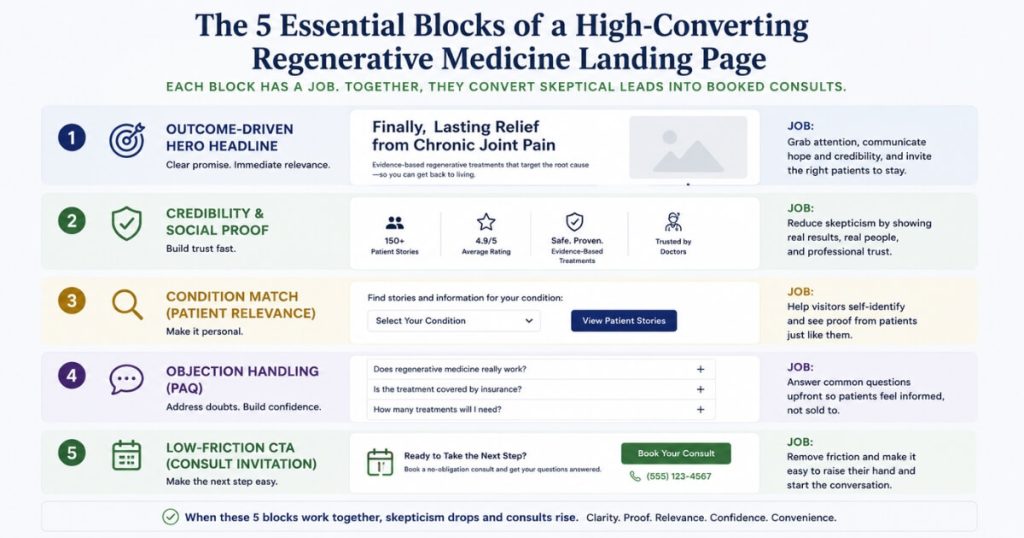
A five-block structure:
- An outcome-led headline
- A proof bar
- A condition-match section
- An objection-handling FAQ
- A single low-friction consult call-to-action repeated down the page
Block one is the headline.
It names the outcome and the patient, not the procedure.
“Get back to walking without knee surgery” beats “Advanced Regenerative Orthobiologics.”
Block two is proof, placed high.
Include years in practice, number of procedures performed, real patient results, physician credentials, and any research or society affiliations.
Block three is the condition match.
Let the visitor self-identify (knee, shoulder, back, neuropathy, hip) and show that you treat exactly that.
A patient who sees their own diagnosis on the page believes you understand them.
Block four is the FAQ.
Handle the real objections out loud:
- Does this actually work?
- Am I a candidate?
- What does it cost?
- Is it covered?
Block five is the consult CTA.
And it has to be low-friction.
We watched this structure work at Orthobiologics Associates, where we generated $309,590 in cash-pay revenue in 10 months from SEO alone and converted leads to booked appointments at a 79.4% rate.
The traffic was organic and the page did the selling.
Patients arrived already half-convinced because the site proved the outcome before it ever asked for the booking.
If you want the same compounding effect, you need a real stem cell clinic marketing foundation, not a redesign of the homepage banner.
Should my regenerative consult be the call-to-action, or should I push patients straight to treatment?
The consult is the call-to-action, always.
Pushing a problem-aware patient straight to a $15,000 treatment decision is the single fastest way to kill conversion.
The job of the website is to book the consult.
The job of the consult is to enroll the treatment.
When clinics try to compress those two steps into one — “Book your stem cell therapy now” — they ask for a decision the patient isn’t ready to make on a webpage.
The patient leaves to “think about it.”
Which means they leave to search for a competitor who made the next step smaller.
The CTA should be a consult, an evaluation, or a candidacy assessment.
Something that feels like gathering information, not signing up.
Lower the friction further by making the CTA specific and time-bound.
“See if you’re a candidate for regenerative knee treatment” converts better than “Contact us.”
The patient acquisition system behind the page then takes over.
Fast follow-up. A real phone conversation. A consult that does the high-ticket selling in person, where it belongs.
How much proof does a regenerative website need to overcome skepticism?
More than you think.
Regenerative medicine carries a built-in credibility tax, so proof has to be stacked, specific, and visible without scrolling.
Patients researching stem cell and PRP have read the skeptical headlines.
They’ve seen “unproven” in the press and “not FDA-approved for that” in forums.
That means a generic “trusted by thousands” banner does nothing.
It reads like every other clinic.
What moves them is specificity.
The exact number of procedures your physician has performed.
The years of focused experience.
Named patient stories with the actual condition and the actual result.
Before-and-after function, not just imaging.
And any teaching, publishing, or society membership that signals you’re part of the legitimate end of the field.
Proof also has to be distributed, not dumped.
A single testimonials page buried in the navigation converts far worse than proof woven into every section.
A credential line under the headline.
A result inside the condition-match block.
A named story beside the FAQ.
The patient should never be more than a screen away from a reason to believe you.
Does the regenerative website matter if I’m running paid ads instead of SEO?
It matters more, not less.
Paid ads make a weak website expensive instead of just ineffective.
When you run ads, you’re paying for every visitor who hits the page.
If the page doesn’t convert, you’re not just losing the patient.
You’re lighting the ad budget on fire to deliver traffic to a leak.
A strong regenerative landing page is what makes paid traffic profitable.
A weak one guarantees a bad return no matter how good the targeting is.
The same five-block structure applies.
Except the proof and the condition-match have to do even more work because ad traffic is colder than organic search traffic.
This is why the clinics with the best return treat the page and the channel as one system.
Organic search built $309,590 in cash-pay revenue for one regenerative practice on the strength of the page alone.
But the same page is what would make a paid campaign convert too.
Fix the page first.
Then turn on the traffic.
Never the other way around.
What’s the fastest fix if my regenerative website is underperforming right now?
Rewrite the headline to name the outcome and the patient.
Move your strongest proof above the fold.
Replace every “Contact Us” with a specific consult CTA.
Those three changes can move conversion before you touch the design.
Most regenerative sites are losing patients in the first five seconds because the headline talks about the clinic instead of the patient’s knee.
Change that first.
Then take your single best proof point — the procedure count, the named result, the credential — and put it where it’s seen without scrolling.
Then make the next step small.
A candidacy check, not a treatment purchase.
None of this requires a rebuild.
It requires reordering what’s already there around the patient’s decision.
After the quick fixes, the durable win is building the site as a real patient acquisition engine.
That means proof-rich pages, condition-specific content, and a consult funnel that compounds with search over time.
The same way it did for the regenerative clinics that now book the majority of their leads without paying for a single click.
FAQ’s About a Regenerative Medicine Website That Converts
How long does it take a new regenerative website to start converting consults?
The page-level conversion improvements — headline, proof placement, consult CTA — can lift booking rates within weeks because they change how existing traffic behaves.
The compounding traffic gains from SEO take longer.
Typically several months.
But they’re what eventually let a regenerative clinic book the majority of its consults without paid ads.
One regenerative practice built $309,590 in cash-pay revenue over 10 months on organic search and a converting page, with no ad spend at all.
Should pricing be on my regenerative medicine website?
Generally no.
Regenerative treatment is a candidacy-and-outcome decision, not a price-shopping decision.
Publishing a number invites comparison-shopping before the patient understands the value.
The better play is to qualify candidacy and build value on the consult.
That’s where your team can frame the investment against the alternative the patient is actually facing.
The website’s job is to book the consult.
The consult’s job is to handle price.
What converts better for a stem cell clinic: a homepage or dedicated condition landing pages?
Dedicated condition pages convert better.
A patient with knee pain who lands on a page about regenerative knee treatment sees their exact problem named and believes you specialize in it.
A general homepage forces them to translate your service menu into their diagnosis.
Many won’t make the leap.
Build condition-specific pages for your highest-volume problems and point both ads and search to them.
How many calls-to-action should a regenerative landing page have?
One CTA, repeated.
Use the same consult action — a candidacy check or evaluation.
Repeat it after the headline, after the proof, after the condition match, and after the FAQ.
Multiple competing CTAs (call, email, download, book, chat) split the visitor’s attention and lower conversion.
One clear next step, offered several times as the patient gets more convinced, converts best.
Do I need testimonials and before-and-afters to convert regenerative consults?
Yes.
Proof is the heaviest lever on a regenerative website because the field carries a credibility tax.
Named patient stories with the real condition and the real functional result help.
So do physician credentials, procedure counts, and any research or teaching affiliation.
All of these reduce the skepticism a regenerative patient brings to the page.
Distribute that proof through every section rather than isolating it on one testimonials page.
What’s the next step?
If your regenerative or stem cell website is pulling traffic but not booking consults, the problem is almost never the design.
It’s that the page describes your services instead of proving you can fix this patient’s problem and making the consult a small, safe next step.
Fix the headline.
Stack the proof.
Turn every CTA into a candidacy check.
You’ll convert more of the traffic you already have.
On a strategy call we’ll pull up your site, map it against the five-block structure that converted leads to booked appointments at a regenerative clinic we grew to $309,590 in cash-pay revenue in 10 months with zero ad spend, and show you exactly where the consults are leaking out.