
How Does a Regenerative or Pain Practice Build a Doctor-to-Doctor Referral Pipeline?
The most valuable patient a regenerative or pain practice can get is the one another doctor sends. They arrive with borrowed trust. They’re already screened as a real candidate. And they convert at a rate cold leads never will. Yet most clinics leave this channel almost entirely untapped. They chase ads while a roomful of orthopedists, PTs, and primary care doctors down the street are sending their tough cases somewhere else. Here’s how to build a deliberate, compliant doctor-to-doctor referral pipeline that becomes one of the most durable growth engines in your practice.
How does a regenerative or pain practice build a doctor-to-doctor referral pipeline?
You build it by identifying the physicians who already see your ideal patients. Make it effortless for them to refer. Then consistently give their patients an outstanding experience and clear communication back.
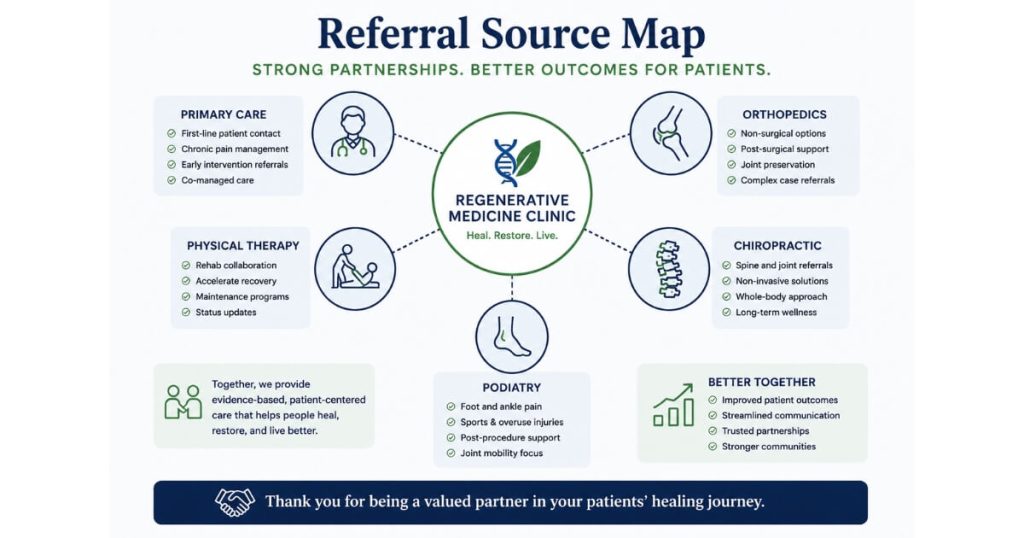
Start by mapping the referral sources that touch the conditions you treat.
Primary care, orthopedics, physical therapy, chiropractic, podiatry, rheumatology, and sports medicine all see patients who are candidates for regenerative or pain treatment.
These patients have often run out of conventional options.
Make referring frictionless with a simple intake process, a dedicated contact, and a clear one-page overview of who you help and how.
Then deliver.
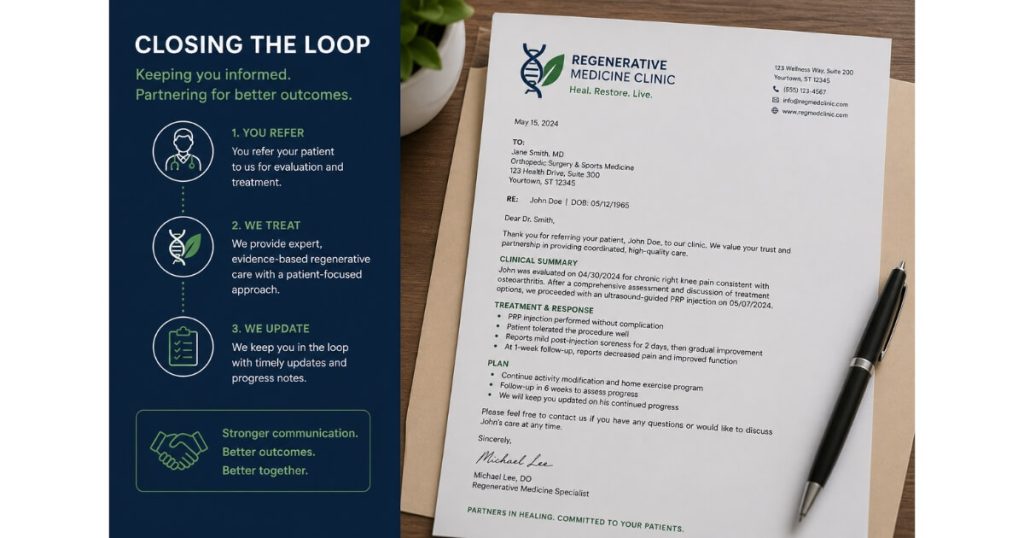
See referred patients quickly, treat them exceptionally, and close the loop by sending the referring doctor a timely note on what you did and how the patient is doing.
The loop-closing is what most clinics skip.
It’s exactly what turns a one-time referral into an ongoing relationship.
Referred patients are the highest-trust, lowest-cost patients you can get because they arrive pre-sold by a doctor they already trust.
Strong pain management marketing includes this professional-referral layer.
We helped a pain-management specialist add over $40,000 a month and cut insurance dependence in half partly by strengthening exactly these relationships and the cash-pay positioning around them.
Why are physician referrals so valuable for a cash-pay regenerative practice?
Because a referred patient arrives with borrowed trust.
That is the single hardest thing to earn in a skeptical, high-ticket, cash-pay category.
When a doctor a patient already trusts says “go see this clinic,” it pre-handles the “does this actually work” and “can I trust them” objections before the patient ever calls.
That trust transfer shortens the sales cycle, lifts conversion, and lowers acquisition cost.
You’re not paying to generate cold demand or to overcome skepticism from scratch.
Physician referrals also tend to be better-qualified.
The referring doctor has already screened the patient as a real candidate for your treatment.
That means your consult time is spent on people who fit.
For a regenerative or pain practice trying to move away from insurance dependence and toward premium cash-pay services, a steady stream of pre-trusted referrals is one of the most durable and profitable patient sources you can build.
It compounds.
It doesn’t churn like paid ads.
And it reinforces your positioning as the specialist other doctors send their tough cases to.
Which doctors should a regenerative or pain clinic target for referrals?
Target the physicians whose patients have hit the limits of conventional care for the conditions you treat.
That includes primary care, orthopedics, physical therapy, chiropractic, podiatry, rheumatology, sports medicine, and neurology, depending on your specialty.
The logic is simple: who sees the patient right before they become a candidate for what you do?
An orthopedic surgeon has patients who aren’t ready for or don’t want a joint replacement.
Those are ideal regenerative-pain candidates.
A physical therapist sees patients who plateau.
A chiropractor sees chronic pain that needs more.
Primary care is the front door for almost everything and refers out constantly.
Prioritize the sources that see the highest volume of your specific conditions.
Also prioritize the ones whose treatment philosophy is compatible with regenerative or interventional pain options.
Don’t try to court every doctor in town.
Build deep relationships with a focused list of high-fit referrers.
A handful of consistent referral partners will outproduce a wide, shallow network.
Quality and fit of the referral source beats sheer quantity.
How do you approach referring physicians without being pushy or violating compliance?
Lead with education and patient value.
Build a genuine professional relationship.
Never offer anything of value in exchange for referrals.
That’s both the ethical and the legal line.
The right frame is collegial, not salesy.
You’re a specialist offering their patients an option for cases where conventional care has run out.
You make their job easier by handling those patients well and keeping them informed.
Practical moves include offering to give a brief educational talk to their staff.
You can share clear case information on the types of patients who do well.
You can invite them to see your facility.
Above all, close the loop with prompt, professional communication on every patient they send.
On compliance, the bright line in healthcare is that you cannot pay for referrals or provide anything of value in exchange for them.
Anti-kickback and self-referral laws are serious.
The relationship must be built on clinical value and trust, not incentives.
Done right, physician outreach is just good medicine and good relationships.
You earn referrals by being the specialist who takes great care of their patients and communicates like a true partner.
(Always confirm your specific outreach with your own healthcare compliance counsel.)
How do you keep referring doctors sending patients over time?
You keep referrals flowing by closing the loop every single time.
Deliver outstanding patient outcomes and experience.
Stay visible without being a pest.
The number one reason referral relationships die is silence.
A doctor refers a patient, hears nothing back, and quietly stops.
Prevent that with a reliable communication system.
Send a prompt note after the initial visit.
Then, send an update on treatment and progress.
Send a thank-you that makes the referring physician look good to their patient.
Beyond communication, the patient experience itself is your retention engine.
When referred patients come back to their primary doctor raving about how they were treated, that doctor refers again.
Stay top of mind with periodic, value-led touchpoints.
That could be a relevant update on a treatment, an invitation to an educational event, or a check-in that isn’t a sales pitch.
Track which sources refer and which have gone quiet.
That way, you can re-engage before a relationship lapses.
Consistency, communication, and outcomes are what turn a referral source into a long-term partner who feeds your practice for years.
Should physician referrals replace or complement your other marketing?
Physician referrals should complement, not replace, your other marketing.
They’re one of the strongest channels, but a healthy regenerative or pain practice runs them alongside SEO, reviews, and paid acquisition.
Referrals are high-trust and low-cost.
But they’re not infinitely scalable on their own.
They can also be slow to build.
Relying on them exclusively leaves you exposed if a key referrer retires or changes course.
The strongest practices treat physician referrals as one durable pillar in a diversified system.
SEO and local search capture the patients actively looking for you.
Reviews and patient stories build the trust that converts them.
Paid ads add reach and speed.
Physician relationships bring pre-trusted, well-qualified cases that convert at the highest rate.
Each channel reinforces the others.
A practice with strong SEO and an established reputation is also a more attractive referral partner.
The referring doctor can see you’re the credible specialist.
This is what well-rounded medical practice marketing looks like.
Build the referral pipeline as a deliberate, ongoing program.
Anchor it inside a broader strategy so your growth never depends on a single source.
That’s the same diversification behind over $2 million in 10 months for a cash-pay pain practice.
FAQ’s About Doctor-to-Doctor Referrals for Regenerative and Pain Practices
How does a regenerative or pain practice build a doctor-to-doctor referral pipeline?
Identify the physicians who already see your ideal patients.
Make it effortless for them to refer.
Consistently give their patients an outstanding experience and clear communication back.
Map referral sources: primary care, orthopedics, PT, chiropractic, podiatry, rheumatology, and sports medicine.
Make referring frictionless with a simple process and dedicated contact.
See referred patients quickly.
Close the loop with a timely note on what you did and how the patient is doing.
Loop-closing is what turns a one-time referral into an ongoing relationship.
Why are physician referrals so valuable for a cash-pay regenerative practice?
Because a referred patient arrives with borrowed trust.
That’s the hardest thing to earn in a skeptical, high-ticket, cash-pay category.
A trusted doctor’s recommendation pre-handles the “does this work” and “can I trust them” objections.
It shortens the sales cycle, lifts conversion, and lowers acquisition cost.
Referrals are also better-qualified.
The referring doctor has already screened the patient as a candidate.
They compound and don’t churn like paid ads.
How do you approach referring physicians without violating compliance?
Lead with education and patient value.
Build a genuine professional relationship.
Never offer anything of value in exchange for referrals.
Offer staff talks, share case information, invite them to your facility, and above all close the loop with prompt communication.
The legal bright line is that you cannot pay for referrals.
Anti-kickback and self-referral laws are serious.
The relationship must rest on clinical value and trust, not incentives.
Confirm specifics with your own compliance counsel.
How do you keep referring doctors sending patients over time?
Close the loop every time.
Deliver outstanding outcomes and experience.
Stay visible without being a pest.
Silence kills referral relationships.
Send a prompt note after the initial visit.
Update on progress.
Send a thank-you that makes the referring doctor look good.
The patient experience itself drives retention.
Referred patients who rave to their primary doctor generate more referrals.
Track which sources have gone quiet and re-engage before relationships lapse.
What’s the next step?
A doctor-to-doctor referral pipeline is one of the highest-trust, lowest-cost, most durable patient sources a regenerative or pain practice can build.
It’s also sitting untapped in almost every market.
Map your high-fit referrers.
Make referring effortless.
Deliver an exceptional experience.
Close the loop relentlessly.
Keep it fully compliant by building the relationship on clinical value, never on incentives.
Then anchor it inside a broader marketing strategy so your growth compounds from every direction.
Real ADvice helps regenerative and pain practices build these professional-referral and cash-pay systems.
From helping a pain specialist add over $40,000 a month and cut insurance dependence in half to adding over $2 million in 10 months for a cash-pay pain practice.
If you want to turn referrals into a deliberate growth engine, that’s the conversation to book.