
Should a Regenerative or Pain Practice Hire an In-House Marketer or a Marketing Agency?
Every growing regenerative and pain practice hits the same fork: do you hire a marketing person to bring it all in-house, or do you partner with an agency?
It feels like a control-versus-cost question, but that framing usually leads owners to the wrong answer.
The real question is what marketing a high-ticket regenerative practice actually requires — and whether one salary can deliver it.
Here’s an honest breakdown of what each option really costs, what each one delivers, and how to decide which fits your clinic at its current stage.
Should a regenerative or pain practice hire an in-house marketer or a marketing agency?
Most regenerative and pain practices are better served by a specialized agency until they’re large enough to build a full in-house team.
The reason is simple: one in-house salary buys one person’s skill set, while an agency buys an entire team’s.
Marketing a high-ticket regenerative practice well requires:
- SEO
- Paid ads
- Creative
- Copy
- Web
- Analytics
- Conversion expertise
All of those disciplines have to work together.
No single hire is strong at all of them.
A good agency brings the whole stack.
It also brings pattern recognition from running campaigns across many similar clinics.
In many cases, that comes for less than the loaded cost of two or three specialists.
The in-house option becomes compelling later.
That happens once you’re spending enough and have enough volume to justify a real team.
Even then, most mature practices keep a hybrid.
They use an internal marketing lead who owns the brand and the numbers, with an agency supplying the specialized execution.
This build-versus-buy call is one of the most consequential decisions a practice owner makes.
It’s exactly where experienced medical practice marketing consultants earn their keep.
They help you match the model to your stage instead of overbuilding too early or undersupplying a function your whole pipeline depends on.
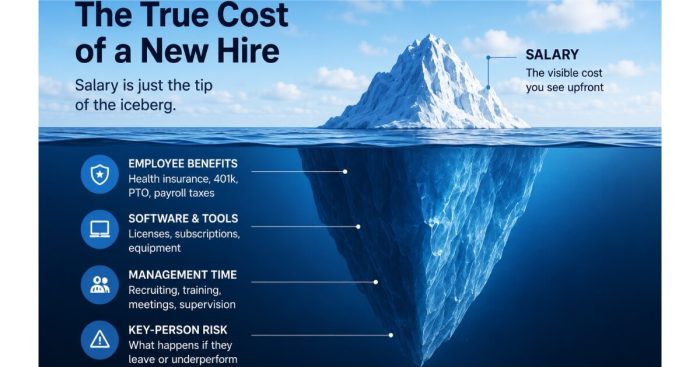
What does an in-house marketer actually cost a regenerative practice?
Far more than the salary.
In many cases, it costs more than a comparable agency once you load in benefits, payroll taxes, software, training, and the management time the owner has to spend.
A single competent marketer is a meaningful annual salary.
On top of that comes:
- 20–30% in benefits and overhead
- Ad platforms
- SEO tools
- Design software
- Analytics tools
- Hiring and management time
And you’re still buying just one skill set.
A great paid-ads person is rarely also a great SEO, copywriter, web developer, and analyst.
If they leave, your marketing leaves with them.
Then you start over.
The salary number is the smallest part of the real cost.
The bigger costs are the coverage gaps and the key-person risk of betting your entire patient pipeline on one individual.
This is the same lesson the best practices learn about all of their medical practice marketing.
A single point of failure is a liability.
That could be:
- One channel
- One referral source
- One person who holds all the knowledge
A team — internal, external, or blended — is more durable than a hero.
What does a marketing agency give a regenerative or pain clinic that an in-house hire can’t?
A full team of specialists, cross-clinic pattern recognition, and a system that doesn’t break when one person quits.
With an agency, you get:
- SEO talent
- Paid media talent
- Creative talent
- Copy talent
- Web talent
- Analytics talent
All at the same time.
That is very different from one generalist trying to cover all of it.
The most valuable thing they bring is pattern recognition.
An agency that has run dozens of regenerative and pain campaigns already knows which offers, channels, and funnels convert in this niche.
As a result, you skip the expensive trial-and-error an in-house hire would have to learn on your dime.
You also get continuity and accountability.
The system and the playbooks stay even if an individual rolls off.
A good agency reports to the numbers rather than to a job title.
That niche pattern recognition is what produced results like $309,590 in cash-pay revenue in 10 months from SEO alone at a 79.4% conversion rate.
A single in-house generalist would have spent a year just learning what a specialized team already knew on day one.
The trade-off is less moment-to-moment control and a partner you have to manage well.
That’s why the relationship works best when you keep ownership of strategy and brand in-house.
When does it make sense for a regenerative practice to build an in-house marketing team?
When your spend and volume are large enough that a full in-house team is cheaper than agency fees.
It also makes sense when marketing has become core enough that you want it fully under your roof.
That threshold is higher than most owners think.
A real in-house team isn’t one person.
It’s a marketing lead plus specialists or contractors for:
- SEO
- Ads
- Creative
- Web
That structure only pencils out at significant scale.
The cleaner first step for a growing practice is to hire one internal marketing lead.
That person owns:
- The brand
- The strategy
- The weekly numbers
An agency then handles the specialized execution underneath them.
Going fully in-house too early usually means paying a full salary for partial coverage.
It also reintroduces the key-person risk you were trying to avoid.
The regenerative practices that have scaled their brand the furthest tend to build a team and a system rather than lean on one person.
That’s the way a regenerative physician became the number one stem cell expert on YouTube and hired four additional doctors.
The growth came from building durable infrastructure, not a one-person marketing department.
Build the team when the math and the volume clearly justify it.
Don’t do it simply because owning it feels safer.
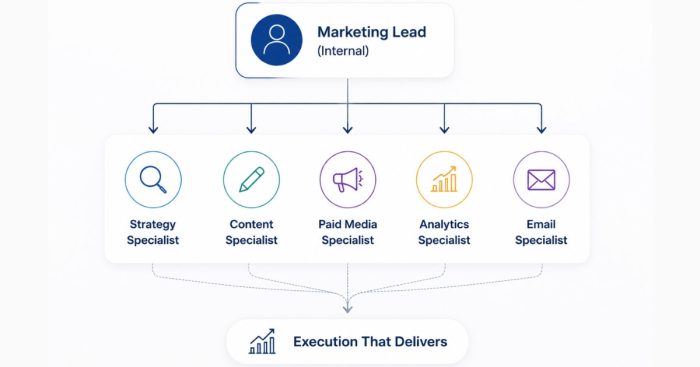
Can you do both — use an agency and an in-house marketer at the same time?
Yes.
For most growing regenerative and pain practices, the hybrid is the best model.
That means:
- An internal marketing lead who owns strategy, brand, and the numbers
- An agency that supplies the specialized execution
The hybrid gives you the best of both.
Your internal lead keeps the brand voice consistent.
They hold the agency accountable to the weekly metrics.
They also make sure marketing stays aligned with how the clinic actually sells and delivers care.
The agency brings the depth of specialists and the niche pattern recognition that a single hire can’t.
Together, they cover more ground than either could alone.
The structure also removes key-person risk because the system lives in the partnership, not in one head.
The common mistake is treating it as either/or and swinging between extremes.
Examples include:
- Firing the agency the moment you hire someone internal
- Expecting one overwhelmed in-house person to do everything
The clinics that grow most smoothly evolve the mix over time.
Agency-led early.
An internal lead added as they scale.
More brought in-house only once the volume and spend justify it.
The model should change as the practice changes.
How do you decide between hiring in-house and hiring an agency for your clinic?
Decide on four factors:
- Your budget
- The breadth of skills you need
- How fast you want results
- How much you want to manage
If you need SEO, ads, creative, and conversion all working now, and your budget won’t cover three or four specialists, an agency wins.
You get the whole team and the niche pattern recognition immediately.
You also get less to manage.
If marketing is already core to your business, your volume is high, and you’d rather own the function fully and direct it daily, building in-house starts to make sense.
For most regenerative and pain practices, the right answer is a hybrid that scales with you:
- Agency-led while you grow
- An internal marketing lead added as you scale
- A larger in-house team only once the spend and volume clearly justify it
Match the model to your stage.
Then revisit the decision as you grow.
The worst outcome is overbuilding an expensive in-house department before you need it.
It’s equally risky to starve a function your entire patient pipeline depends on because hiring one person felt cheaper than partnering with a team.
FAQ’s About Hiring an In-House Marketer vs a Marketing Agency for a Regenerative or Pain Practice
Should a regenerative or pain practice hire an in-house marketer or a marketing agency?
Most regenerative and pain practices are better served by a specialized agency until they’re large enough to build a full in-house team.
One in-house salary buys one person’s skill set, while an agency buys an entire team’s.
Marketing a high-ticket regenerative practice well requires SEO, paid ads, creative, copy, web, analytics, and conversion expertise all at once.
No single hire is strong at all of them.
A good agency brings the whole stack, plus pattern recognition from running campaigns across many similar clinics.
The in-house option becomes compelling later, once you’re spending enough and have enough volume to justify a real team.
Even then, most mature practices keep a hybrid model.
What does an in-house marketer actually cost a regenerative practice?
Far more than the salary.
Once you load in benefits, payroll taxes, software, training, and management time, an in-house marketer often costs more than a comparable agency.
A single competent marketer is a meaningful annual salary plus 20–30% in benefits and overhead.
You also pay for ad platforms, SEO tools, design software, analytics, and the time required to hire, direct, and review them.
The bigger costs are the coverage gaps and the key-person risk of relying on one individual.
What does a marketing agency give a regenerative or pain clinic that an in-house hire can’t?
A full team of specialists, cross-clinic pattern recognition, and a system that doesn’t break when one person quits.
With an agency, you get SEO, paid media, creative, copy, web, and analytics talent simultaneously.
An experienced agency already knows which offers, channels, and funnels convert in this niche.
That allows you to skip expensive trial-and-error.
You also gain continuity and accountability because the playbooks and systems remain in place even if individual team members change.
When does it make sense for a regenerative practice to build an in-house marketing team?
It makes sense when your spend and volume are large enough that a full in-house team costs less than agency fees.
That threshold is higher than most owners think.
A real in-house team is not one person.
It includes a marketing lead plus specialists or contractors for SEO, ads, creative, and web.
The cleaner first step is often hiring an internal marketing lead while keeping an agency for specialized execution.
Build the team when the math and the volume clearly justify it.
How do you decide between hiring in-house and hiring an agency for your clinic?
Decide based on your budget, the breadth of skills required, the speed of results you need, and how much you want to manage.
If you need multiple marketing disciplines working immediately and can’t justify several specialist salaries, an agency usually wins.
If marketing is already core to the business and you want full ownership of the function, building in-house becomes more attractive.
For most regenerative and pain practices, a hybrid model is the most practical path.
What’s the next step?
The in-house-versus-agency decision comes down to your stage, not your preference.
Early and growing, a specialized agency gives you the whole marketing team and the niche pattern recognition for less than the loaded cost of two or three specialists.
It also removes the key-person risk of betting your pipeline on one hire.
As you scale, add an internal marketing lead to own the brand and the numbers.
Reserve a full in-house team for when your spend and volume clearly justify it.
The smartest practices run a hybrid and let the mix evolve as they grow.
Real ADvice acts as the specialized marketing team for regenerative and pain practices.
It’s the breadth and niche pattern recognition behind outcomes like $309,590 in 10 months from SEO alone at a 79.4% conversion rate.
If you want help deciding whether to hire, partner, or build a hybrid for your clinic’s current stage, that’s the conversation to book.