
How Should a Regenerative Medicine Clinic Run Google Ads When Stem Cell and PRP Keywords Get Disapproved?
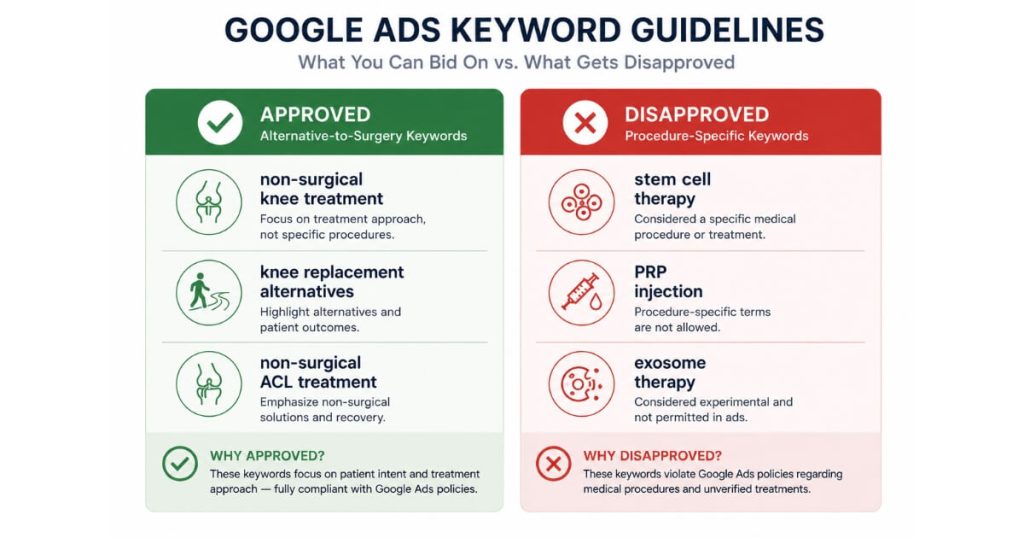
Stem cell, PRP, and exosome keywords get flagged by Google Ads’ “FDA questionable” filter — so the highest-intent search terms for a regenerative medicine clinic are the ones the platform refuses to serve. Here’s the alternative-to-surgery keyword playbook one Fargo regenerative clinic uses to keep ads compliant, the exact CPC math behind the campaigns that work, and the two service lines we tell most regenerative practices to drop from paid search entirely.
Why does Google Ads disapprove stem cell, PRP, and exosome keywords for regenerative medicine clinics?
Google Ads flags stem cell, PRP, exosome, and most direct regenerative keywords as “FDA questionable” healthcare claims and either disapproves the ad outright or limits delivery to near zero.
The platform reads them as therapies the FDA has not approved for the indications most patients search for, so the policy filter blocks the auction before your bid is ever considered.
That means the highest-intent searches a regenerative medicine clinic wants to capture:
- “stem cell therapy for knees”
- “PRP for back pain”
- “exosomes for joint pain”
…are the exact phrases the platform refuses to serve.
Clinic owners who try to fight the disapproval almost always lose; the policy is enforced at the keyword level, not the landing-page level, and Google’s ad reviewers do not negotiate.
The fix is to bid on the alternative-to-surgery angle instead.
That keyword strategy is a core part of effective regenerative medicine marketing, where attracting high-intent patients often depends on matching search behavior instead of promoting specific regenerative therapies.
Patients searching:
- “knee replacement alternatives”
- “non-surgical ACL treatment”
…have the same purchase intent — they want to avoid surgery — but the search phrase itself does not trigger the FDA policy filter.
Clinics struggling with policy restrictions often find that running Google Ads when stem cell and PRP get disapproved requires an entirely different keyword strategy, shifting from treatment-specific terms to surgery-alternative searches that still capture high-intent patients without triggering Google’s healthcare filters.
You land them on a:
“Stop letting pain get in the way of what you love”
…page, then your in-clinic consult sells the actual regenerative therapy.
What Google Ads keywords actually work for a regenerative medicine clinic?
The keyword set that wins is the alternative-to-surgery cluster:
- Non-surgical knee treatment
- Knee replacement alternatives
- Non-surgical ACL treatment
- Non-surgical MCL treatment
- Non-surgical PCL treatment
- Alternatives to ligament surgery
- Non-surgical shoulder treatment
- Non-surgical back pain treatment
- Alternatives to spinal fusion
These pass policy review, capture surgery-averse searchers, and route the click to a landing page where you can describe regenerative options without the policy trip-wire.
A separate compliant cluster works for body sculpting:
- HD LiPo
- FunSculpting
- Non-surgical body contouring
- Non-surgical liposuction alternative
These have looser policy enforcement because the procedure category is recognized as cosmetic rather than medical claim-driven.
Avoid bidding on hair restoration as a regenerative offshoot.
In one mid-sized market we audited, the combined hair restoration search volume across two states was roughly 1,200 searches per month at a $15 average cost-per-click — with a $6 minimum bid and $25 top-of-page bid.
Four clicks cost $100, which is about four times the cost-per-click of body sculpting keywords in the same market.
The math collapses before you book a consult.
How much should a regenerative medicine clinic spend on Google Ads per month?
Start with one campaign at $1,000 per month, not three campaigns at $300 each.
The auction self-throttles to local search volume, so over-budgeting on a low-volume keyword cluster is wasted spend — Google simply won’t find enough searches to deplete the cap.
The right signal that the budget is too low is when the daily spend pegs at the cap for two consecutive weeks.
The right signal that the budget is too high is when:
- The daily cap is $50
- Actual spend runs $30 for two consecutive weeks
That underspend canary metric is how you size every regenerative ads campaign.
We helped a regenerative medicine clinic generate $309,590 in cash-pay revenue in 10 months without any paid ads by leaning into SEO instead — and that’s exactly the right move when your local search volume is too thin to support a $1,000/month campaign at all.
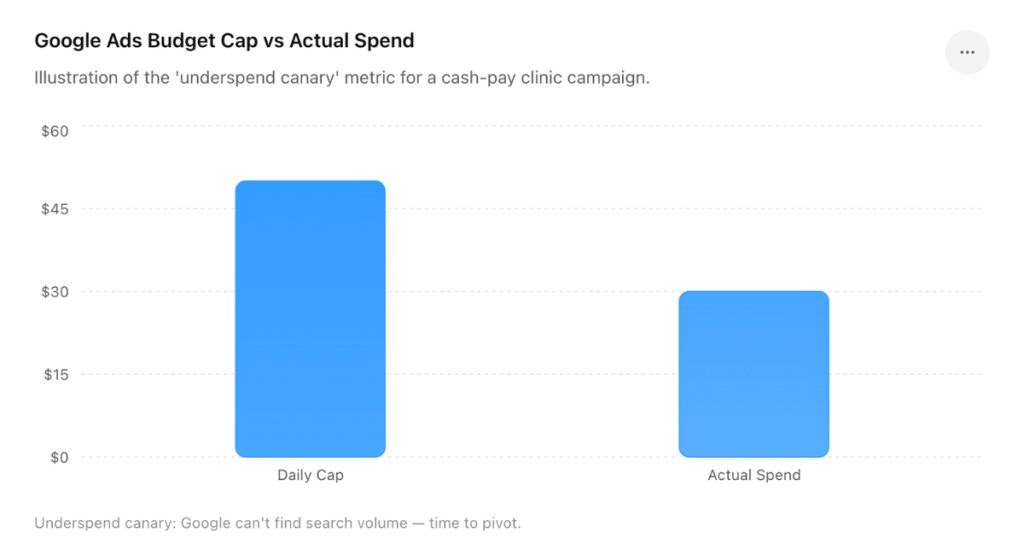
If your $1,000/month campaign throttles down to $600 in actual spend, you have two choices:
1. Widen the keyword set
- Add nearby cities
- Add adjacent body parts
2. Move the budget into an organic-first SEO program
Don’t keep pouring budget into a campaign Google can’t fulfill.
What’s the best gateway offer to convert regenerative medicine Google Ads clicks into booked patients?
A buy-one-get-one PRP joint injection is the cleanest gateway offer for regenerative medicine ads.
The marginal cost is low — material cost on a PRP draw and spin runs about $150, and the patient’s blood is already drawn for the first injection, so the second injection adds minutes, not new supplies.
From a unit economics standpoint, you can afford to discount aggressively because the consult-to-stem-cell-conversion is what actually pays the bill.
The offer also solves the seasonality problem.
Body sculpting demand drops in summer because the procedure requires an eight-week compression-garment downtime that patients won’t accept in beach season.
A PRP-into-stem-cell pipeline runs year-round and gives surgery-averse patients an entry point that doesn’t require any downtime at all.
For the ad creative, lead with the surgery-avoidance angle:
“Considering knee surgery? See what regenerative medicine can do first.”
Land the click on a page that walks through:
- The consult
- The diagnostic
- The patient outcomes
…not a page that opens with “stem cell therapy,” which can re-trigger the policy filter on the destination URL.
Which Google Ads campaigns should a regenerative medicine clinic NOT run?
Two categories almost always lose money for regenerative clinics:
- Hair restoration paid search
- Direct stem cell paid search
We covered the stem cell disapproval issue above; the hair restoration math is the second trap.
Hair restoration in most mid-sized markets carries:
- A $6 minimum bid
- A $25 top-of-page bid
- Roughly $15 average cost-per-click
With four clicks to $100 and a conversion rate to a $5,000–$15,000 ARTAS or robotic hair restoration consult that runs in the low single digits, you’re looking at a $2,500+ cost-per-acquired-patient before factoring in show rates.
Rank organically — most regenerative clinics can land in the top five of their local Map Pack for hair restoration with on-page SEO alone — and route the leads through search, not ads.
The exception is markets larger than 500,000 people where hair restoration search volume exceeds 5,000 per month.
In that case, the volume justifies the CPC.
For everyone else, skip it.
We also tell most regenerative clinics to skip Meta ads as of 2026.
The platform has tightened delivery on medical claims, retargeting pools have shrunk, and what worked on Facebook in 2022 and 2023 — broad-targeted joint pain creative with a discount lead magnet — now gets either disapproved or under-delivered.
Put the budget into:
- Google Ads’ alternative-to-surgery keywords
- Or into the SEO-driven membership model an HRT clinic we grew from $1M to $4M used instead
How should a regenerative medicine clinic measure its Google Ads front-desk conversion?
Measure two KPIs separately:
- Productivity (leads-to-booked-appointments)
- Activity (outbound contacts per day)
They are not the same number and they fail in different ways.
Productivity
Productivity is the conversion rate from a Google Ads lead to a confirmed booked appointment on the calendar.
In one Fargo regenerative clinic we work with, the front-desk coordinator booked five of 22 inbound leads from a FunSculpting Google Ads campaign in a single month — a 23% conversion rate, which is the floor for a regenerative ads program in a small-to-mid market.
- Below 20% → audit the script and the follow-up cadence
- Above 30% → the lead source is high-intent and you should scale spend
Activity
Activity is the raw count of calls, texts, and follow-ups the coordinator makes each day.
When productivity drops, audit activity first.
If leads are sitting for 24 hours before the first outbound call, the answer isn’t lead quality — it’s speed-to-lead.
Track the two metrics on the same weekly dashboard and you’ll see which lever to pull every Monday.