
Should a Regenerative Medicine Clinic Niche Down to One Condition or Market All Its Services?
Most regenerative clinics feel pressure to advertise everything they do — knee pain, shoulder, neuropathy, back pain, hair, aesthetics — because every unadvertised service feels like money left on the table. But trying to market all of it at once is exactly why so many clinics stay stuck. The clinics that grow fastest do the opposite: they niche their marketing to one condition, become known as the place for that problem, and then cross-sell everything else once the patient trusts them. Here’s how to think about niching versus marketing your full menu — and why the answer is “do both, in the right order.”
Should a regenerative medicine clinic niche down to one condition or market all its services?
Niche your marketing down to one condition even though your clinic still offers everything — lead with a specific problem in your messaging, and keep the full menu available once patients are in the door.
The mistake most regenerative clinics make is trying to advertise:
- Knee pain
- Shoulder pain
- Neuropathy
- Back pain
- Hair restoration
- Aesthetics
All in the same campaign.
This produces a vague “we do regenerative medicine” message that speaks to no one.
A patient with knee pain responds to an ad about knee pain, not to a generic list of services.
So you:
- Pick a lead condition with strong demand and good economics.
- Build focused campaigns and dedicated treatment pages around it.
- Become known as the place for that problem.
- Cross-sell your other services to patients once they trust you.
This is the depth-before-width principle:
- Niche the message to win the patient.
- Widen the relationship to grow lifetime value.
It’s the heart of effective stem cell clinic marketing — an orthobiologics practice generated $309,590 in cash-pay revenue in 10 months from SEO alone at a 79.4% conversion rate precisely because the marketing was focused and condition-specific, not a scattered everything-to-everyone pitch.
Niche the marketing, keep the menu.

Why does niching down work so well in regenerative medicine marketing?
Because patients identify with their specific problem, not with your service list, and a focused message converts far better than a broad one.
Message-to-market match is the whole game.
When a person with chronic knee pain sees an ad, a page, or a video that speaks directly to chronic knee pain:
- They feel understood.
- They lean in.
When they see a generic “regenerative medicine clinic” that lists ten things, nothing grabs them.
Niching also makes you:
- Findable
- Rankable
Search and AI assistants reward depth, so a clinic with a deep, specific page on PRP for knee pain will out-rank and out-cite a thin page that mentions twenty treatments.
A focused message lets you:
- Concentrate your ad budget
- Sharpen your creative
- Build authority faster
Because becoming known as the go-to clinic for one condition is achievable while becoming known for everything is not.
It also pre-qualifies the patient:
A knee-pain campaign brings you knee-pain patients, so your consults are spent on people who fit.
Focus compounds into authority, and authority is what wins a trust-first, high-ticket category.
What are the risks of marketing every service at once?
Marketing everything at once dilutes your message, wastes your budget, weakens your search authority, and makes you forgettable in a category where being the specialist is the whole advantage.
When your ads and your website try to speak to every condition:
- No single prospect feels the message was written for them.
- Conversion drops across the board.
Your ad spend gets spread thin across too many audiences and offers, so nothing reaches the depth needed to perform.
Your website becomes:
- A mile wide
- An inch deep
Which is exactly what search engines and AI assistants demote in favor of focused, authoritative pages.
Competitively, a clinic that’s vaguely “full-service regenerative medicine” loses to the one that’s clearly:
- “The knee-pain experts”
- “The neuropathy clinic”
Because patients and referring doctors both gravitate to the specialist.
There’s also an operational cost:
Trying to run great campaigns for many conditions simultaneously usually means running mediocre campaigns for all of them.
The everything-at-once approach feels safe because it leaves no service unadvertised, but in practice it’s the slowest, most expensive way to grow.
How do you pick which condition a regenerative clinic should lead with?
Pick the condition with the best combination of patient demand, treatment economics, your clinical strength, and competitive opening in your market.
Start with demand:
- Which condition do enough people in your area actively search for and seek treatment for?
Knee pain, neuropathy, and joint pain are typically high-volume regenerative niches.
Then weigh economics:
- Which condition supports a strong cash ticket?
- Which condition ideally leads into ongoing or follow-on care?
- Which condition has lifetime value that justifies acquisition cost?
Layer in your clinical strength and outcomes.
Lead with what you genuinely do best, because your proof and patient stories there will be strongest.
Finally, look at the competitive landscape:
- Where are local competitors weak?
- Where are they generic?
- Where can you become the recognized authority fastest?
The goal is to find the overlap of:
- High demand
- Good economics
- Real clinical results
- A winnable competitive position
Then commit your marketing focus there.
If you’re weighing this decision, it’s exactly the kind of call good medical practice marketing consultants help you make.
You can always add a second niche later, but you win fastest by leading with the one condition where you can dominate the local conversation.
Can a regenerative clinic still offer all its services if its marketing is niched?
Absolutely — niching your marketing does not mean dropping services; it means leading with one condition to win the patient, then cross-selling the rest once trust is established.
This is the single most important distinction in this whole question.
Your clinic can and should still offer:
- PRP
- Stem cell therapy
- Neuropathy programs
- Hormone optimization
- Aesthetics
- Everything else
You simply don’t try to advertise all of them at once.
You lead acquisition with your focused niche.
Once a patient is in the door and has had a great experience, you introduce the other services that fit their needs.
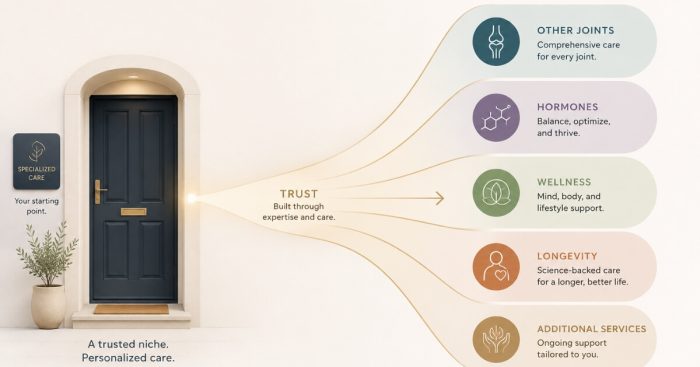
A knee-pain patient who trusts you becomes a candidate for:
- Treating their other joints
- A wellness program
- A hormone program
- Sending their spouse
This is where lifetime value is built:
Focused acquisition plus broad, trust-based cross-selling.
The patient menu stays wide; only the front-door message gets narrow.
Done well, niching the marketing actually increases how much of your full service line gets used, because more patients come in the door and more of them stay and expand.
When does it make sense to expand beyond a single niche?
Expand to a second niche once you’ve established clear authority and a predictable, profitable patient flow in your first one — depth before width, then width on a proven foundation.
The right time to add a second condition is not when you’re impatient, but when your lead niche is genuinely dialed in:
- Campaigns are profitable
- The conversion process is humming
- You’re recognized locally for that condition
- Adding more volume there is hitting diminishing returns
At that point you’ve also built the infrastructure:
- The funnel
- The follow-up system
- The content engine
- The team
That you can point at a second condition far more efficiently than you could have at the start.
Expand by treating the second niche the same disciplined way you treated the first:
- Create a focused message.
- Build dedicated pages and campaigns.
- Develop its own proof.
The authority-led version of this is what made a regenerative physician the number one stem cell expert on YouTube — own a lane, then stack the next.
Avoid the temptation to expand because a niche feels limiting.
A single well-owned condition usually has far more room to grow than owners assume.
Master one, systematize it, then stack the next.
FAQ’s About Niching Down a Regenerative Medicine Clinic’s Marketing
Should a regenerative medicine clinic niche down to one condition or market all its services?
Niche your marketing down to one condition even though your clinic still offers everything — lead with a specific problem in your messaging, and keep the full menu available once patients are in the door.
Advertising knee pain, neuropathy, back pain, and aesthetics in one campaign produces a vague message that converts no one.
Pick a lead condition with strong demand and economics, build focused campaigns and pages around it, become known for that problem, then cross-sell the rest.
Niche the marketing, keep the menu.
Why does niching down work so well in regenerative medicine marketing?
Because patients identify with their specific problem, not your service list, and a focused message converts far better than a broad one.
Message-to-market match means a knee-pain prospect leans in when the message speaks to knee pain and tunes out a generic list.
Niching also:
- Makes you rankable
- Concentrates your budget
- Builds authority faster
- Pre-qualifies patients
Search and AI reward depth, so your consults are spent on people who fit.
What are the risks of marketing every service at once?
It dilutes your message, wastes your budget, weakens your search authority, and makes you forgettable.
No prospect feels the message was written for them.
Ad spend spreads too thin to perform.
Your website goes a mile wide and an inch deep, which search and AI demote.
You lose to the clinic clearly known as the specialist.
It also forces mediocre campaigns across many conditions instead of great ones on a focused niche.
Can a regenerative clinic still offer all its services if its marketing is niched?
Yes — niching the marketing doesn’t mean dropping services; it means leading with one condition to win the patient, then cross-selling the rest once trust is established.
You still offer:
- PRP
- Stem cell
- Neuropathy
- Hormones
- Aesthetics
You just don’t advertise them all at once.
A knee-pain patient who trusts you becomes a candidate for other joints, wellness programs, or referrals.
The menu stays wide; only the front-door message gets narrow.
What’s the next step?
The niche-versus-full-menu question has a clear answer:
Niche your marketing, keep your menu.
Lead acquisition with the one condition where you have the best mix of:
- Demand
- Economics
- Clinical strength
- A winnable market
Build focused campaigns and deep, specific pages around it.
Become the recognized authority for that problem.
Then cross-sell your full service line to patients who already trust you.
That sequence wins the patient and grows the lifetime value at the same time.
Real ADvice helps regenerative and stem cell practices find and own the right niche, the kind of focus behind $309,590 in 10 months from SEO alone at a 79.4% conversion rate and the number one stem cell expert on YouTube.
If you want help deciding which condition to lead with and how to build the marketing around it, that’s the conversation to book.