
Should a Regenerative Medicine Clinic Add a Hormone Membership? (The $300/$300/$300 Model That Built a 320-Member Practice)
A regenerative clinic we consult with was quoting hormones like a menu: $99 consult, $40 lab draw plus lab costs at cost, $50 follow-ups — in the office manager’s words, “nothing set right now.” Meanwhile, a clinic outside Sacramento runs one structured hormone membership model and has 320 members on it. Same medicine. Different architecture. This article is the model we walked through on that call: how to price it, present it, what to include, and the two mistakes that quietly kill hormone memberships.
Should my regenerative medicine clinic add a hormone membership?
Yes.
Procedures create uneven revenue.
By contrast, hormone memberships create a recurring financial floor underneath them.
À-la-carte hormone pricing also leaves much of the value on the table.
Regenerative clinics rely heavily on procedural revenue, including:
- PRP
- Shockwave
- Prolozone
That income arrives in waves.
Then it disappears between treatment cycles.
Hormone care works differently.
It creates a monthly patient relationship that renews itself.
When both service lines operate under one roof, the membership base helps cover fixed costs.
Meanwhile, procedural revenue becomes margin.
The cross-sell also works in both directions.
For example, hormone members with ongoing joint pain can become regenerative medicine consultations.
Likewise, regenerative patients who begin feeling better often ask about:
- Energy
- Sleep
- Libido
However, the model only works when it has a clear structure.
Quoting $99 consultations, at-cost labs, and $50 follow-ups may be clinically generous.
Commercially, though, it has no form.
The patient never joins anything.
As a result, nothing retains them.
The evidence shows why the structure matters.
A clinic outside Sacramento has built 320 members using the model below.
We’ve seen the same model work inside a regenerative practice that enrolled 102 members after restructuring into men’s HRT, women’s HRT and concierge tiers.
Building that recurring engine is the heart of men’s hormone clinic marketing, regardless of your clinic’s original specialty.
How should a hormone membership be priced and presented?
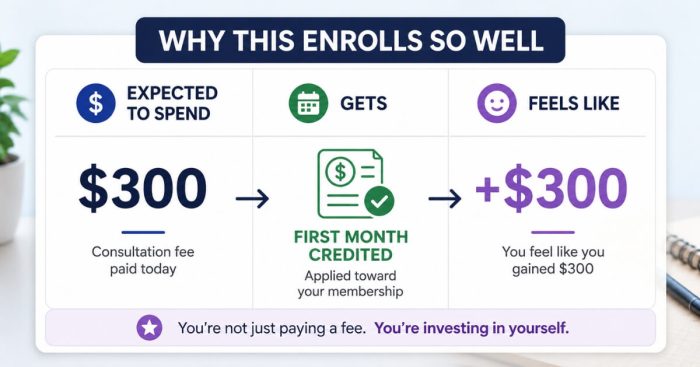
Use three matching numbers:
- $300 for labs
- $300 for the initial consultation
- $300 per month for the program
Then credit the consultation fee toward the first month when the patient enrolls.
The patient journey starts with laboratory testing.
When someone calls, the first step is simply scheduling the labs for $300.
The clinic orders the testing directly.
That protects the patient from insurance surprises.
In some cases, patients who run hormone panels through insurance receive co-pays as high as $1,000.
Next comes the initial consultation.
The visit includes:
- A complete laboratory review
- A discussion of goals
- A symptom review
- Clinical recommendations
The price remains simple:
“The consultation is just $300, the same as the labs.”
Then comes the program close:
“If you decide to move forward on any of our programs, they’re just $300 a month — and you can credit your initial consultation toward your first month.”
The structure converts well because the numbers feel coherent.
The patient already expected to spend $300 on the consultation.
Now that same $300 becomes the first month of care.
Psychologically, it feels as though they gained $300.
The exact prices can change by market.
For example, a smaller market may use:
- $200 for labs
- $200 for the consultation
- $200 per month
The key is the presentation.
Three matching numbers and a consultation credit feel clear and fair.
By comparison, a menu of $99, $40, and $50 charges feels scattered.
The model can also scale with demand.
The Sacramento-area clinic started at $300 per month.
Later, it increased pricing to $350.
Five months ago, the clinic raised it again to $400 because demand supported the change.
At 320 members, that equals more than $100,000 per month in recurring membership revenue.
What should the hormone membership include?
Include everything recurring:
- All follow-up laboratory testing
- All follow-up consultations
- The cost of medications
Then add 15% off everything else the clinic offers.
The monthly fee should make the patient’s ongoing hormone care feel like a complete system.
Follow-up labs should be included.
Follow-up visits should also be included.
Most importantly, medications should be included.
The moment a member is asked to pay separately for something that feels like part of their hormone treatment, the membership’s perceived value begins to crack.
The 15% member discount adds another layer of value.
It may apply to:
- Peptides
- Weight-loss services
- Supplements
- Every other clinic service
That discount does two jobs.
First, it keeps patient spending inside the clinic instead of sending it to a nearby compounding pharmacy.
Second, it creates the feeling of:
“Why would I go anywhere else?”
For example, a member paying $350 per month may also receive discounts on peptides, weight-loss support, and aesthetics under the same roof.
Therefore, they have less reason to shop elsewhere.
For a multi-service regenerative clinic, the hormone membership becomes the central hub.
Every other service can connect to it.
That diversified revenue structure is exactly what helped a pain practice we work with add $2,095,039 in revenue in 10 months.
Why do hormone memberships fail at some clinics?
They usually fail for two reasons:
- Members stop feeling the value.
- Billing doesn’t match the medication supply.
The first problem is familiar.
Patients cancel while saying:
“I’m spending $200 a month on this membership and I don’t really feel like I’m getting any value.”
That’s usually an inclusion problem.
If the monthly fee doesn’t visibly cover:
- Laboratory testing
- Follow-up visits
- Medications
the membership can feel like a subscription to nothing.
The second problem is less obvious.
In our experience, it is one of the biggest differences between successful and unsuccessful hormone membership programs.
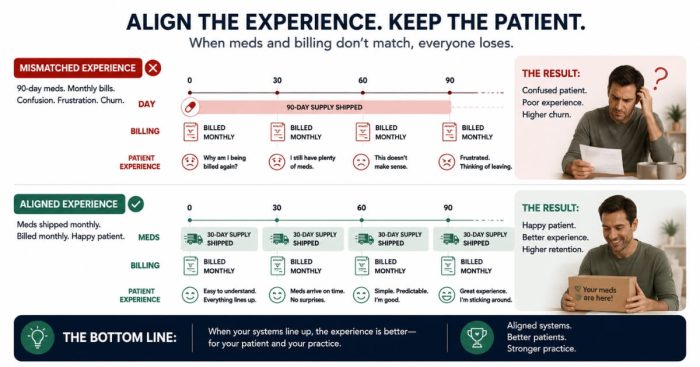
The issue appears when billing doesn’t align with the medication quantity.
For example, a member may receive a 90-day medication supply but still get charged every 30 days.
That can feel strange.
The patient sees:
- Three charges
- One bottle
- A growing suspicion that the membership is only a payment plan
The solution is to own the transaction.
The compounding pharmacy bills the clinic.
Then the clinic ships the medication to the patient.
As a result, the patient connects the medication directly to the monthly membership.
In their mind, that’s what they’re paying for.
Align the billing rhythm with the refill rhythm.
Then every monthly fee corresponds to care being delivered.
Are $6,000–$8,000 hormone programs still sellable in 2026?
Barely.
The market has shifted toward monthly pricing.
Clinics that successfully sold large upfront hormone packages for years are now moving toward consultation-fee-plus-membership models.
One New York clinic we know sold $6,000–$8,000 hormone programs for about a decade.
However, the market has changed.
Patients now compare hormone care like a subscription.
As a result, a large upfront payment often loses to a simpler $400-per-month option.
The clinic adapted by offering:
- A $650 initial consultation
- A $450-per-month membership
- Direct primary care included as the premium value-add
New York does not allow the clinic to charge cash for labs, so the consultation became the entry point instead.
The lesson for a regenerative clinic entering hormone care now is simple.
Skip the big-package era.
Start with monthly pricing.
Use the matching-numbers model on the front end.
Then increase value inside the membership instead of increasing the size of the invoice.
Recurring revenue also wins on lifetime value.
A membership that renews for three years can quietly outperform a $7,000 package sold once.
That’s the same shift we encourage throughout regenerative medicine marketing.
Prioritize durable revenue over dramatic invoices.
Should new hormone patients start on pellets or injectables?
Lead with:
- Injectables
- Creams
- Patches
Offer pellets to patients who specifically ask for them.
The first treatment should reduce commitment anxiety.
A patient can try an injectable, cream, or patch and often notice results within a month.
If it isn’t the right fit, they can stop.
That lowers the perceived risk.
Pellets feel different.
For a new patient, implantation can feel intimidating because:
- It is a procedure.
- The pellet remains in the body for months.
- A simple trial begins to feel surgical.
That creates unnecessary friction at the start of the relationship.
Keep pellets available.
Some patients arrive asking for them, often because a friend recommended them.
However, don’t make pellets the default entry point.
The membership model works because getting started feels simple:
- Labs
- Consultation
- Consultation credit
- Month one
Every extra barrier before the patient feels better can cost you someone who might otherwise remain a member for years.
FAQ’s About Hormone Memberships at Regenerative Clinics
How much should a hormone membership cost per month?
Start around $300 per month.
Include:
- Follow-up labs
- Follow-up consultations
- Medications
Then raise pricing as demand proves the model.
One clinic using this structure increased pricing from:
- $300
- To $350
- Then to $400
It now has 320 members.
In smaller markets, a $200/$200/$200 version of the same model can work.
What do I say when a patient asks why labs don’t go through their insurance?
Explain that clinic-ordered labs create a predictable price.
Insurance-billed hormone panels can leave patients with surprise co-pays as high as $1,000.
By contrast, the clinic’s negotiated rate is fixed and included within the program structure.
Offer the patient the choice.
Most will choose the predictable number.
Should the consult fee really be credited to the first month?
Yes.
That credit is the enrollment engine.
The patient already expected to spend $300 on the consultation.
Applying that payment to month one makes joining feel like receiving $300 back.
Matching numbers plus the credit often outperform cheaper but unstructured à-la-carte pricing.
How should membership billing align with medication refills?
Match billing to the rhythm of care.
A 90-day medication supply billed every 30 days can weaken trust.
Instead:
- Let the pharmacy bill the clinic.
- Let the clinic ship to the patient.
- Make the monthly fee clearly correspond to medication and care being delivered.
Owning the transaction links the prescription to the membership in the patient’s mind.
When should we raise the membership price?
Raise pricing when:
- Demand exceeds capacity
- Retention remains strong
- The value is clearly proven
Increase the price for new members first.
The clinic with 320 members raised prices twice as demand increased.
Existing members who keep their original rate then become a powerful reason for new patients to join before the next increase.
What’s the next step?
If your clinic is still quoting hormone care à la carte with “nothing set,” or your procedural revenue creates great months followed by empty ones, book a strategy call.
In 60 minutes, we’ll structure:
- The three matching prices
- What the membership includes
- How billing should align with medication delivery
- The enrollment script your front desk can use on the next inbound call