
How Do I Reduce No-Shows for High-Ticket Regenerative and Pain Consultations?
Nothing wastes a regenerative or pain practice’s marketing budget faster than a booked consult that never shows up. You paid to generate the lead, your team spent time booking it, and the chair sits empty. No-shows aren’t a patient problem — they’re a system problem, and high-ticket regenerative consults are especially vulnerable because the patient is nervous, the decision is big, and the wait is often long. This is the FAQ on why your consults book and ghost, and the confirmation system that gets serious patients to actually arrive.
Why do regenerative and pain patients book consults and then no-show?
Because the gap between booking and the appointment is empty.
The patient books in a moment of motivation, then hears nothing, the urgency fades, the nerves grow, and by the appointment day the easiest choice is to not show up.
High-ticket regenerative consults are uniquely prone to this.
The patient is contemplating an expensive, out-of-pocket, somewhat intimidating decision.
They booked because the pain or the hope spiked, but doubt creeps back in:
- Maybe it won’t work.
- Maybe it’s too much money.
- Maybe they should wait.
If your practice goes silent between booking and the visit, you’ve left them alone with that doubt.
A long wait time makes it worse because there’s more time for the motivation to drain.
The fix isn’t to chase patients harder on the day.
It’s to keep them engaged and reassured across the whole gap, so by the time the appointment arrives, showing up feels like the natural next step rather than a decision to reconsider.
That’s a system, and it’s the same discipline that lets the best clinics run their patient acquisition at a high show rate.
What confirmation system reduces regenerative consult no-shows?
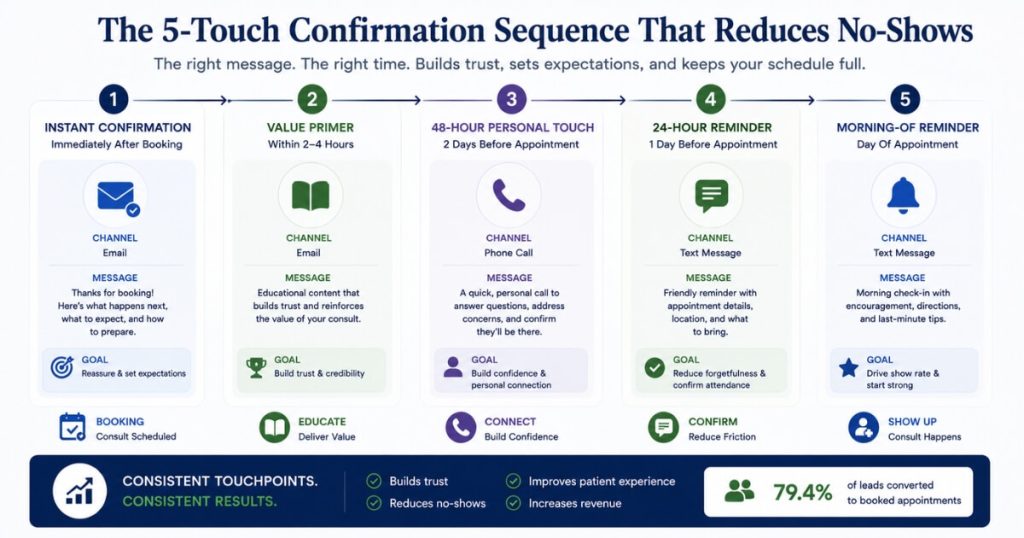
A multi-touch sequence across the gap:
- An instant confirmation
- A value primer
- A personal confirmation call around 48 hours out
- A reminder text the day before
- A morning-of reminder
Several touches. Multiple channels.
Touch one is the instant confirmation the moment they book — email and text — so the appointment feels real.
Touch two, a day or two later, primes value:
- What to expect at the visit
- What the patient will learn
- Maybe a short patient story so the nerves ease and the hope is reinforced
Touch three is the human one:
A real confirmation call around 48 hours out.
This is the single highest-leverage touch because a person answering questions converts a wobbling patient back to committed.
Touch four is a day-before reminder text with logistics.
Touch five is a short morning-of reminder.
The 48-hour call matters most.
A booked patient who talks to a friendly human, gets their question answered, and feels expected will show up far more often than one who only got automated texts.
Most clinics skip the call because it’s work — which is exactly why doing it is an edge.
How much does cutting wait time improve regenerative consult show rates?
A lot.
The longer a patient waits between booking and the consult, the more no-shows you get.
Getting patients in fast is one of the most effective things you can do.
Motivation decays with time.
A patient who books and is seen in two or three days arrives on the same wave of motivation that made them book.
A patient who books and waits two or three weeks has had time for:
- The pain to ease a little
- The budget to feel scarier
- The doubt to win
If your earliest consult slot is far out, you’re manufacturing no-shows before the confirmation sequence even starts.
Practically, hold a few near-term consult slots specifically for fresh leads.
Treat speed-to-appointment as a conversion lever, not just a scheduling detail.
Combined with the confirmation sequence, fast scheduling is what keeps the patient on the motivation wave from booking through to the chair.
Should I require a deposit or credit card to hold a regenerative consult?
For high-ticket regenerative consults, a small refundable deposit or a card-on-file hold can sharply reduce no-shows by adding a little skin in the game — but only if your traffic is warm enough to tolerate the friction.
A deposit works because it converts a free, consequence-free booking into a small commitment.
Patients who put money down show up at much higher rates.
For warm, search-driven regenerative patients who are already serious, a modest refundable deposit credited toward treatment is a clean filter that boosts show rate without scaring off real buyers.
For colder paid-social traffic, a deposit may suppress bookings too much, so test it rather than assume it.
The middle path many clinics use is a card-on-file hold with a clear, gentle no-show policy:
Nothing is charged if they show, but the commitment is real.
Pair that with the confirmation sequence and you protect your provider’s time without building a wall in front of serious patients.
What show rate should a high-ticket regenerative clinic aim for?
High enough that no-shows aren’t a meaningful drag on your provider’s calendar.
The way to get there is to treat show rate as a number you actively manage, not a fact you accept.
Many regenerative clinics quietly tolerate a show rate that’s costing them a third of their booked consults because they’ve decided no-shows are just how it is.
They aren’t.
A clinic with a tight confirmation sequence, fast scheduling, and a deposit or hold can convert a far higher percentage of bookings into kept appointments.
The clinics that book leads at high rates — Orthobiologics Associates converted leads to booked appointments at 79.4% on the way to $309,590 in cash-pay revenue in 10 months — get that conversion because the whole front end, including show rate, is engineered, not left to chance.
Track it monthly.
Attribute the misses to the gap in your system.
Fix the specific touch that’s failing.
Show rate is a managed metric.
The clinics that manage it stop wasting their best leads.
What’s the fastest way to lift my regenerative consult show rate this month?
Add a human confirmation call 48 hours before every consult and pull your earliest available slots closer.
Those two changes move show rate faster than anything else, and neither costs ad budget.
The 48-hour call is the highest-leverage single move because it reintroduces a person into a process that’s gone automated and cold.
The caller:
- Confirms
- Answers the question the patient has been quietly worrying about
- Makes the patient feel expected
The second move — getting patients in sooner — keeps them on the motivation wave.
Together they attack the two biggest causes of no-shows:
- Silence
- Delay
Layer the rest of the sequence and a deposit or hold over time.
But if you do nothing else this month, add the call and shorten the wait.
The clinics that win the pain management marketing game don’t just generate more consults — they keep the ones they generate.
FAQ’s About Reducing Regenerative Consult No-Shows
Why do my regenerative consults book and then no-show?
Because the time between booking and the appointment is empty and the patient is left alone with doubt about an expensive, intimidating decision.
They book on a spike of motivation, hear nothing, and the urgency drains away — especially if the wait is long.
No-shows are a system problem, not a patient problem.
Fill the gap with confirmation touches and shorten the wait.
What is the most effective way to reduce consult no-shows?
A personal confirmation call about 48 hours before the appointment, combined with getting patients in sooner.
The call reintroduces a human into an automated process, answers the patient’s lingering question, and makes them feel expected, which dramatically lifts show rate.
Shorter wait times keep patients on the motivation wave that made them book in the first place.
Should I take a deposit to hold a regenerative consultation?
For warm, high-intent regenerative traffic, a small refundable deposit or card-on-file hold credited toward treatment sharply reduces no-shows by adding commitment.
For colder paid-social traffic it may suppress bookings too much, so test it.
A card-on-file hold with a gentle no-show policy is a common middle path that protects provider time without blocking serious patients.
Does wait time affect regenerative consult show rates?
Significantly.
The longer a patient waits between booking and the consult, the more likely they are to no-show because motivation decays and doubt grows.
Hold a few near-term slots for fresh leads and treat speed-to-appointment as a conversion lever.
A patient seen within a few days arrives on the same motivation that made them book.
What show rate should a regenerative clinic expect?
High enough that no-shows aren’t meaningfully draining the provider’s calendar — and it should be actively managed, not accepted.
Clinics that engineer the front end with a confirmation sequence, fast scheduling, and a deposit or hold keep far more of their bookings.
One regenerative clinic converted leads to booked appointments at 79.4% because the entire front end, show rate included, was engineered rather than left to chance.
What’s the next step?
Every no-show is a lead you paid for, sitting in an empty chair.
For high-ticket regenerative and pain consults, the cause is almost always the same: silence between booking and the visit, and a wait that’s too long.
Fill the gap with a multi-touch confirmation sequence, add a human call 48 hours out, get patients in faster, and consider a deposit — and you’ll stop wasting your best leads.
On a strategy call we’ll build the confirmation system for your practice and benchmark your show rate against the front-end conversion that took a regenerative clinic to a 79.4% lead-to-booked rate and $309,590 in cash-pay revenue in 10 months.