
Radio Advertising for Cash-Pay Medical Practices in 2026 — Why Conservative Talk Radio and Low-T / Hormone Offers Convert (and How to Get the Host to Recommend You)
Every quarter, a cash-pay medical practice owner asks us whether radio still works — and our answer in 2026 is the same as it was in 2022: yes, but only if you stop running radio like every other channel.
Across 40 of the fastest-growing cash-pay clinics in the country, the radio campaigns that print money share one pattern: conservative talk radio, a Low-T or hormone offer, and a host who recommends the clinic on-air.
The :60 spots that “everyone runs” do almost nothing.
This FAQ walks through:
- Why the audience match matters
- How to land a host endorsement
- When podcasts beat broadcast
- What a realistic budget looks like
- How to track ROI without losing patients to attribution gaps
Does Radio Advertising Still Work for Cash-Pay Medical Practices in 2026?
Yes — radio still works for cash-pay medical practices in 2026, but only on the right format with the right offer.
Talk radio with a Low-T or hormone offer does really well; almost everything else is a waste of budget.
The reason radio still converts in 2026 is that the audience it reaches has barely been disrupted.
The 45-to-70-year-old male who:
- Drives a truck
- Listens to talk radio on the morning commute
- Trusts the host’s voice
…is not the same person scrolling TikTok at midnight — and he is exactly the patient a cash-pay TRT, hormone, or Low-T clinic wants to book.
Anton’s framing from running radio across the cash-pay portfolio is simple:
“Any type of like talk radio conservative talk radio Low T offer does really well.”
That audience and that offer match in a way almost no paid platform replicates at the same trust level.
The reason most clinics try radio and fail is that they:
- Buy a generic music-station :60 spot
- Target “adults 35–64”
- Run a discount they would have run on Facebook
Music-station listeners are tuning out the ads, the demo is too broad, and the offer doesn’t match the listener’s frame.
Radio in 2026 is not a mass-reach channel — it’s a high-trust niche channel, and the clinics that treat it that way win.
Why Does Conservative Talk Radio Convert So Well for Low-T / TRT and Hormone Offers?
Conservative talk radio converts so well for Low-T / TRT and hormone offers because the audience, the format, and the offer line up almost perfectly.
You have:
- Older or middle-aged male listeners with cash to spend
- A long-form host they already trust
- A treatment they are increasingly aware they need
The Demographic Match
The cash-pay TRT and hormone patient profile skews:
- Male
- 40 to 65
- Symptomatic
- Employed
- Comfortable paying out-of-pocket for a quality-of-life treatment
That is the same listener who keeps conservative talk radio on for two or three hours of a commute or work day.
Older / conservative-leaning audiences are the right match for hormone offers because:
- They have lived in their bodies long enough to know something is off
- They are at the income stage where the $200–$600/month membership doesn’t kill the budget
The Format Match
Talk radio is long-form and conversational.
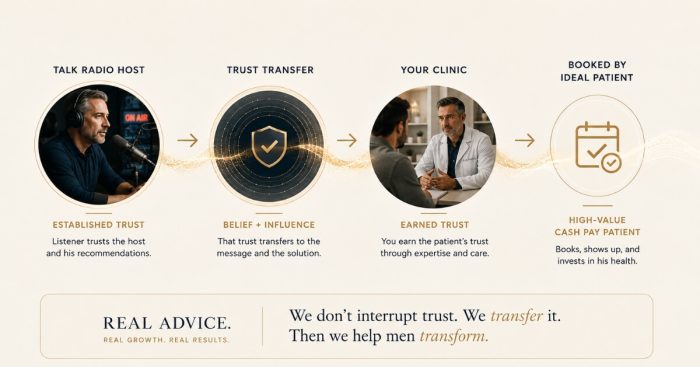
The host establishes trust over hours of programming, and when that host talks about a clinic — not reads a pre-recorded spot, but talks about it — the listener treats it as a recommendation from a friend, not an ad.
The cash-pay hormone outcome compounds when you stack that audience with a high-trust channel:
an HRT clinic we grew from $1M to $4M in 4 years with 250 active members paying $1,000/month
…shows what happens when the right hormone offer meets the right buyer over time — the membership LTV makes almost any acquisition channel that brings in the right patient profile pay for itself within months.
How Do I Get a Radio Host to Recommend My Cash-Pay Medical Practice On-Air (and Why Does That Change the Response Rate)?
The way to get a radio host to recommend your cash-pay medical practice on-air is to negotiate a live-read or host-endorsement package directly with the station or the host’s rep.
The reason it changes the response rate is that listeners trust the host’s voice in a way they do not trust a produced spot.
Anton’s exact framing on this is the whole game:
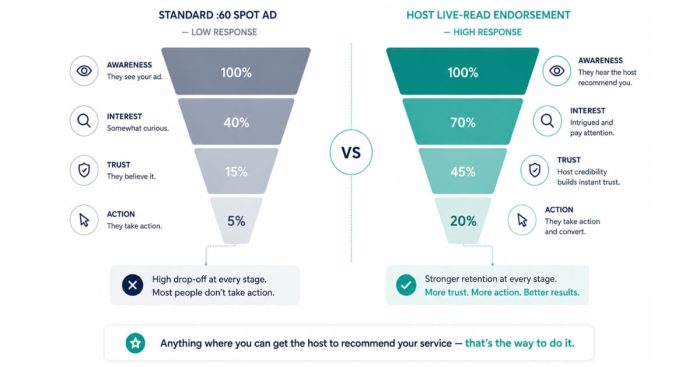
“Anything where you can get the host of the show to talk about or recommend your service that’s the way to do it.”
A produced :60 spot sounds like an ad, and the listener’s ad-filter kicks in inside the first two seconds.
A live-read where the host says:
“I’ve been working with Dr. So-and-so at [Clinic] for my own labs, and if you’re a guy over 45 wondering why you’re tired all the time, call them”
…is functionally a personal recommendation.
The response rate on a host endorsement can be many multiples of a standard spot for the same dollar spent.
That’s a recurring theme in effective men’s hormone & TRT clinic marketing, where trust and credibility consistently outperform generic advertising when the goal is attracting high-value cash-pay patients.
The Practical Path
- Identify the two or three conservative talk shows in your metro with the right audience match
- Ask the station’s sales rep specifically about:
- “host-read live endorsement”
- “host endorsement package” pricing
- Be willing to invest in the host actually trying your service or meeting your medical director
Hosts will not endorse what they have not at least met.
Most clinics never ask for the endorsement package because they assume the standard rate card is the only option — it isn’t.
The bigger the host, the higher the cost, but the return on a true endorsement from a trusted local host can carry an entire month of acquisition.
Should I Run Radio Ads or Sponsor Podcasts in 2026 — and How Do They Compare?
Both work in 2026, and the same rule applies to both:
The play is to get the host to recommend your service.
Broadcast Radio
Broadcast radio gives you reach in a specific metro.
Best for:
- Local clinics
- Tight geographic targeting
- TRT
- Hormone
- Joint pain
- Neuropathy offers
Podcasts
Podcasts give you a tightly targeted national or niche audience with even higher host-listener trust.
Anton’s framing extends directly from radio into podcasting:
“You can even like get into podcasts now and if you can get the podcast host of recommend your stuff it works pretty well.”
Podcast sponsorships have grown into a credible acquisition channel for cash-pay clinics — particularly:
- Hormone
- TRT
- Longevity
- Men’s health
- Biohacking offers
The trade-off is that podcasts are typically more expensive per impression and require careful audience-show matching.
The Decision Rule
If your clinic:
- Serves one metro
- Maps to a specific local talk-radio audience
…broadcast radio with a host endorsement wins.
If your clinic:
- Offers telehealth
- Has multiple locations
- Sells a national-shippable program
- Offers compounded hormone protocols, peptides, or supplements alongside the medical service
…a relevant podcast with a host-read endorsement gives you better targeting per dollar.
As Anton puts it about the podcast route:
“Just a little bit more expensive but it does work for sure.”
What’s a Realistic Budget for a Radio Campaign at a Cash-Pay Medical Practice?
A realistic radio budget for a cash-pay medical practice starts in the $5K–$15K per month range for a meaningful broadcast presence in one metro.
Host endorsement packages typically require an additional premium on top of standard spot rates.
The Structure That Works
Do not run radio at all unless you can commit to at least 90 days of consistent presence on the same one or two shows.
Radio rewards:
- Frequency
- Repetition
- Familiarity
…more than almost any other paid channel.
A listener typically needs to:
- Hear the offer multiple times
- Hear it from the same host
- Hear it on the same show repeatedly
…before the trust transfers.
A four-week test on three different stations will almost always fail and tell you “radio doesn’t work” — when in reality, you never reached the frequency threshold on any single station.
Budget Allocation
Build the budget around a host endorsement first, then layer in supporting spots.
A host-read live endorsement:
- Two to four times per show
- On two to three shows per week
…is a far better use of $10K than 100 produced :60 spots scattered across a music-station rotation.
The math on cash-pay hormone, TRT, and Low-T memberships ($200–$1,000/month LTVs) is forgiving.
If a $10K month produces 10 new members at $500/month, the campaign pays back inside two months and prints from there.
The same applies to high-ticket:
- Joint pain
- Neuropathy
- Regenerative offers
…running on talk radio that skews older.
Which Cash-Pay Medical Offers Do NOT Work on Radio?
Aesthetic, injectable, and beauty-driven cash-pay offers do not work on radio.
That includes:
- Filler
- Botox
- CO2 lasers
- Body contouring
- Most medspa-only offers
These fail on radio because the audience that listens to talk radio is not the audience that buys those services.
The Audience Math
Filler and Botox patients skew:
- Female
- Younger
Conservative talk radio listeners skew:
- Male
- Older
Trying to run filler on talk radio is the same mistake as trying to run TRT on TikTok with a 22-year-old creator:
- Wrong audience
- Wrong platform
- No amount of creative testing will save the channel
The same applies to most aesthetic and laser categories.
These offers belong on:
- TikTok
- Meta
- Google Search
- Organic social
…where the audience is actually scrolling and searching.
Another Problem: Visual Dependency
Radio also does not work well for offers that require heavy visual demonstration.
Examples include:
- Body contouring
- CoolSculpting
- Laser treatments
These need before-and-after imagery to convert — radio can’t deliver that.
The cash-pay offers that DO work on radio share three traits:
- They sell to an older male audience
- They solve a clearly named symptom
- They reward trust-driven decision-making over visual proof
Examples include:
- Low testosterone
- Low energy
- Hormonal decline
- Joint pain
- Neuropathy
If your offer doesn’t tick all three boxes, run it on a different channel.
How Do I Track ROI on a Radio Campaign Without Losing Patients to Attribution Gaps?
Track radio ROI with:
- A dedicated tracking phone number
- A campaign-specific landing page URL
- A “how did you hear about us?” intake question
- An inbound call team trained to flag radio mentions
Why Attribution Gets Messy
Listeners hear the spot in the truck, do nothing in the moment, and Google your clinic name three days later.
At that point, the booking shows up as:
- Branded search
- GMB
- Organic traffic
…and the radio campaign looks like it didn’t work.
The Fix: A Layered Tracking Stack
1. Dedicated Tracking Number
Give the host a dedicated phone number to read on-air that only that show uses.
Example:
- A clean local number routed through CallRail or WhatConverts
Every call to that number is a confirmed radio lead.
2. Vanity URL
Give the host a short, memorable vanity URL such as:
- YourClinic.com/talk
- /host-name
This captures form-fills attributable to the spot.
3. Intake Attribution
Train your new patient coordinator to ask:
“How did you hear about us?”
…on every inbound call and record radio specifically if the patient mentions it.
The Honest Reality
Radio attribution will always be slightly fuzzy.
Some listeners will:
- Not remember the number
- Not type the vanity URL
- Book through branded search later
…even though the radio campaign drove the interest.
Build a 15–25% halo factor into your ROI math to account for that.
The clinics that win on radio do not chase perfect attribution.
They:
- Track the directionally correct signal
- Look at total booked-patient volume month-over-month
- Trust the trend more than the dashboard
If your TRT or hormone bookings climbed 30% the month you started a host endorsement on a talk-radio show, the radio is working — even if only half of those bookings show up tagged as “radio” in the CRM.
What’s the Next Step?
If you want a second pair of eyes on whether radio is the right next channel for your cash-pay medical practice — or how to structure a host endorsement on a talk show in your metro that will actually move bookings — book a strategy call with the team that has run radio, podcast, and broadcast campaigns across 40 of the fastest-growing cash-pay clinics in the country.
We will look at:
- Your offer
- Your patient profile
- Your current channel mix
- Your budget
…and tell you whether radio belongs in your 2026 plan and exactly how to launch it.