
How Do I Price and Launch a Luxury Cash-Pay Membership for High-Net-Worth Patients? (No Free Consults, $599 + $599, First 50 Members)
A 20-year-old founder with an investor, a medical director, and zero leads booked a strategy session with us to launch a luxury men’s health membership — $899 to $1,500 a month, all-inclusive, aimed at high-net-worth patients. The call turned into a masterclass on premium pricing psychology, why free consults break high-ticket math, and what actually produces the first 50 members. Here’s the FAQ version.
What do high-net-worth patients actually pay for?
What they know is genuinely expensive — and nothing else.
Wealthy patients overpay for expertise and outcomes. However, they refuse to overpay for commodities.
The best illustration from the call: a billionaire who keeps friends waiting on his own jet while he picks up coffee and bagels himself — because the catering service wanted $3,000 for it.
Plane fuel costs what plane fuel costs.
Dunkin’ Donuts does not cost $3,000.
That’s the entire psychology of the high-net-worth patient in one story.
They’ll happily pay $1,500 a month for physician expertise, medication management, and measurable outcomes. However, they’ll silently resent you for marking up a $99 blood draw to $400.
Practical translation for your membership: price the scarce things — provider time, clinical judgment, and results — with confidence.
Meanwhile, pass through or bundle the commodity things, such as labs, shipping, and supplements, at honest value.
Luxury positioning isn’t charging more for everything.
It’s charging boldly for exactly the things a sophisticated buyer knows are worth it.
How should I structure an all-inclusive luxury membership?
One monthly number that covers everything — labs, medications, follow-ups, nutrition, and coaching — padded with high-perceived-value services the patient would otherwise buy elsewhere.
The clinic on this call planned $899 to $1,500 a month, all-inclusive, with lab draws done by mobile phlebotomy at the patient’s home or office.
That’s a perfect luxury perk because busy executives will gladly pay an extra hundred dollars to never sit in a draw station.
The rule for building the stack is simple: if you want to charge more, bundle in things they would have spent money on somewhere else.
Direct primary care is the classic example.
Medication management and a quick call that replaces an urgent-care visit offer high perceived value with a relatively low marginal cost to deliver.
Peptides work the same way as a member perk.
At an $899 monthly price with 50% off peptides, the clinic still clears roughly 30% margin on them.
In addition, a discounted peptide program deepens the relationship while feeding the hormone pipeline, since a man trying BPC-157 for the first time is typically six to twelve months away from starting hormone treatment.
This is the same value-stack logic that powers every strong men’s hormone clinic marketing offer.
The membership should feel like a private client relationship, not a subscription to refills.
Should a high-ticket clinic offer free consultations?
No — a free consult in front of a $900-a-month ask makes zero sense.
Instead, charge for enrollment and credit it back.
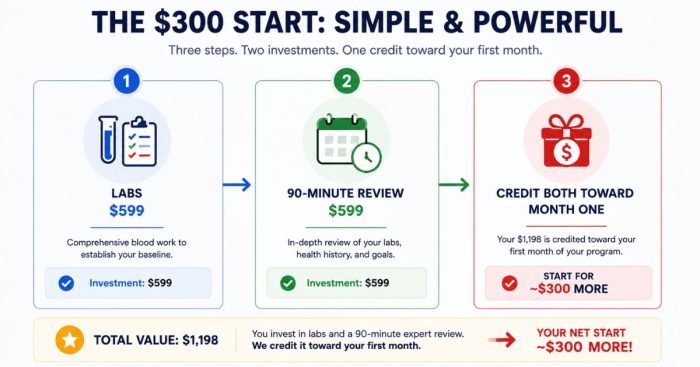
The offer we built live on the call was $599 for comprehensive labs, followed by $599 for a 90-minute provider lab review.
Both are real services.
Both are paid.
And both can be credited toward the first month of membership when the patient enrolls.
The psychology does the closing for you:
“You can credit that initial $599 toward any program you start with us — so you’d get started for just about $300 more.”
The patient feels like they were gifted $600.
One caller called it girl math. Whatever you call it, it works because it incentivizes spending more, not less.
Why does paid beat free at this tier?
First, the fee filters for seriousness because a $1,200 consult investment self-selects buyers.
Second, it pays the provider for a genuinely thorough 90 minutes.
Finally, it sets the price anchor at premium from the first transaction.
And note the range.
Impulse buys happen between $400 and $600, which is exactly why each step sits at $599 instead of creating a scarier single $1,200 gate.
A lower-ticket clinic can run the same structure smaller: $300 labs, $350 consult, and $400 a month.
How many members until a premium membership practice gets easier?
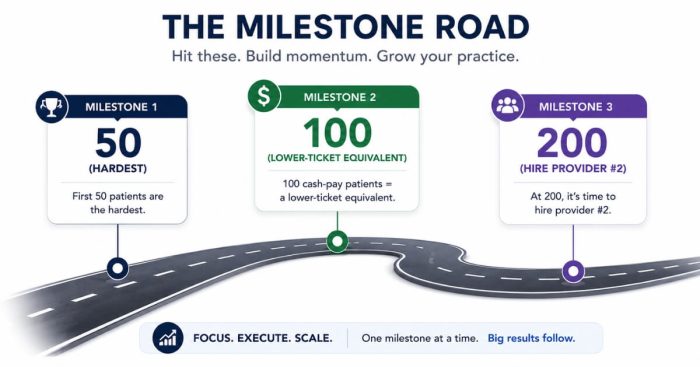
Fifty at a premium price point — roughly $50K a month — is the hardest milestone.
At a lower ticket, that milestone is closer to 100 members.
Plan the second provider around 200.
These aren’t theoretical numbers.
A longevity practice we work with in Charlotte runs a $1,200-a-month program where roughly 50 members already means $50–60K a month of recurring revenue.
A statewide men’s telehealth clinic runs 700 members at a $200 price point — same revenue logic, different ticket.
And an HRT clinic we’ve grown for years now holds 250 active members at $1,000 a month — it crossed the second-provider threshold around 200 members.
Why are the first 50 members the hardest?
Because you don’t yet have reviews, a referral flywheel, or much proof.
After 50, men start talking to other men about the experience, and the compounding begins.
One warning for the 200-member milestone: adding a second provider isn’t only about capacity.
It’s also about leverage.
A sole provider at a thriving practice can eventually realize they’re irreplaceable, and some begin to act like their credentials alone built the business.
Redundancy protects the company.
In our experience, that ego risk tends to run higher with MDs and DOs than with NPs and PAs.
How do I get my first members with zero patient base?
SEO plus in-person events — two channels that spend time instead of cash — combined with a founders’ offer that turns influential locals into walking case studies.
Our advice to this startup was explicit: don’t start with paid ads.
Google Ads on the front end of a brand-new practice can burn investor cash while you’re still learning what the market responds to.
Instead, build the website around long-tail patient questions and create city-level pages for every market where the provider is licensed.
At the same time, get physically in front of the target patient.
That might mean golf outings, marathons, Hyrox events, or other places where high-income men already gather.
Use something simple, like a free-labs conversation starter.
High-income men often don’t want a funnel first.
They want a real person they can talk to.
That’s how a comparable clinic went from zero without ad spend.
For the first ten members, run a founders’ offer.
Invite influential, well-connected locals in at cost — cover the medications, labs, and provider time, but nothing more.
You’re not discounting.
You’re buying proof.
Ten connected men with real results become your case studies, Google reviews, and referral engine.
That outcome-anchored proof is also the foundation of strong longevity clinic marketing long after launch.
When you eventually turn ads on, use a quiz funnel with a discovery-call close and budget at least $100 a day.
What tech stack should a startup membership practice run on?
A CRM built for conversation and automation — we build clinics on GoHighLevel — plus honest operational plumbing from day one.
That means:
- Booking
- Two-way texting
- Pipelines
- Nurture sequences
The founder on this call asked about HubSpot.
Our answer was straightforward: HubSpot and Salesforce are enterprise platforms, and two-way texting isn’t native in the way a small clinic needs.
You often end up bolting on extra tools to accomplish basic workflows.
For a small-to-mid-size practice, GoHighLevel handles workflows, patient journeys, autoresponders, and pipelines in one place.
However, the software matters less than the sequence.
Build the CRM and website first.
Script the enrollment offer second.
Launch SEO and events third.
Run paid traffic last.
A premium brand with a broken follow-up system isn’t actually premium.
It’s just an expensive logo.
FAQ’s About Luxury Cash-Pay Membership Pricing
How much should a luxury men’s health membership cost?
Premium all-inclusive memberships typically run $899–$1,500 a month when they genuinely cover labs, medications, follow-ups, nutrition, and coaching.
The price holds when the scarce things — provider expertise and outcomes — justify it.
Meanwhile, commodity items should be bundled at honest value.
Why shouldn’t a high-ticket clinic offer free consultations?
Because a free consult followed by a $900-a-month ask breaks the buyer’s logic.
A paid enrollment sequence — $599 for labs plus a $599 ninety-minute review, both credited toward the first month — filters for serious patients and anchors the premium price.
It also makes enrollment feel like receiving a $600 credit rather than taking on another charge.
What’s the hardest milestone for a new membership practice?
The first 50 members at a premium price point, which is roughly $50K per month in recurring revenue.
At a lower ticket, the comparable milestone is around 100 members.
The difficulty comes from having no review base, little proof, and no referral flywheel yet.
After 50, word of mouth starts to compound.
Should a brand-new clinic run paid ads?
Not at launch.
Spend time before cash.
Start with SEO built around long-tail patient questions and city pages, then pair it with in-person events where the target patient already spends time.
Turn ads on after you have a patient base, reviews, and a proven enrollment offer.
At that point, budget at least $100 per day for a quiz-funnel campaign.
What’s the next step?
If you’re launching — or repricing — a premium membership practice, book a strategy call.
In 60 minutes we’ll pressure-test your price point against your value stack, script the paid enrollment offer for your specialty, and map the zero-to-50-members plan across SEO, events, and founders’ offers.