
How Do You Handle “What’s the Price?” and “Is This Covered by Insurance?” on a Cash-Pay Medical Practice Inbound Call? (Verbatim Rebuttals + the “Why Do You Want to Change?” Pivot)
The two most common questions on a cash-pay inbound call are “what’s the price?” and “is this covered by insurance?” — and both are reflexive disqualification attempts, not real objections. The patient’s reptile brain is trying to escape the conversation before they have to confront the real reason they called. The clinics that lose the most leads answer each question literally and watch the caller hang up. The clinics that book the most consults have verbatim rebuttals memorized for both questions, paired with a “why do you want to change?” pivot that surfaces the real motivation behind the call. This is the FAQ on the verbatim rebuttals, the tone that makes them work, and the listening discipline that solves 90 percent of inbound-call conversion problems before any specific script comes into play.
What are the two most common objections on a cash-pay medical practice inbound call?
The Two Questions
- “What’s the price?”
- “Is this covered by insurance?”
These are the two questions almost every inbound cash-pay caller leads with.
Both are reflexive disqualification attempts — the caller’s reptile brain trying to escape the conversation before they have to confront the real reason they called.
The Common Mistake
Most front-desk and patient coordinator teams answer these questions literally.
They:
- Quote a price
- Explain the insurance position
- Lose control of the conversation
As a result, the lead often disappears before any real discovery takes place.
What High-Converting Clinics Do Instead
They use verbatim rebuttals.
Those rebuttals:
- Defuse the disqualification attempt
- Redirect the conversation
- Surface the real problem
- Keep the call alive long enough to book the consult
Clinics that train these rebuttals into the team routinely see inbound-to-booked conversion rates increase 10–20 percentage points within 30 days because they stop losing leads during the first minute of the call.
What’s the verbatim rebuttal when a cash-pay inbound caller asks “how much does it cost?”
GLP-1 Version
“We have affordable options for all doses. What are you currently taking, or would this be your first time?”
Non-GLP-1 Version
“The cost depends on what you actually need, which is exactly what the consult is designed to figure out. Before I tell you the consult price, can I get your name and your best email so I can send you the details either way?”
The Principle Behind the Script
The framework is identical across specialties:
- Acknowledge the question.
- Give a short non-answer.
- Pivot to discovery.
- Capture contact information.
- Present pricing later with context and value.
What Not to Say
Avoid responses like:
“Well, you don’t want to know what we do at all? The only thing that matters to you is cost?”
That sounds punitive and immediately creates resistance.
Remember: the patient is not necessarily objecting to your price.
They’re simply asking the only objection their reptile brain knows how to ask.
Your job is to take control of the conversation without making them feel wrong for asking.
A medspa where we added $6.7M in revenue across 3,727 new patients in one year drilled this rebuttal into every front-desk team member through weekly recorded coaching.
What’s the verbatim rebuttal when a cash-pay inbound caller asks “is this covered by insurance?”
The Script
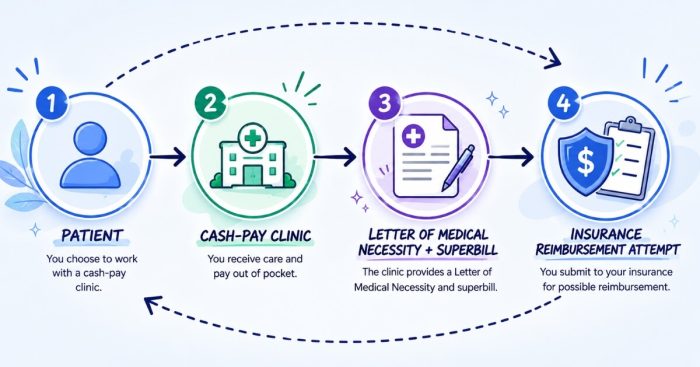
“Gosh, it’s not that we don’t want it to be covered by insurance. It’s just that for most people, insurance doesn’t deem it medically necessary and want to cover it. We will work with you to provide a letter of medical necessity and a superbill for your insurance company, and some patients have had success with that. What was it specifically you were looking for?”
What This Script Does
The script accomplishes three things:
- Places responsibility on insurance rather than the clinic
- Offers a letter-of-medical-necessity and superbill bridge
- Immediately pivots back to discovery
Tone Matters
The tone should be:
- Endearing
- Concerned
- Slightly conspiratorial against insurance
It should never sound:
- Defensive
- Apologetic
The patient expects to hear:
“Sorry, we don’t take insurance.”
Instead, they hear:
“We’ll help you pursue reimbursement if that’s important to you.”
That difference keeps the conversation moving.
Why do cash-pay patients always ask about price first — and what does it actually mean?
What the Question Really Means
Most callers are not actually asking:
“What’s the price?”
What they’re really asking is:
“Can I afford this?”
It’s a protective reflex.
The question gives them an exit ramp if the conversation starts becoming uncomfortable.
The Reality
If the patient were satisfied:
- With their current treatment
- With their current costs
- With their current results
They wouldn’t be calling.
There is always a deeper reason behind the inquiry.
How Great Teams Respond
They stay curious.
They ask:
- “Tell me a little bit about what’s going on.”
- “What have you tried recently?”
- “How long has this been going on?”
The goal is not to answer the price question immediately.
The goal is to uncover the real motivation.
Once the patient starts talking about the actual problem, the pricing conversation becomes much easier.
How does a cash-pay clinic use the “why do you want to change?” pivot when a caller seems stuck?
The Question
When discovery stalls, ask:
“It sounds like you have a good program. Why do you want to change?”
Why It Works
The question forces the caller to explain:
- Where they are now
- Where they want to be
- The gap between the two
Without this question, the team member often ends up guessing.
With this question, the patient tells you exactly what is missing.
Using the Pivot With Competitor Patients
This is especially effective when the caller is already working with another clinic.
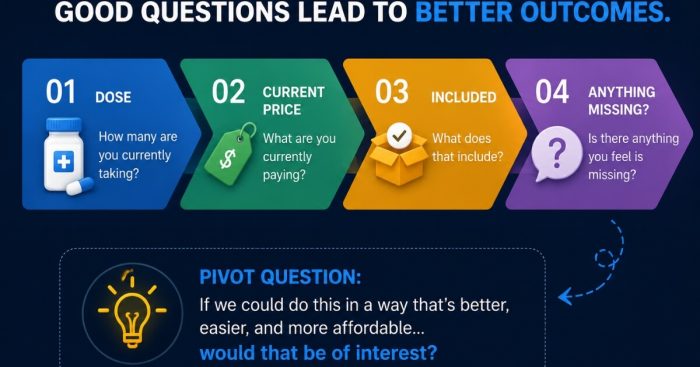
Before asking the pivot question, gather information:
- What dose are you on?
- How much are you paying now?
- What’s included in that price?
- Is there anything you’re paying for separately?
Then ask:
“Why do you want to change?”
Surface the gap.
Then show how your clinic fills it.
What’s the right tone for a cash-pay sales team on the phone?
Three Characteristics
The tone should be:
- Childlike curiosity
- Upward inflection
- Genuine listening
What It Should Not Sound Like
Avoid sounding like an order taker.
For example:
“Okay, I see. Okay, I see.”
That sounds transactional.
What Patients Need
Patients are discussing deeply personal issues:
- Weight
- Energy
- Sleep
- Sexual function
- Joint pain
- Brain fog
They need to feel heard.
Examples
Ask questions like:
“Tell me a little bit about what’s going on?”
“What have you tried recently to lose weight?”
“How long has this been going on?”
Each question should be delivered with genuine curiosity.
Why This Matters
The team member who masters curiosity solves most conversion problems before a sales script is ever needed.
A regenerative medicine clinic we worked with hit a 79.4 percent conversion rate from lead to booked appointment with exactly this tone discipline at the front desk.
What’s the next step?
If your front desk is losing leads during the first 60 seconds of inbound calls, there is a good chance the breakdown is happening around:
- The pricing objection
- The insurance objection
What We Review on the Call
During the strategy call, we:
- Listen to a recorded inbound call
- Identify where the lead is being lost
- Rewrite the pricing rebuttal
- Rewrite the insurance rebuttal
- Install the “why do you want to change?” pivot
- Build a weekly coaching process
Why This Matters
The pricing question and insurance question account for roughly 60–70 percent of inbound objections at cash-pay clinics.
Improving those responses is one of the highest-ROI sales training opportunities available.
The Outcome
Most clinics see meaningful conversion gains within 4–6 weeks once the rebuttals are drilled into muscle memory through weekly recorded-call coaching.