
What Should a Post-Procedure Patient Aftercare Sequence Include? (A 70-Day Follow-Up Cadence That Drives Referrals and Reviews)
Most cash-pay clinics pour everything into getting a patient to say yes — and then go silent the moment the procedure is done. That silence is where reviews, referrals, and repeat revenue quietly die. The clinics that grow on word-of-mouth treat the period after the procedure as a designed sequence, not an afterthought: a structured cadence of thank-yous, check-ins, surveys, and carefully timed referral asks that runs for weeks. Here is the FAQ on what a post-procedure patient aftercare sequence should include, built from a proven 70-day cadence used by a spine and pain practice.
What should a post-procedure aftercare sequence include?
A multi-week cadence that opens with a personal thank-you and care guide, layers in check-in calls and surveys, then asks for referrals, reviews, and testimonials once the patient is feeling the result — ending by moving them onto your monthly newsletter list.
The proven version runs about 70 days and alternates email and phone touches so the patient never feels spammed or forgotten. It starts on day one with a personalized thank-you video and the post-procedure care guide, moves through a personal phone check-in around day five, a satisfaction survey around day nine, and a patient-portal and referral introduction around day fourteen. The back half is where the asks live: testimonial requests, referral calls, a contest, a personal note from the physician, and a final follow-up call before the patient rolls onto the house newsletter list around day seventy.
The point is that none of this is left to chance. Each touch has a job — reassure, check in, collect feedback, ask for a referral, request a review — and they are sequenced so the asks come only after the care has been felt. That ordering is the whole reason it works.
Why start aftercare with a personalized video and care guide on day one?
Because the first 24 hours set the tone for the entire relationship — a personal thank-you video plus the post-procedural care guide tells the patient they are cared for, not just billed.
Day one is not the time to ask for anything. It is the time to give: a short, personal message from the practice thanking the patient for choosing you, paired with the practical care guide they need to recover well and a clear way to reach you with questions. That combination does two things — it reduces post-procedure anxiety, which improves outcomes, and it establishes that your clinic stays present after the money has changed hands.
This opening generosity is what earns the right to ask later. A patient who felt looked after on day one is a patient who happily fills out the survey on day nine and refers a friend on day thirty-five. Skip the day-one care and every later ask lands cold.
When and how should you ask for referrals?
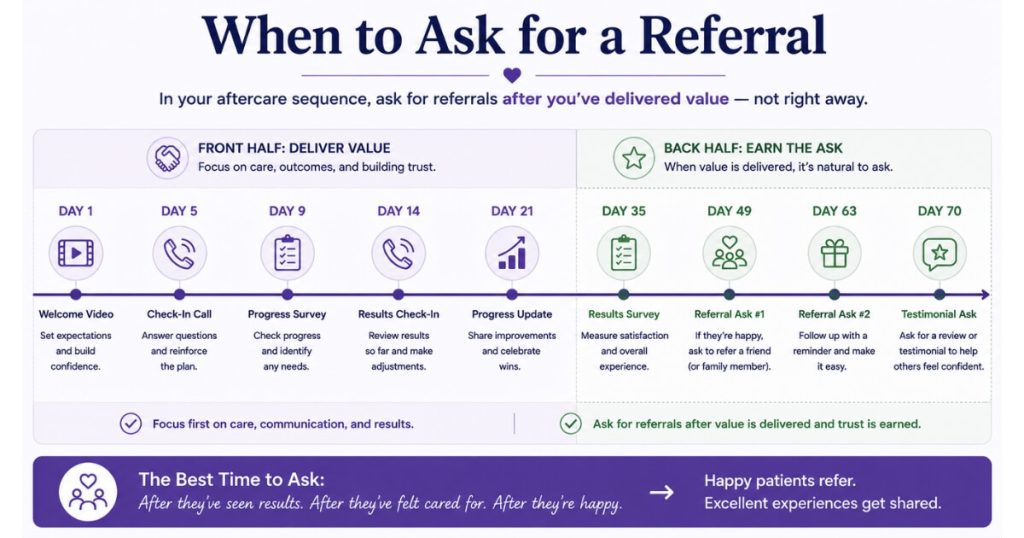
Not immediately — wait until the patient has felt the result, then ask repeatedly but warmly across the back half of the sequence, with specific, descriptive prompts rather than a generic “refer a friend.”
Asking for a referral the day after a procedure is asking before you have earned it. The proven cadence holds the referral asks until the relationship is established — introducing the idea around day fourteen alongside the patient portal, then returning to it through testimonial requests, a dedicated referral phone call around day forty-two, and a personal note from the physician later in the sequence. By spacing the asks, you catch the patient at different moments of feeling good without ever nagging.
The framing matters as much as the timing. Instead of a flat “refer us,” the asks invoke the people the patient cares about — friends, family, or loved ones who may be living in pain — and offer to speak with them personally. That makes referring feel like helping someone they love, not doing the clinic a favor. We have watched this kind of referral discipline produce real organic volume at a pain and regenerative practice where we added over $2 million in revenue in 10 months with 26 organic website leads a month.
How do you collect reviews and testimonials inside the sequence?
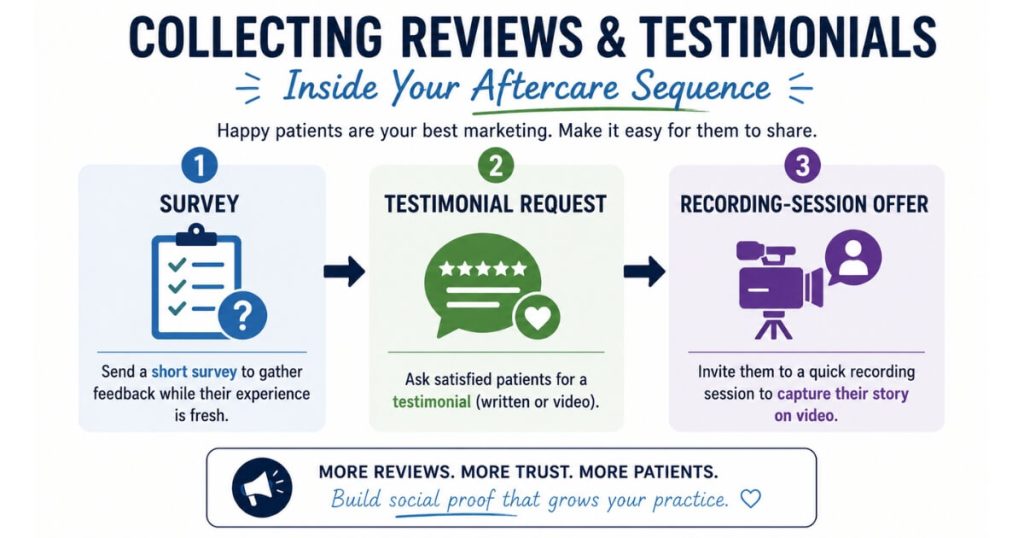
By building dedicated survey and testimonial touches into the cadence — a satisfaction survey early, a testimonial request later, and an open invitation to come back for a recording session.
Reviews and testimonials do not happen on their own; you have to ask, and you have to ask at the right moment. The sequence places a confidential satisfaction survey around day nine to capture the experience while it is fresh, follows up on that survey around day twenty-one for anyone who did not respond, and then makes a direct testimonial request later, pointing patients to existing testimonial videos and inviting them to share their own story — even offering to host a recording session at the clinic.
That structure turns reviews from a hope into a system. The early survey gives you private feedback to fix problems before they become public, and the later testimonial ask converts your happiest patients into public proof. For a cash-pay practice, that proof is the engine of the next patient’s decision — and it compounds the same way word-of-mouth growth did at a pain practice where we lifted monthly revenue by $40K+ and improved retention.
Why include a personal message from the doctor or owner?
Because a direct note from the physician — not the front desk, not an automation — signals that the person who treated the patient still cares, which deepens loyalty and makes the referral ask far more powerful.
Later in the sequence, the cadence includes a personal message from the practice’s lead physician thanking the patient for taking the journey with the clinic and reflecting on what it means to help them get their life back. Coming from the doctor by name, that message carries weight no automated email can. It reminds the patient of the relationship at the human level and reinforces that they chose a practice that genuinely cares about outcomes.
This is also the most credible place to seat a referral ask. When the physician personally notes how meaningful it is to help people in pain and invites the patient to think of friends or family who might need the same help, the request lands as an extension of care rather than a marketing push. The owner’s voice is the highest-trust asset in the sequence — use it deliberately.
What happens at the end of the aftercare sequence?
The patient graduates onto your monthly newsletter list, so the relationship continues indefinitely instead of ending when the formal sequence does.
Around day seventy, after the final personal follow-up call, the patient is added to the house list for ongoing monthly nurture. This is the quiet but critical step most clinics miss: the aftercare sequence has a defined end, but the relationship should not. Moving the patient onto a regular newsletter keeps your clinic in their life, keeps you top of mind for their next need, and keeps them warm for future offers and reactivation.
That hand-off is what converts a one-time procedure patient into a long-term asset. The intensive 70-day sequence does the work of turning a satisfied patient into a referrer and reviewer; the ongoing newsletter does the work of keeping them connected for years. Together they make sure the patient you worked so hard to earn never simply disappears after they heal.
FAQs About a Post-Procedure Patient Aftercare Sequence
What should a post-procedure patient follow-up sequence include?
A multi-week cadence that opens with a personalized thank-you video and care guide, adds check-in calls and a satisfaction survey, and then asks for referrals, reviews, and testimonials once the patient feels the result — ending by moving them onto your monthly newsletter list. A proven version runs about 70 days, alternating email and phone touches.
When should I ask a patient for a referral after a procedure?
Not immediately — wait until the patient has felt the result, then ask warmly and repeatedly across the back half of the sequence, starting around day fourteen. Frame the ask around friends or family who may be in pain, and offer to speak with them personally, so referring feels like helping someone they love.
How do I get more patient reviews and testimonials?
Build dedicated touches into your aftercare cadence: a confidential satisfaction survey early (around day nine) to capture the experience while it’s fresh, a follow-up on that survey, and a direct testimonial request later that points to existing testimonials and invites the patient to share their own — even offering a recording session.
Should the doctor send a personal message in the sequence?
Yes. A note from the treating physician by name signals that the person who cared for the patient still cares, which deepens loyalty no automated email can match. It’s also the most credible place to seat a referral ask, because it lands as an extension of care rather than a marketing push.
What happens when the aftercare sequence ends?
The patient should graduate onto your monthly newsletter list around day seventy, so the relationship continues indefinitely. The intensive sequence turns a satisfied patient into a referrer and reviewer; the ongoing newsletter keeps them connected for years and warm for future offers and reactivation.
What’s the next step?
If your clinic goes quiet the moment a procedure is done, you are leaving your cheapest growth — referrals and reviews from happy patients — on the table. Build a structured aftercare sequence: open with a personal thank-you and care guide, layer in check-in calls and surveys, time your referral and testimonial asks for after the patient feels the result, use the physician’s voice for the highest-trust touches, and finish by moving the patient onto your monthly newsletter.
If you want someone to build that aftercare sequence into your CRM — the touches, the timing, the referral and review asks — that is the conversation to book. We will map the full post-procedure cadence for your practice on the call.