
How Do You Position Cash-Pay Primary Care Against Insurance-Based Clinics?
Most cash-pay primary care practices think they are competing on price against insurance. That is exactly why they lose the conversation. You cannot beat free, and to a patient with a copay, an insurance appointment feels free. But you do not have to. The thing a lean cash-pay or direct primary care practice actually sells is access. You can see a new patient next week. The insurance clinics around you are booked four to six months out. This is the positioning playbook for cash-pay primary care against insurance-based clinics. It covers the availability frame, the value story, and the exact front-desk script. It also covers how to turn a one-off cash visit into a recurring DPC membership — pulled straight from the field with practices doing it right now.
How Do You Position Cash-Pay Primary Care Against Insurance-Based Clinics?
You position it on speed and access, not price. Let the patient choose between getting in next week as a cash-pay patient, or waiting six to eight weeks for an insurance appointment.
The single most persuasive thing a cash-pay primary care practice owns is availability. In most markets, insurance clinics are booked four to six months out for a new patient. A major hospital system can be a year out. A lean cash-pay practice can see that same patient next week.
That gap is the entire pitch. It is also the part most owners never lean on. They are too busy worrying about whether their prices will scare people off. They will not. You are not asking the patient to pay for something they could get for free. You are offering a faster, more direct path to the people who want it. The slower insurance path stays completely intact for everyone else.
Framed this way, cash-pay stops being a tax and becomes an upgrade. When somebody is ready to book a doctor, they are usually ready now. That is human nature. It is the same impulse behind DoorDash priority delivery and Amazon Prime. People will pay for speed.
The patient who says yes is buying time. The patient who says no still books an insurance appointment. Either way, you never lose the patient. This is the same logic that runs through every channel in the broader medical practice marketing playbook. Stop fighting on the field where the competitor is stronger. Compete where you actually win.
How Do You Answer “Why Wouldn’t I Just Use My Insurance?”
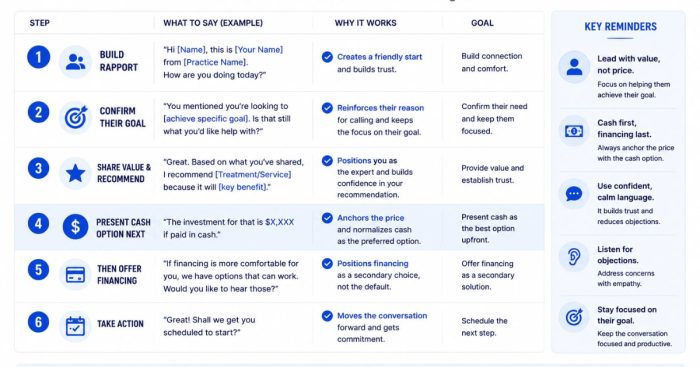
You answer it with availability first, then value. Something like: “You absolutely can use your insurance, and we’ll book you. The only real difference for you right now is that insurance is about six weeks out, and cash gets you in next week.”
Lead with the access gap, because it is concrete and undeniable. Most patients self-select on speed before price ever enters the conversation, so do not bury the one fact that wins the deal.
Only after the patient has reacted to the availability gap do you layer in the value points. These are genuinely true of a direct-pay model. There’s a flat, predictable $200 initial visit and $100 follow-up, with no surprise billing. There’s priority access and direct contact with the provider. There’s faster lab turnaround. And there are exclusive in-clinic discounts on services and specialty labs. Insurance often does not cover these, or they come buried under a high deductible.
For any practice with weight-loss demand, the value story is even cleaner. Patients already know their insurance will not cover GLP-1 medications like tirzepatide. So cash is the only route to that outcome, regardless of how they feel about insurance generally.
The honest version of this answer never disparages insurance. It never implies the patient is being foolish for having it. Instead, it positions cash as the elevated option for people who want their care faster and more directly, while keeping the insurance door wide open. You are adding a lane, not closing one.
What Is the Exact Script a Front Desk Should Use to Offer Cash-Pay Primary Care?
When a new patient calls, ask whether they have insurance, then present the cash option first and the wait second.
Here is the field-tested version. The patient calls. Your receptionist welcomes them and asks, “Would you be a new insurance patient or a new cash-pay patient?” If they ask the difference, the answer is simple: “Honestly, the biggest difference right now is availability — let me take a look.”
Then comes the script. “It looks like we’re booked out about six weeks for any new insurance patients. But let me see what I can do.” Next: “I can actually get you in as a new cash-pay patient next week. It’s just $200 for your initial visit and $100 for follow-ups.” Finally: “Would you prefer to come in next week and pay cash, or wait six weeks and use your insurance?”
The sequence is not optional. You present the opportunity to get in sooner, then you present the wait. Reverse it — lead with the six-week wait, then offer cash as a workaround — and it reads as slimy and opportunistic. Leading with the upside lands as helpful instead.
Keep the script identical across every receptionist. The fastest way to lose trust is for two front-desk people to describe the same offer two different ways. Have one or two rebuttals ready. Train the team until it flows naturally instead of sounding read off a page. Record the calls so you can hear what is actually happening and tighten it.
Won’t Patients Get Angry That You Save Appointment Slots for Cash-Pay?
A small number will, and that is fine. You do not need everyone to say yes. The patients most likely to push back are usually the ones a cash model is built to filter out.
Expect a fraction of patients to ask the obvious question: “If you can see that cash slot, why can’t you see me on insurance?” The rebuttal is simple and honest. The practice keeps a separate cash-pay or direct primary care track. That track exists for patients who want priority booking and faster access — the same way clinics have offered concierge tiers for decades.
You are not lying about availability. You are offering an upgraded lane, and you can say so plainly. The framing reminder that defuses almost all of the friction is that you are giving people more, not taking anything away. Anyone who prefers to wait and use insurance is still booked and still gets excellent care.
The math also protects you. If you book even five or six cash-pay patients a week, the occasional complaint becomes background noise. Against that, you get a meaningfully more profitable, more predictable practice. It is genuinely not for everyone, and it does not need to be. A patient who chooses insurance is not a loss. A patient who is rude about the very existence of a cash option is often telling you they were never going to be a good fit. Run it as a trial. Watch how people actually respond, and let the results — not the loudest objector — set your confidence.
How Do You Transition Cash-Pay Primary Care Patients Into a Recurring DPC Membership?
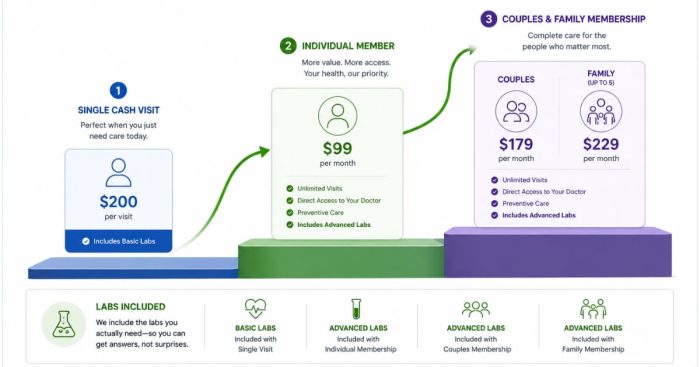
You start them with a simple cash visit, then introduce the direct primary care membership as the cheaper, more complete option once they see the value.
The on-ramp should be deliberately low-friction. A $200 initial visit and $100 follow-up are easy to say yes to, with zero membership commitment. That removes the biggest objection at the moment of booking.
But the economics quietly favor the membership. A patient who comes in monthly and adds a la carte services — labs, weight-loss treatment, peptides — will typically spend more than the membership costs. A roughly $275-per-month membership is often the cheaper path. So the membership is not a hard sell. It is the obviously cheaper option for anyone who is going to be a regular. You simply point that out: “We also have a membership that ends up costing less than your copays once you add labs or weight loss.”
Build a real service ladder behind that first visit so the upgrade is self-evidently worth it. Offer individual, couples, and family DPC tiers. Add extras like included children’s sick visits and a large included lab panel. This is how true concierge medicine works. Patients pay annually or monthly. They get priority access and direct provider contact. And the practice trades unpredictable insurance reimbursement for stable recurring revenue.
Practices that build this membership engine well can scale it dramatically. Eternity Health Partners built a base of 250 members at $1,000 per month on exactly this kind of recurring direct-pay model.
What Results Should You Expect When You Start Positioning Cash-Pay Against Insurance?
Expect a conversion rate of roughly one in seven to one in ten of the patients you present the option to. At typical primary care call volume, that adds up fast.
A practice booking around 20 new patient appointments a day should reasonably expect at least two of those to take the cash option daily, once the script is dialed in. That is ten or more new cash-pay patients a week. This comes from demand you were already generating. No new ad spend required, just a better conversation at the front desk.
Setting that benchmark up front matters. The team needs to know that most patients still choosing insurance is the expected outcome, not a failure. A patient who picks insurance is not a loss. They still book, and you still help them.
Run it as a trial. Record the inbound calls, review what worked and what triggered pushback, and refine the script and the offer against real objections rather than imagined ones.
Over a longer horizon, the bigger prize is reducing insurance dependence altogether. That is where the financial transformation lives. Practices that lean into cash and direct primary care can cut their insurance reliance substantially and add real monthly revenue, the way Dr. Groysman cut insurance dependence in half and added $40K a month by repositioning the practice around cash-pay care. The script is the start. The membership model and a deliberate channel strategy are how it compounds.
FAQ’s About Positioning Cash-Pay Care Against Insurance
How do you position cash-pay primary care against insurance-based clinics?
You position it on speed and access, not price. Let the patient choose between getting in next week as a cash-pay patient, or waiting six to eight weeks for an insurance appointment. The single most persuasive thing a cash-pay primary care practice owns is availability.
Insurance clinics in most markets are booked four to six months out. A major system can be a year out. A lean cash-pay practice can see a new patient next week. That gap is the whole pitch.
You are not asking the patient to abandon their insurance or pay for something they could get free. You are offering a faster, more direct path for the people who want it. The slower insurance path stays fully intact for everyone else.
Framed this way, cash-pay stops being a tax and becomes an upgrade. The patient who says yes is buying speed, the same way they click priority delivery or pay for Amazon Prime. The patient who says no still books an insurance appointment, so you never lose the patient. The positioning works because it is true. It gives the patient a real choice. And it costs you nothing to offer.
How do you answer “why wouldn’t I just use my insurance?”
You answer it with availability first, then value: “You absolutely can use your insurance, and we’ll book you. The only real difference for you right now is that insurance is about six weeks out, and cash gets you in next week.”
Lead with the access gap, because it is concrete and undeniable. Most patients self-select on speed before price ever comes up. Then layer the value points that are genuinely true of a direct-pay model. There’s a flat $200 initial visit and $100 follow-up, with no surprise billing. There’s priority access and direct contact with the provider. There’s faster lab turnaround, and exclusive in-clinic discounts on services and labs that insurance does not cover or that come with high deductibles.
For practices with weight-loss demand, the value story is even cleaner, because patients already know insurance does not cover GLP-1 medications like tirzepatide. Cash is the only path to that outcome regardless. The honest version of this answer never disparages insurance. It positions cash as the elevated option for people who want their care faster and more directly, while keeping the insurance door open.
What is the exact script a front desk should use to offer cash-pay primary care?
When a new patient calls, ask whether they have insurance, then present the cash option first and the wait second. The script sounds like this: “Let me see how soon we can get you in. It looks like we’re booked out about six weeks for new insurance patients.” Then: “But I can actually get you in as a new cash-pay patient next week. It’s just $200 for your initial visit and $100 for follow-ups.” Finally: “Would you prefer to come in next week and pay cash, or wait six weeks and use your insurance?”
The sequence matters enormously. Present the opportunity to get in sooner, then the wait. If you reverse it — leading with the wait and then pitching cash as a workaround — it feels slimy and opportunistic. Leading with the upside lands as helpful.
Keep the script consistent across every receptionist, so the patient experience does not get muddy. Have one or two rebuttals ready, such as explaining that the practice keeps cash-pay availability open for patients who want priority access. Every front-desk person should be trained on the script so it flows naturally, rather than sounding read off a page.
Won’t patients get angry that you save appointment slots for cash-pay?
A small number will, and that is fine. You do not need everyone to say yes, and the patients most likely to push back are usually the ones a cash model is designed to filter out.
Expect a fraction of patients to ask, “If you can see that cash slot, why can’t you see me on insurance?” The rebuttal is simple and honest. The practice keeps a separate cash-pay or direct primary care track for patients who want priority booking and faster access. Many practices have always offered concierge tiers the same way.
You are not lying about availability. You are offering an upgraded lane. The framing reminder that defuses almost all of the friction is that you are giving people more, not taking anything away. Anyone who prefers to wait and use insurance is still booked and still gets excellent care.
And the math protects you. If you book even five or six cash-pay patients a week, the occasional complaint becomes background noise. Against that, you get a meaningfully more profitable practice. It is not for everyone, and it does not need to be.
How do you transition cash-pay primary care patients into a recurring DPC membership?
You start them with a simple cash visit. Then introduce the direct primary care membership as the cheaper, more complete option, once they see the value. The pitch sounds like this: “We also have a membership that ends up costing less than your copays once you add labs or weight-loss services.”
The on-ramp is intentionally low-friction. A $200 initial visit and $100 follow-up are easy to say yes to, with no membership commitment. But a patient who comes in monthly and adds a la carte services like labs or weight loss will typically spend more. A $275-per-month membership is often the cheaper path.
So the membership is designed to reward recurring patients. It converts one-off cash visits into predictable revenue. Build a real service ladder behind that first visit. Offer individual, couples, and family DPC tiers, with extras like included children’s sick visits and a large included lab panel. That way, the upgrade is obviously worth it.
This is how true concierge medicine works: patients pay annually or monthly, get priority access and direct provider contact, and the practice trades unpredictable insurance reimbursement for stable recurring membership revenue.
What results should you expect when you start positioning cash-pay against insurance?
Expect a conversion rate of roughly one in seven to one in ten of the patients you present the option to. At typical primary care call volume, that adds up fast.
A practice booking around 20 new patient appointments a day should reasonably expect at least two of those to take the cash option daily, once the script is in place. That is ten or more new cash-pay patients a week, from demand you were already generating.
The point of setting that benchmark up front is so the team is not discouraged. Most patients will still choose insurance, and that’s expected. A patient choosing insurance is not a loss, because they still book. Run it as a trial. Record the inbound calls so you can review what worked and refine the script. Tune the offer based on real objections.
Over a longer horizon, the bigger win is reducing insurance dependence entirely. Practices that lean into cash and direct primary care can cut their insurance reliance dramatically. They can add tens of thousands of dollars in monthly revenue. Or they can build a membership base into the hundreds at a thousand dollars a month.