
How Do You Legally Market Peptide Therapy in 2026 (After the FDA 503A Crackdown)?
Peptide clinics have spent the last two years watching ad accounts get banned, landing pages flagged, and supply chains tighten as the FDA has narrowed which compounded peptides 503A pharmacies can prepare and which named peptides ad platforms will allow in their networks.
However, the clinics still growing in this category have not retreated. Instead, they have adjusted the marketing motion. They market the provider, the evaluation, and the outcome — not the molecule. They sell programs, not products. They build channel mixes that survive Google and Meta policy revisions.
So what does compliant peptide marketing actually look like in 2026? More importantly, how are cash-pay clinics still adding revenue in this category despite the regulatory headwind?
NOTE: This article describes marketing strategy, not clinical practice. It is not legal or regulatory advice. Every clinic operating in this category should consult its own counsel for compliance with state and federal pharmacy, prescribing, and advertising regulations.
How do you legally market peptide therapy in 2026 after the FDA 503A crackdown?
You market the provider, the personalized evaluation, and the outcome category — not the named peptide. You sell programs, not products. You move budget from named-product paid ads into organic content, owned audiences, and channels that allow general “hormone optimization,” “longevity,” or “recovery” framing.
At a high level, the shift is straightforward. The clinic markets the medical service rather than the molecule.
Why the marketing environment changed
The regulatory environment changed materially over the last 18–24 months as FDA enforcement of 503A compounding-pharmacy boundaries tightened.
As a result, many compounded peptides that were freely prescribed and easy to source two years ago became harder or impossible to obtain through compliant channels.
At the same time, ad platforms used the regulatory shift as cover to tighten their own ad policies against peptide-named copy.
What stopped working
The marketing motion that worked in 2023 — “Buy BPC-157 here” / “Order Tirzepatide direct” landing pages, paid Meta ads with named-peptide imagery — produces account bans, disapproved campaigns, and merchant-processor reviews in 2026.
Consequently, clinics that continue using those tactics often find themselves fighting platform restrictions instead of growing revenue.
What successful clinics are doing now
The clinics adjusting cleanly have done four things.
First, they shifted the marketing frame from “products we sell” to “evaluations we provide.”
Second, they moved language from named peptides to outcome categories.
Third, they built organic and owned-channel reach through SEO content, YouTube, podcasts, email lists, and referral partnerships.
Finally, they became disciplined about provider documentation.
Because of that shift, the marketing posture aligns with the underlying clinical process rather than competing against it.
This provider-first approach has become the foundation of legally marketing peptide therapy after the FDA 503A crackdown, allowing clinics to continue attracting patients without relying on named-molecule advertising that increasingly triggers platform restrictions and compliance concerns.
What can a peptide clinic NOT say in its ads or on its website in 2026?
Specific therapeutic claims for named molecules. Direct-to-consumer “order online” frames that imply no provider evaluation. Comparative claims against FDA-approved drugs. Any language that suggests the practice is selling a product rather than providing a medical service.
Before reviewing any marketing asset, it helps to apply a simple test.
The easiest compliance test
The safe heuristic for ad copy review is straightforward.
If a regulator from the FDA or FTC, an ad-policy reviewer at Google or Meta, or a curious medical board investigator pulled the ad up and read it cold, would the ad look like a product listing or like a medical service description?
Product listings get banned.
Medical service descriptions generally do not.
Marketing assets that should be removed
Specific things to remove from current marketing assets include:
- Named-peptide product imagery
- Prices listed next to specific compounded molecules
- “Buy now” CTAs that bypass a provider consultation
- Before-and-after photos with named-peptide captions
- Claims that named peptides “cure,” “reverse,” “eliminate,” or “treat” specific conditions
- Comparative claims against FDA-approved branded drugs
- Copy that promises specific outcomes without provider individualization
What compliant websites look like
The clinics that have rebuilt their websites in this category in the last 12 months tend to land on a similar information architecture.
For example, most successful sites include:
- A “what we treat” page
- A “how we work” page
- A provider credibility page
- A consult-booking process
As a result, the website functions as a medical-service platform rather than a product storefront.
That architecture survives policy review at every major ad platform.
The architecture that sells named peptides through a checkout does not.
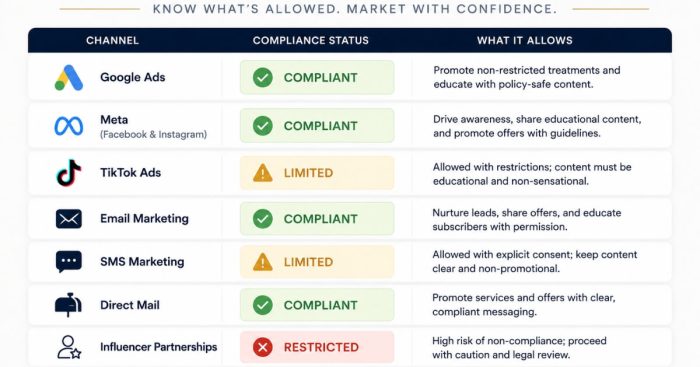
What channels actually work for a peptide clinic when Google and Meta ban most peptide ad copy?
SEO and organic content first, YouTube and podcasts second, email and owned audiences third, partner and referral networks fourth, and paid social fifth — only after the first four are producing material lead flow and the ad copy has been rewritten to survive policy review.
When paid advertising becomes more restrictive, channel selection becomes increasingly important.
SEO and organic content
SEO is the strongest channel in this category because the patient population searching for “peptide therapy near me” or “hormone optimization clinic [city]” is high-intent.
A comprehensive peptide therapy clinic marketing strategy builds on this foundation with educational content, provider authority, local SEO, and compliant conversion funnels that continue generating qualified consultations despite changing ad-platform policies.
More importantly, these searches happen at the outcome-category level.
That is exactly where compliant peptide marketing should live.
As a result, SEO content ranks and converts without triggering ad-policy review.
YouTube and podcasts
YouTube and podcasts are the second-strongest channel because they allow providers to build authority in long-form content.
Rather than promoting molecules, providers can discuss outcome categories and treatment philosophies.
Consequently, the content remains compliant while still generating trust.
A provider explaining “how we approach metabolic optimization in our clinic” in a 20-minute video is creating an asset that can generate patients for years.
A separate clinic in the regenerative space — Dr. Joy Kong, who built the #1 stem-cell YouTube presence in the country and now operates a multi-doctor practice scaled out of her schedule — ran exactly this playbook to navigate her own category’s restrictive ad environment.
The lesson is transferable: where paid ads are restricted, organic authority compounds.
Email and owned audiences
Email and owned audiences are the third channel because they are immune to platform policy.
A peptide clinic with a meaningful email list can generate repeat consults, referrals, and enrollments without relying on ad-platform approval.
Because of that independence, email often converts at multiples of paid acquisition.
Partner and referral networks
Partner and referral networks are the fourth channel because they bypass advertising entirely.
Sports performance coaches, longevity-focused chiropractors, functional-medicine practitioners, and executive-health programs all encounter patients who may benefit from peptide-capable providers.
Therefore, referral partnerships can become a highly reliable source of new patients.
Paid social
Paid social comes last.
Not because it cannot work, but because the policy environment changes constantly.
Even today, clinics running paid social successfully are testing carefully and rewriting copy regularly to remain compliant.
How should a peptide clinic structure its consult and intake to stay compliant?
Provider-led clinical evaluation first, documented medical history and labs second, individualized protocol third, ongoing monitoring fourth. The patient becomes a patient before the prescription is decided — not after.
The compliance principle underneath all peptide marketing in 2026 is that the practice is providing a medical service, not selling a product.
Why patient flow matters
That principle has to be true at the level of the actual patient experience.
A patient who books a consult, fills out a short form, receives a prescription, and never speaks with a provider is not in a medical relationship.
Instead, they are participating in a transaction.
As a result, that kind of flow attracts scrutiny from regulators, payment processors, and ad platforms.
What a compliant intake process looks like
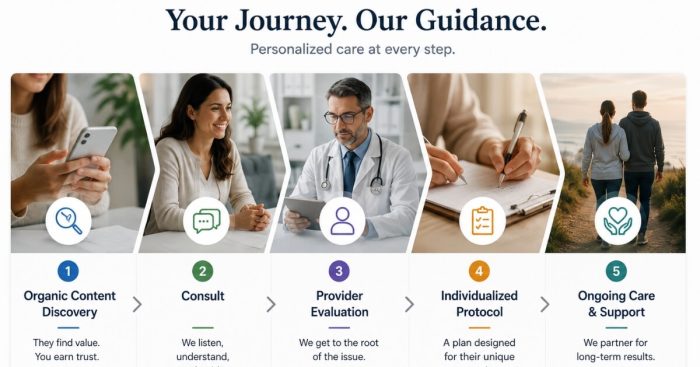
The cleaner flow looks like this:
Discovery → Consult Booking → Clinical Evaluation → Individualized Protocol → Ongoing Monitoring
First, the patient discovers the clinic through content, search, or referrals.
Next, they schedule a consultation.
Then the provider conducts a full evaluation.
Afterward, the provider develops a personalized protocol.
Finally, the patient enters an ongoing monitoring process.
Why this approach improves marketing results
This flow has marketing benefits beyond compliance.
Patients who go through a real evaluation tend to stay longer, refer more often, and purchase additional services.
In addition, they develop stronger trust in the provider relationship.
Consequently, patient lifetime value increases significantly.
How should a peptide clinic price its programs given the supply-side risk?
Price the program, not the molecule. Build in supply-side optionality. Avoid month-to-month subscriptions priced as if any one peptide were a forever-available input.
The supply-side environment is now a business consideration as much as a clinical one.
Why molecule-based pricing creates risk
The supply chain for compounded peptides has tightened materially.
As a result, clinics that priced memberships around specific molecules have often been forced to renegotiate or refund when supply conditions changed.
The pricing model that survives disruption
The pricing structure that holds up is program-based.
The patient pays for:
- Evaluation
- Ongoing monitoring
- Provider access
- Protocol management
The specific therapeutic remains a clinical decision.
Because of that flexibility, the program can continue even when individual therapeutics become unavailable.
A practical pricing structure
A clean structure includes:
- Upfront enrollment: $600–$1,500
- Monthly membership: $200–$500
This membership covers ongoing provider access, monitoring, protocol management, and adjustments.
Meanwhile, therapeutic costs are passed through separately.
Handling supply disruptions
This structure also solves a common patient concern.
If a molecule becomes unavailable, the provider adjusts the protocol.
As a result, the patient relationship continues and the practice’s recurring revenue remains intact.
What does compliant peptide marketing copy actually look like in 2026?
Outcome-category-led, provider-credibility-anchored, evaluation-forward, and program-structured — with no named-peptide hooks in the ad-eligible copy.
Once the operational and compliance pieces are in place, the next challenge is messaging.
Examples of compliant headlines
Compliant headline examples include:
- Metabolic Optimization for Adults Over 40 — A Provider-Led Program at [Clinic Name]
- Recovery and Longevity Medicine — Individualized Protocols, Ongoing Provider Monitoring
- Hormone and Peptide Therapy Consultations — Cash-Pay, No Insurance Required
None of these headlines name a molecule.
However, all of them clearly describe the medical service.
What compliant body copy looks like
Compliant body copy follows the same pattern.
Lead with provider credentials.
Then explain the evaluation process.
Next, discuss the outcome category.
Finally, close with a consult-booking CTA.
The named-peptide discussion belongs inside the provider-patient conversation, not inside the advertisement.
Why early adaptation matters
The clinics that adjusted to this kind of marketing copy over the last 18 months are still running paid spend in the category.
By contrast, clinics that resisted the shift often ended up relying on organic channels after platform restrictions forced their hand.
The same compliance discipline applies to other ad-restricted categories — a multi-channel weight-loss and medspa clinic where we added $6.7 million in revenue in one year on 3,727 new patients navigated GLP-1 ad-policy restrictions the same way: outcome-category creative, provider-credibility anchors, and a compliant funnel from click to consult.
The lesson is simple: get ahead of policy changes before the platform forces the issue.
What’s the next step?
If you run a cash-pay peptide clinic and your ad accounts have been hit with disapprovals, bans, or merchant-processor reviews in the last six months, the marketing motion needs adjustment.
More specifically, the adjustment is structural rather than tactical.
Move from molecule-selling to medical-service marketing.
Move budget from paid ads into SEO, YouTube, and owned audiences until the copy is rewritten.
Rebuild the consult and intake flow so the provider-led evaluation becomes the entry point rather than the exit.
Finally, restructure pricing so the program remains stable even when the supply environment changes.
If you want a 60-minute walk-through of which parts of your current marketing setup are creating policy and compliance risk, which channels you should build into over the next 12 months, and what a compliant funnel from discovery to enrolled patient looks like in your geography, book a strategy call.
We will review your current site, ad assets, and consult flow together.