
How Do You Transition a Pain Management Practice From Insurance to Cash-Pay Without Losing the Patient Base?
Most pain management practice owners want to be more cash-pay. They have watched reimbursement rates erode for a decade, watched their billing department absorb more denials every quarter, and watched the patients who appreciate their work the most pay almost nothing for it.
However, the path from insurance-led to cash-pay-led is where good intentions die. Drop insurance contracts too early and the patient base evaporates. Hold them too long and the practice never builds the cash leg that fills the gap.
So how do successful pain practices make the transition? Let’s look at the process, the timeline, and the operational steps involved.
How Do You Transition a Pain Management Practice From Insurance to Cash-Pay Without Losing the Patient Base?
The short answer is simple: build the cash-pay leg before reducing your dependence on insurance.
You do it in stages, you build the cash-pay leg before you cut the insurance leg, and you sequence by case type — not by patient.
Why Most Practices Get the Transition Wrong
The mistake practices make is treating the transition as a one-day flip.
Drop the largest payer, send a letter to the patient base, hope for the best.
That move works for primary care and concierge medicine because the offering is fundamentally a relationship subscription.
However, it does not work for pain management because pain patients are procedure-shopping inside their condition window.
What the Right Transition Model Looks Like
The model that works is parallel construction.
Keep the insurance book in place.
Identify the case types in the practice that already have a strong cash-pay logic.
Build cash-pay packaging around those case types first.
Real-World Example
The pain practice that ran this exact arc most cleanly is Dr. Groysman, an SGB specialist who grew monthly revenue by $40K and cut his insurance dependence in half.
Same patient base. Same town. Different revenue mix at the end.
Which Case Types Should a Pain Practice Move to Cash-Pay First?
Not every service should be moved to cash-pay immediately.
In fact, sequencing matters.
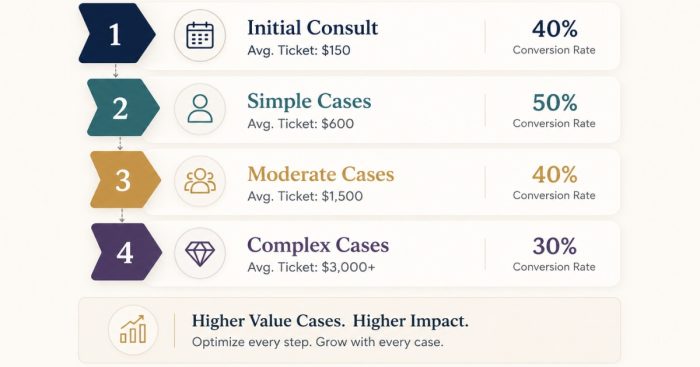
Start With Regenerative Procedures
Regenerative joint procedures first.
The order matters because patient self-selection only works when the cash-pay value proposition is obvious.
The patient who books a regenerative procedure is already mentally in a cash-pay mode.
Move Specialty Programs Second
Specialty programs follow.
SGB for chronic pain, ketamine for treatment-resistant pain, and peptide protocols where legally compliant are common examples.
Add Memberships Third
Memberships come third because they require a working cash-pay base to layer onto.
Layer too early and the membership lacks substance.
Layer at the right time and it becomes recurring revenue.
Leave Basic Injection Codes Last
Basic injection codes stay on insurance for most practices.
For most patients, the cash-pay value proposition is simply too weak.
How Should a Pain Practice Price Its First Cash-Pay Procedure?
Pricing is one of the most important decisions in the transition process.
Price the Outcome, Not the Inputs
Anchor the price to the value of the outcome, not the cost of the inputs.
The instinct is to price by inputs.
However, outcome-based pricing creates stronger positioning and healthier margins.
Package the Program
Package, do not itemize.
A cash-pay patient does not want to know what the vial of PRP costs.
This positioning should also carry through your regenerative medicine marketing, where the emphasis stays on patient outcomes, the treatment experience, and clinical expertise instead of individual procedure components.
Instead, they want to know the outcome, timeline, and expected experience.
Create Clarity Before Presenting Price
Use the 10 Clarities discovery framework to make sure the patient understands the program before the price is on the table.
As a result, pricing conversations become easier and conversion rates improve.
What Do You Tell Patients Who Say, “But I Have Insurance”?
Sooner or later, every provider hears this question.
Reframe the Conversation
You tell them you offer two paths.
Then you explain why the cash-pay path exists.
Finally, you allow them to decide based on their goals.
Explain the Trade-Off Clearly
The mistake most providers make is treating this as an objection.
In reality, it is simply a request for information.
Patients want clarity.
Offer Financing at the Right Time
For price-sensitive patients, financing can be helpful.
However, financing should never be the lead conversation.
Instead, lead with the program and the outcome first.
How Long Does an Insurance-to-Cash Transition Take?
Most owners underestimate the timeline.
Understanding the realities of transitioning a pain practice from insurance to cash-pay helps owners avoid the common mistake of expecting immediate results. The practices that succeed typically treat the transition as a multi-year operational project rather than a quick revenue strategy.
Building the Cash-Pay Leg
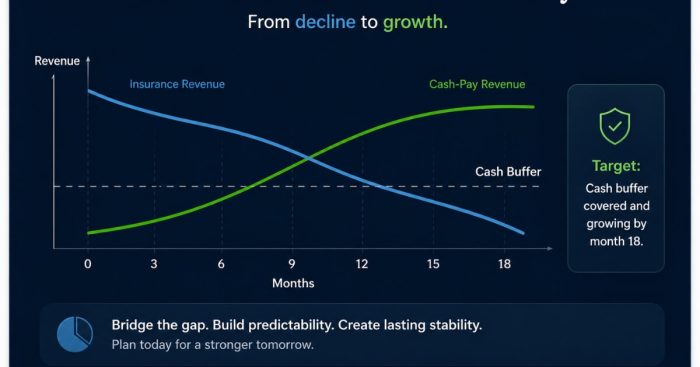
Twelve to eighteen months to build a meaningful cash leg.
Reducing Insurance Dependence
Two to four years to fully wean off the insurance contracts that need to go.
The Three Variables That Determine Speed
The pace is governed by three variables:
- Existing reputation
- Operational discipline
- Provider capacity
Why Operations Matter Most
The variable practices most often miscalculate is operations.
Cash-pay growth requires a different operating motion than insurance billing.
As a result, separate systems and dedicated team members become essential.
What Financial Buffer Should a Pain Practice Keep Before Starting the Transition?
Before making the transition, a financial safety net is critical.
Maintain Six Months of Operating Expenses
Operating expense buffer is non-negotiable.
Six months of payroll, rent, malpractice, equipment leases, and overhead should remain available.
Create a Separate Transition Reserve
In addition, maintain a separate transition reserve of $30K–$60K.
This reserve covers:
- Patient Coordinator hiring
- Program development
- CRM upgrades
- Marketing collateral
- New landing pages
Track Cash-Leg Revenue Growth
The number that matters most is the cash-leg trajectory.
If the cash leg is producing $20K by month six, $50K by month twelve, and $100K by month eighteen, the practice is generally on track.
Learn From Proven Examples
The practices that hit these milestones most consistently often follow proven models.
For example, Elite Pain Doctors’ $2,095,039 growth in 10 months included a meaningful cash-pay leg built alongside the insurance book.
What’s the Next Step?
At this point, the path becomes much clearer.
If you run a pain management practice and want to become less dependent on insurance, start by identifying the services with the strongest cash-pay potential.
Next, package those services into outcome-focused programs.
Then install a dedicated Patient Coordinator seat to improve conversion and follow-up.
Finally, if you want a 60-minute walk-through of which services should move first, how to price them, and what timeline makes sense for your practice, book a strategy call.
We will review your current case mix and payer mix together.