
Should a Concierge HRT Clinic Use a Paid Testing Consult Instead of a Free Discovery Call? (The $650 Stepping-Stone Model)
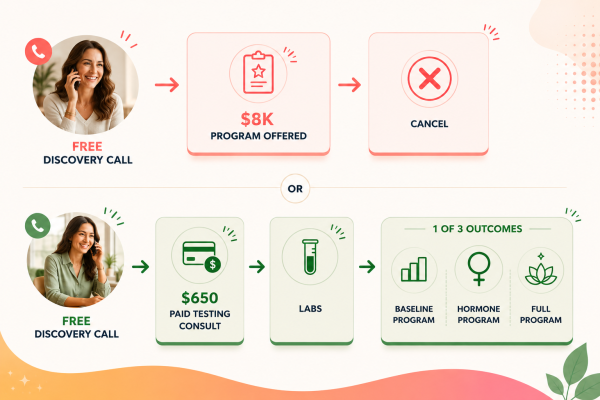
Most concierge HRT and longevity practices either give the initial consult away free or sell straight into a $5K-$10K program from the discovery call. Both lose patients — anxious patients in particular, who buy the program in a moment of clarity and then cancel before their first lab draw. Here is how one of our concierge clients is fixing that with a $650 paid testing consult, the stepping-stone offer that protects the back-end program while keeping every patient on a yes-path.
Should a concierge HRT clinic charge for the initial consult instead of offering a free discovery call?
Yes — for any patient who is not an obvious program fit on the first phone call.
A paid testing-based consult at $500 to $700 filters out tire kickers, captures revenue from patients who would otherwise stall, and turns the appointment from a sales pitch into a clinical interpretation.
The clinic we work with prices this consult at $650 and includes a $300 food-sensitivity panel inside the fee.
Below $500 the patient reads it as a glorified intake fee; above $1,000 the fee becomes its own sales conversation.
The $500-$700 band signals clinical seriousness without scaring off the patients who are merely exploring optimization.
How much should a concierge HRT clinic charge for a paid first consult?
A concierge HRT clinic should charge $500 to $700 for a paid first consult, with diagnostics bundled inside the fee.
Our client’s $650 fee bundles a $300 KBMO food-sensitivity panel; the remaining $350 covers the provider’s interpretation time.
The pricing has to land in a specific window: meaningful enough that the patient is making a commitment, not painful enough that the patient hesitates to schedule.
Anchor it against the back-end program — in our client’s case an $8,000 functional medicine program — so the patient sees the $650 as a fraction of what a full enrollment looks like, not as a standalone fee.
Which new HRT patients should go into a paid testing consult vs. straight to a program enrollment?
Send patients to the paid testing consult when their discovery call does not surface two or more of the core HRT and functional-medicine pillars (gut, detox, hormones, fight-or-flight, muscle), when the patient is framing the visit as “optimization” rather than symptom relief, or when the patient has anxiety that historically makes them a cancellation risk after a high-ticket close.
Patients who already check two or more pillars on the discovery call and have clear, multi-system symptom clusters can skip the testing layer and go directly into program enrollment.
Our client’s own framing:
“Anxiety patients sign up for the eight-grand program, then their logical mind goes out the window, and their anxiety mind takes over, and they are the ones canceling even before they have testing. We have to drip them into that.”
How do you keep anxious longevity patients from canceling after they sign up for an $8,000 program?
Stop offering the $8,000 program first.
Anxious patients buy into the high-ticket program in the discovery call, then cancel before the first lab draw because the cost-anxiety interaction overrides the logic that closed the sale.
A mid-tier paid consult — $500 to $700 — gives them a smaller commitment, builds trust through their own testing, and lets them step into the full program once their results are sitting on the table in front of them.
The case-in-point from our client’s pipeline: a woman with what the founder described as “crippling anxiety” was referred over from a California physician.
On the old free-discovery model, she would have signed up for the $8K program and canceled within ten days.
On the new $650 model, she paid the testing fee, got overwhelmed about an upcoming trip, asked for time, and did not ask for a refund.
The founder’s exact words:
“She is not asking for her money back because it is not eight grand. She is just saying, hey, I need some time.”
A phlebotomist is going to her house Wednesday to draw blood.
How long should a new HRT patient wait between booking the paid consult and the actual appointment?
A new HRT patient should wait 2 to 2.5 weeks between booking the paid consult and the actual appointment — long enough for Quest or LabCorp turnaround on a hormone and metabolic panel plus the bundled food-sensitivity test, short enough that the patient stays engaged.
If your NP pre-reviews the results before the appointment, the consult itself becomes interpretation and protocol design rather than data delivery.
Patient-driven reschedules can stretch this to 3 to 4 weeks; agency-driven delays should not.
The patient who books the consult on Saturday and sees results on the next Friday is the patient who enrolls in the back-end program.
How do I structure a concierge HRT consult so the founder is not the only person who can sell?
Structure the consult around objective lab data instead of founder-led empathy selling.
When the appointment opens with “here is what your bloodwork, gut panel, and hormone results actually show,” any trained clinician or dedicated closer can walk a patient through two or three protocol options and let the data drive the decision.
The script collapses to four beats:
(1) hear the problem;
(2) validate that you have helped patients like that before;
(3) explain that you run testing to get absolutely clear on what they are experiencing;
(4) present the protocol that fits.
As Anton put it on the call with the client:
“It is very duplicatable. You can scale the crap out of that. Instead of it being based off of your charisma, you are using the tools and the framework of the consult.”
For a real-world view of what that scaled-out concierge sales structure produces, see how an HRT clinic we grew from $1M/year to $4M/year in four years built 250 active members at $1,000 per month and removed the owner from day-to-day sales. Owner-removed selling is what the testing-consult framework unlocks at the back end.
Should a concierge HRT clinic build tiered memberships above and below the core program?
Yes — most concierge practices over-rely on a single high-ticket offer and lose patients on either side of it.
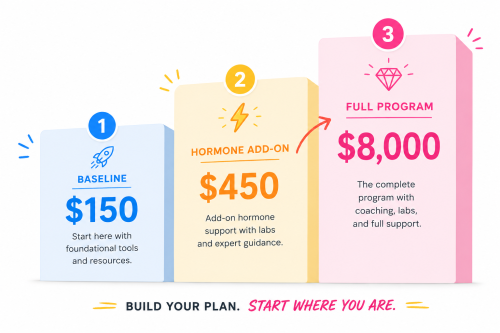
The right structure layers a baseline membership at $150 per month, a hormone-only membership at $450 per month, and the full functional-medicine program at $8,000 underneath one paid testing consult.
Every patient who completes the $650 consult lands in one of those three buckets — there is no patient with nowhere to go.
The membership tiers also stabilize monthly recurring revenue, which otherwise swings $90K+ month to month at this size of concierge practice (our client’s range: $148K in February, $240K in March, $190K in April).
For a parallel example of how a longevity-focused practice scaled with tiered memberships and clinical-data-driven consults, see how a longevity and functional medicine clinic grew website leads by 900% and added 100+ inbound calls per month in just four months.
What should a concierge HRT clinic do this week to roll out the paid testing consult?
A concierge HRT clinic that wants to roll out the paid testing consult should do four things this week:
(1) pick a fee in the $500-$700 band and decide which diagnostics get bundled inside it (food sensitivity, hormone panel, gut panel);
(2) write the four-beat consult script — problem, validation, testing, protocol — so any trained provider can deliver it;
(3) build the three back-end tiers (baseline membership, hormone-only membership, full program) so every consulted patient has a yes-path;
(4) train the new patient coordinator to segment discovery calls into “go straight to program” vs “needs paid testing consult” based on the five-pillar checklist.
If you want help building the script, the tiers, and the patient-segmentation rubric, that is exactly the work we do every day for cash-pay practices.