
What Ranking Factors Does Google Use for a Cash-Pay Medical Practice Website? (Domain Authority, Topical Authority, Search Intent, and Freshness)
SEO is my absolute favorite way to build sustainable lead flow for a cash-pay clinic, and that’s not a marketing line — it’s because the leads are the most ready to buy and the most familiar with the business by the time they hit the schedule button. But every cash-pay practice owner I talk to wants the same thing: a clear, unhyped breakdown of what Google is actually grading their website on. Not “create great content.” Not “build backlinks.” The actual stack of signals, in priority order, with what to do about each one.
This article is that stack. I’ll show you exactly what Google weighs — domain authority, topical authority, search intent match, on-page signals, freshness, and legitimacy — and which ones move the needle for a cash-pay clinic versus which ones are noise. After running every major patient-acquisition channel across 40 of the fastest-growing cash-pay medical clinics in the country, this is the FAQ on what Google ranks a cash-pay medical practice website on.
What does Google actually rank a cash-pay medical practice website on?
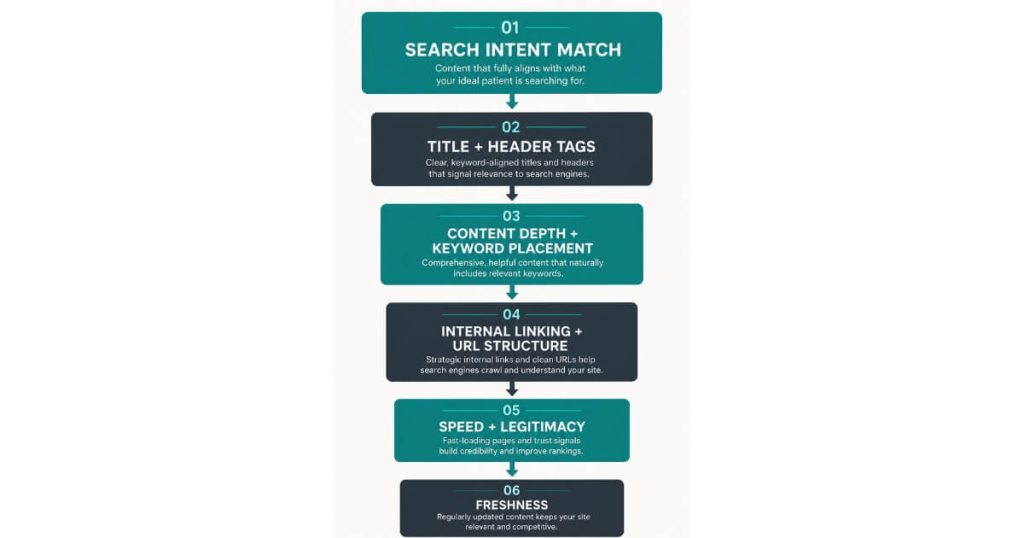
Google ranks your website on domain authority, topical authority, relevance, and frequency of contribution — and the very first check it runs is search intent match. After that match is established, it grades the on-page signals:
- Title tags
- Header tags
- Depth of your content
- Keyword placement
- Internal linking
- URL structure
- Page speed
- Clear business legitimacy
- Fresh content
If you remember nothing else from this article, remember the order.
Search intent match is the gate.
If the content on the page doesn’t answer the actual query someone typed in, none of the other signals matter — Google won’t surface a page about “HRT clinic near me” when someone searched “what is testosterone replacement therapy and how does it work.” Same words, different intent, different page. Cash-pay clinics lose ranking constantly because they cram service-page sales copy under a header that looks like an informational query.
Once intent is matched, the on-page stack runs in the background:
- Title tag matches the query
- H1 confirms it
- The H2s break the topic into the sub-questions a real human would ask next
- The body goes deep enough to satisfy that intent without padding
- Internal links route authority between related pages
- The URL is clean and readable
- The page loads fast
- The site looks like a legitimate medical business (real NAP, real practitioners, real reviews, real schema)
- The content is fresh
Miss any one of those badly enough and you slide. Get them all in line and you compound — which is exactly the dynamic that makes SEO the cheapest, highest-quality lead source in a cash-pay clinic’s mix.
What’s the difference between domain authority and topical authority for a cash-pay clinic — and why does it matter more than backlinks?
Domain authority is how much overall trust Google has assigned your entire site; topical authority is how much trust Google has assigned your site specifically on a topic — and for a cash-pay medical practice, topical authority is what actually wins rankings, because most clinics will never out-link a hospital system but they can absolutely out-cover a hospital system on a tight niche like SGB for PTSD, PRP for knees, or peptide therapy for longevity.
The mistake almost every clinic owner makes is chasing backlinks first. Backlinks roll up into domain authority, sure, but in 2026 Google’s ranking system is heavily weighted toward whether your site demonstrates real, repeated coverage of a specific topic cluster.
If you have:
- One thin page on “bioidentical hormone replacement”
- And a competitor has 27 interlinked pages covering every sub-question a hormone patient could possibly ask
…the competitor wins, even if your domain authority score is technically higher.
Those pages include:
- What it is
- Who it’s for
- The labs they need
- The protocols
- The side effects
- The cost
- The timeline
- The alternatives
Topical authority is built by:
- Depth of coverage
- Internal linking between related pages
- Consistent contribution over time
For a cash-pay practice this is good news. You don’t need a PR campaign.
You need to pick the 3–5 service categories you actually want to be known for and then build out the full question stack underneath each one:
- Service pages
- Condition pages
- FAQ pages
- Comparison pages
- Cost pages
- Protocol pages
…all interlinked.
That’s how a single-location regen clinic out-ranks a 200-location chain on “PRP injection for knee pain in [city].” Topical depth beats raw domain size when the topic is tight and the intent is high.
How does Google check “search intent match” on a cash-pay medical practice page — and how do you actually nail it?
Google checks search intent match by classifying the query into one of four buckets:
- Informational
- Navigational
- Commercial
- Transactional
…and then comparing what’s actually on the page to what pages already ranking for that query look like.
You nail it by:
- Matching the dominant intent type
- Mirroring the format (article vs. service page vs. FAQ vs. comparison)
- Answering the underlying question in the first sentence so both Google and the patient know they’re in the right place
In practice, this means you have to type your target query into Google and look at the top 10 results before you write a single word.
If:
- 8 of the 10 results are informational long-form articles answering “what is” or “how does” → write a long-form article.
- 8 of 10 are service pages with pricing and “book now” CTAs → write a service page.
- They’re hybrid (FAQ-heavy landing pages that double as service pages) → build that hybrid.
Cash-pay clinics constantly publish:
- Service pages where the query wants information
- Informational blog posts where the query wants pricing and booking
That mismatch alone tanks ranking before any other signal is even read.
The second move is mirroring how a patient would phrase the question and answering it in the first sentence under each H2 — exactly the FAQ-style format you’re reading right now.
This is also how you make the page useful for LLM citation, because ChatGPT, Claude, Perplexity, and Gemini all pull from pages structured as direct questions with direct answers.
…is a clean example — most of that lift came from rebuilding the site around the exact questions longevity patients were typing into Google and LLMs, not from adding new traffic channels.
Which on-page factors does Google grade (title tags, headers, depth, keyword placement, internal linking, URL, speed, freshness, legitimacy) and which ones move the needle?
Google grades all of them, but for a cash-pay medical practice they don’t move the needle equally.
These move the needle the most:
- Search intent match
- Title tag
- H2 question-style headers
- Internal linking
- Freshness
These are table-stakes minimums:
- URL structure
- Speed
- Legitimacy
They’re required, but they don’t create lift by themselves.
Here’s how I rank them in priority order for a cash-pay clinic:
1. Title tag
It has to contain the exact query phrasing and signal the format.
Example:
- “What Does PRP Cost in 2026?”
beats - “PRP Pricing Information”
2. H1 and H2 stack
- H1 confirms the title
- H2s are the sub-questions a patient would ask next, phrased verbatim how they’d type them
3. Depth
You have to go deep enough on the topic to actually satisfy intent, which usually means:
- 1,500–2,500 words on a real service or condition page
- Not 400
4. Keyword placement
Natural use of the target query and its variants in:
- The first paragraph
- The H2s
- The conclusion
No stuffing.
5. Internal linking
Every page should link to 3–5 related pages on the same topic cluster using descriptive anchor text.
That is how topical authority gets transmitted.
Then the lower-leverage but still required signals:
- URL structure should be short and human-readable
- The page should load in under 2.5 seconds on mobile
- The site should show clear business legitimacy
- The content should be fresh
Legitimacy includes:
- Real NAP
- Real practitioners with credentials
- Real reviews
- Real medical-business schema
- An SSL cert that isn’t expired
Get the top five right and you’ll out-rank competitors who only have the bottom four right. Get only the bottom four right and you’ll be invisible no matter how fast your site loads.
How often does a cash-pay medical practice need to publish fresh content for Google to keep ranking it?
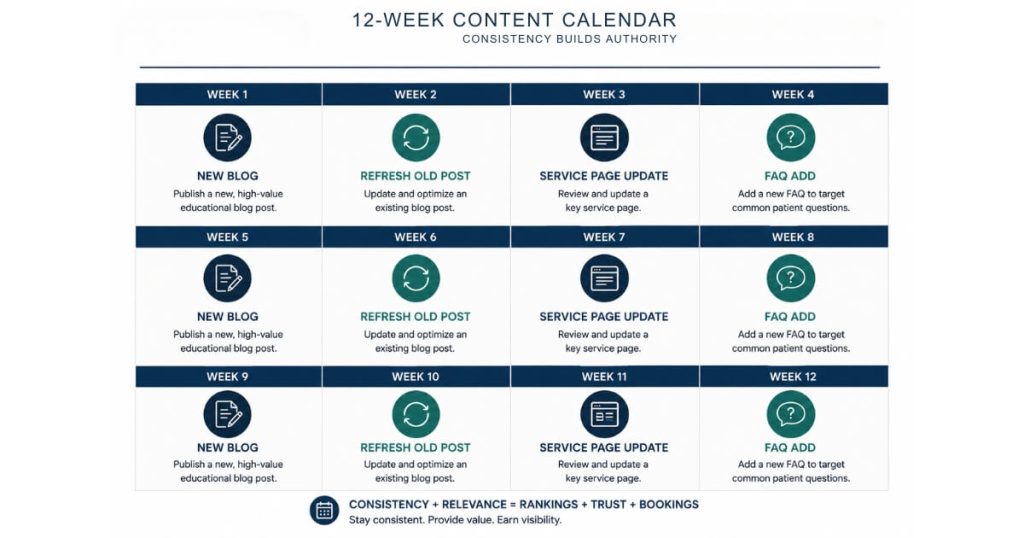
A cash-pay medical practice needs to publish or meaningfully refresh content at least 4–8 times per month to signal “frequency of contribution” to Google.
The mix should be roughly:
- 50% new content
- 50% updates to existing high-value pages
New content includes:
- Blog posts
- FAQ pages
- Condition pages
Existing-page refreshes include:
- Service pages
- Pricing pages
- Top-ranking blog posts
Freshness is one of Anton’s four core ranking factors:
- Domain authority
- Topical authority
- Relevance
- Frequency of contribution
…and it’s the one most clinics flat-out ignore.
They:
- Build a site
- Launch 12 service pages
- Write 3 blog posts in the first quarter
- Then never touch the site again for 18 months
Then they wonder why a new competitor that publishes weekly out-ranks them on their own service names.
Google interprets a static site as a dead site, especially in a YMYL (your-money-or-your-life) category like medical, where stale information is a real patient-safety concern.
The practical cadence:
- One new blog post per week
- One FAQ or condition-page addition per week
- A rolling refresh of the top 5 highest-traffic pages every 60–90 days
Updates should include:
- Prices
- Case-study numbers
- New patient questions from sales calls
- Updated date stamps where the content was actually changed
That cadence is:
- Sustainable for a clinic team
- Frequent enough to satisfy Google’s freshness signal
- Compounding over time
Stop publishing and the curve flattens. Keep publishing and the curve keeps climbing.
Why are SEO leads “the most ready to buy and most familiar with the business” — and what does that mean for your sales process?
SEO leads are the most ready to buy and most familiar with the business because by the time they fill out a form or call your clinic, they’ve:
- Typed a specific problem into Google
- Read your content end-to-end
- Voluntarily clicked through 2–4 of your pages
- Seen your reviews
- Scrolled your team page
- Decided you’re the answer
That is a level of pre-qualification no paid-ads click will ever match.
Map that against the 5 Stages of Awareness:
- Unaware
- Problem Aware
- Solution Aware
- Product Aware
- Most Aware
People buy when they’re Most Aware.
SEO traffic walks itself from Problem Aware to Most Aware while still on your site, because they self-select through the question-by-question content stack.
A Facebook or TikTok lead, by contrast:
- Is usually Problem or Solution Aware
- Needs to be walked the rest of the way by your sales team
The SEO patient is doing that work themselves before they even speak to you.
That is why SEO leads consistently produce:
- The highest show rates
- The highest close rates
- The lowest sales-rep effort per closed case
What this means for your sales process:
Stop treating SEO leads the same as paid-ads leads.
They need:
- Faster intake
- Lighter intake
- Less qualification friction
They’ve already done the consultation in their head.
Don’t:
- Over-qualify
- Force a long discovery call
- Push them through a high-friction quiz when they’re ready to schedule
The right play is:
- A credit-card-hold scheduling page directly off the high-intent page
- A confirmation process that respects how prepared they already are
And couple SEO with:
- Strong Google reviews
- An established social brand
Those reinforce the trust the patient was already building while reading your site.
What’s the next step?
If your cash-pay medical practice is publishing content but not ranking — or ranking but not converting — the gap is almost always one of three things:
- Search intent mismatch on your top-traffic pages
- Topical authority that’s a mile wide and an inch deep
- A freshness cadence that died after the launch sprint
Diagnose those three, fix them in the order I listed in this article, and you’ll see ranking and lead flow move within 60–90 days.
SEO is the cheapest, highest-quality lead source in cash-pay medicine when it’s set up correctly — and the compounding curve is why it stays my favorite channel even as paid platforms get more expensive every year.
If you want a second set of eyes on which ranking factors are actually holding your site back, that’s the conversation we have on a strategy call.
We’ve done it for clinics across:
- HRT
- Regen
- Longevity
- Weight loss
- Ortho
- Pain
Including:
a regenerative medicine clinic where we generated $309,590 in cash-pay revenue in 10 months without paid ads, with a 79.4% lead-to-booked conversion rate
Zero ad spend, all from getting on-page SEO right.