
How Should a Multi-Service Cash-Pay Clinic Triage Weight-Loss, Hormone, and Primary-Care Callers?
A multi-service cash-pay clinic — weight loss, hormones, primary care, ADHD — has a unique front-desk problem: every caller wants something different, and a single generic script converts none of them well. The fix is a triage script with one routing question at the top and a dedicated path beneath it for each service. Here’s the FAQ on exactly how to route and book weight-loss, hormone, and primary-care callers from the same phone line — pulled from a real multi-service clinic’s script.
How Should a Multi-Service Cash-Pay Clinic Triage Callers on the Phone?
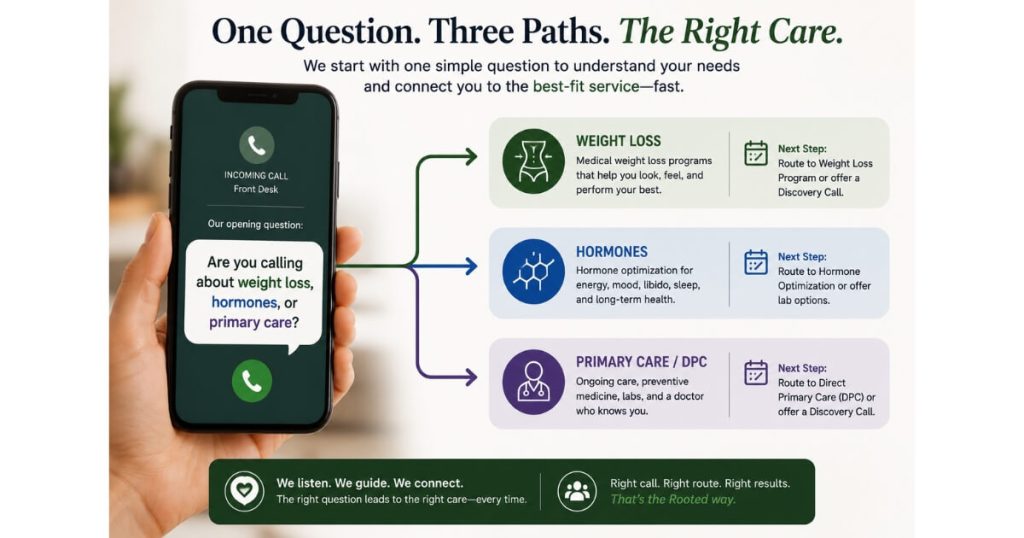
Open with one routing question, then run the path that matches the caller’s answer. The triage happens in the first fifteen seconds, and everything after it is service-specific.
The mistake multi-service clinics make is forcing every caller through the same funnel.
A:
- GLP-1 caller
- Hormone caller
- Primary-care caller
Have completely different objections, price structures, and next steps — so the front desk has to identify which one they’re talking to before anything else.
The opener does it: after the greeting, if the caller doesn’t volunteer their reason, the front desk offers the menu:
“Are you calling about weight-loss injections, hormones, or primary care and ADHD… or something else?”
Then jumps straight to the matching path.
The process is simple:
- Ask the routing question.
- Identify the service line.
- Follow the matching script.
- Book the next step.
One question, three doors, and the rest of the call is tailored.
This kind of structured intake is the backbone of any predictable patient acquisition system.
What’s the Opening Line That Routes a Caller to the Right Service?
“Thank you for calling [Clinic], this is ___. Who am I speaking with?”
Then:
“Hey ___, how can we help you today?”
If they don’t volunteer it:
“Are you calling about weight-loss injections, hormones, or primary care and ADHD… or something else?”
Notice the order.
- Name first, so the rest of the call is personal.
- Open “how can we help” to let them self-route.
- Only then offer the menu if needed.
The menu itself does double duty because it signals the clinic offers all three services, which often surfaces a cross-sell:
“Oh, you do hormones too?”
Once the caller picks a lane, the front desk drops into that path and never makes them repeat themselves.
How Should the Front Desk Handle a Weight-Loss or GLP-1 Caller?
Qualify briefly, get permission to explain, then book a free discovery call held with a card on file. Never quote a dose or a price — that’s the provider’s job.
The weight-loss path is fast.
First qualify:
- “Have you done weight-loss injections before, or would this be your first time?”
- “About how many pounds are you looking to lose?”
Then ask permission:
“Would you like me to explain what it looks like to get started here?”
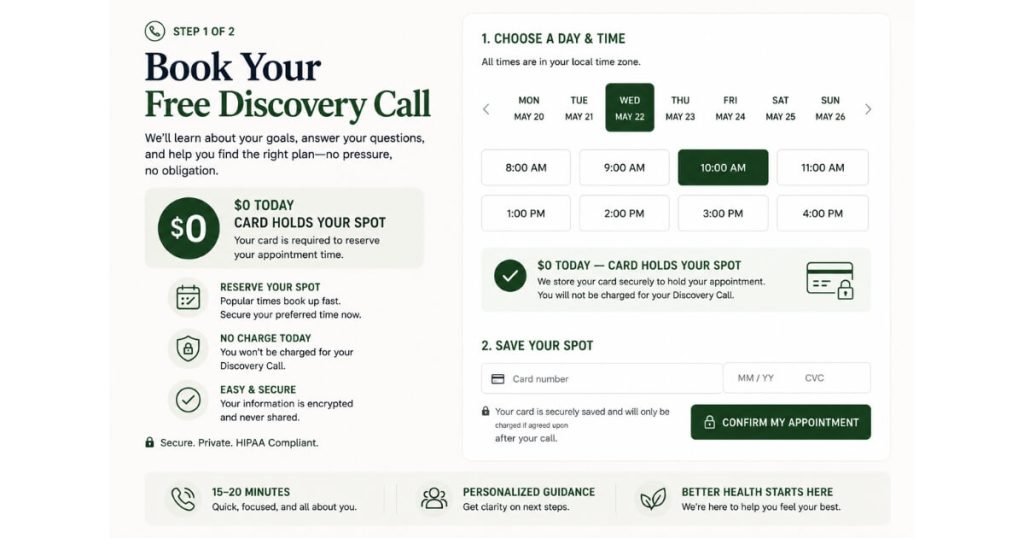
The next step is a complimentary discovery call with a provider who:
- Reviews goals
- Reviews health history
- Builds a safe plan
The booking close is the card on file:
“There’s no charge for the call. We just keep a card on file to reserve the appointment so we don’t give your spot away. It’s zero dollars today; it only gets used if you no-show without letting us know.”
Then assume the close:
“What day works best, early in the week or later? Morning or afternoon?”
And book it.
How Should the Front Desk Handle a Hormone Caller?
Explain the two-step labs-then-review structure, quote the two fees, and frame the review fee as credited toward the first month of membership if they move forward.
The hormone path has more structure because hormones require labs first.
The front desk explains it plainly:
Step 1
Comprehensive labs, paid to the clinic (for example, $300), with a lab order sent out.
Step 2
The hormone review visit (for example, $300), where the provider reviews the labs and designs a plan.
The close is the credit:
“If you decide to start on our membership, that $300 consultation fee is credited toward your first month — so effectively the review is free if you move forward.”
That framing removes the sting of paying for the consult, because it converts the fee into a deposit on care.
Then book the review and collect the labs payment, same assumptive-close pattern as every other path.
What Should the Front Desk Say When the Caller Just Wants Pricing?
Explain — warmly — that price depends on the dose and the provider’s recommendation, so quoting a number without a provider review would be unsafe, and the fastest way to a real number is the free call.
Every multi-service clinic gets the:
“I just want to know your pricing”
caller.
The script handles it without stonewalling:
“I totally get that. Our pricing is based on the dose and the specific medication, and because I’m not a medical provider, it’s actually unsafe for me to guess on a dose or price without the provider reviewing your situation. The good news is that discovery call is complimentary — the provider will tell you what they recommend, go over exact dosing, and give you precise pricing before you decide anything. So the fastest way to get a real number is to get you on that free call.”
It reframes the price question as a reason to book, not a reason to hang up — and it’s honest, because dose-dependent pricing genuinely can’t be quoted at the desk.
How Do I Handle the Caller Who Wants to Run Labs Through Insurance?
Acknowledge the instinct, then explain the surprise-bill risk and the clinic’s negotiated cash-lab pricing so the patient knows the cost up front.
Hormone callers often ask to bill labs to insurance.
The script doesn’t argue — it empathizes and educates:
“Gosh, it’s not that we don’t want that for you. It’s just that when we’ve done that in the past, a lot of people ended up getting surprise bills for thousands of dollars months later — insurance codes things weird, denies parts of the panel, and the patient gets stuck with it. So instead, we negotiated discounted labs through the practice, so you know the cost up front, it’s controlled, and you don’t get a surprise bill later.”
That positions cash labs as protection, not an upsell — which is exactly how a confident cash-pay clinic should frame every place it diverges from insurance, the same way a multi-service weight-loss and medspa clinic we helped add $6.7M in revenue across 3,727 new patients in one year built its intake around clarity and speed.
How Should Every Call End at a Multi-Service Clinic?
With a scheduled next step — always. If the caller truly won’t book, the fallback is texting the scheduling link to keep the lead alive.
No call ends without a next step.
If the caller books, great.
If they hesitate, the front desk doesn’t let them drift off into:
“I’ll think about it”
Instead, offer the soft landing:
“Totally fine. If it’s okay with you, I’ll text you our scheduling link so when you’re ready you can grab a spot before they fill up. What’s the best cell number?”
This:
- Captures the mobile number
- Keeps the lead in the follow-up system
- Gives the chase sequence something to work with
A multi-service clinic lives or dies on this discipline, because three service lines mean three times the volume slipping through the cracks if every call doesn’t end with a committed next action.
FAQs About Multi-Service Clinic Call Triage
What’s the First Thing the Front Desk Should Do on a Multi-Service Clinic Call?
Get the caller’s name, then route them with one question — “Are you calling about weight loss, hormones, or primary care?” — and run the path that matches their answer. Triage first, tailor everything after.
Should the Front Desk Quote Prices for Weight-Loss or Hormone Services?
No. Pricing depends on the provider’s dose and plan, so the front desk should explain that quoting without a provider review is unsafe and that the free discovery call is the fastest way to a real number.
How Do You Book a Free Discovery Call Without No-Shows?
Hold the appointment with a card on file framed as “$0 today — it only gets used if you no-show without letting us know.” It reserves the slot and filters out the least-committed callers without charging anyone up front.
How Do I Handle a Hormone Caller Who Wants to Use Insurance for Labs?
Empathize, then explain the surprise-bill risk and the clinic’s negotiated cash-lab pricing so the patient knows the cost up front. Frame cash labs as protection from unpredictable insurance billing, not as an upsell.
What Should the Front Desk Do if a Caller Won’t Book?
Offer to text the scheduling link and capture the cell number, so the lead stays in the follow-up system. No call should end without either a booked appointment or a committed next step.
What’s the Next Step?
If your multi-service clinic runs every caller through one generic script, you’re converting your weight-loss, hormone, and primary-care leads at a fraction of their potential. A triage script — one routing question, a dedicated path per service, a card-on-file close, and a next step on every call — fixes that without adding a single lead.
If you want help building the triage script and the booking system around your specific service mix, that’s the conversation to book. We’ll map your call flow and show you where each service line is leaking.