
Why Is a Membership Model the Key to Scaling a Cash-Pay Healthcare Business? (The Cash-Flow Stability That Lets You Hire Ahead)
Every clinic owner who’s tried to scale on one-off treatments knows the feeling: a great month, followed by the dread of having to do it all again from zero. The clinics that actually scale don’t start at zero. They sit on a base of members paying monthly — and that stability, more than any marketing tactic, is what funds the next provider, the next location, and the owner’s sleep. This is the FAQ on why memberships are the key to scaling a cash-pay healthcare business, and how to start building the base.
Why is recurring membership revenue the foundation for scaling a clinic?
Because scale requires investment, and investment requires knowing the revenue will be there next month —
“having stability in your cash flow makes it very easy to scale and make the investments into the business and still be able to sleep at night.”
That’s the core of it, straight from the source:
When most of your patients are on membership:
- you don’t have to worry about churning a lot of customers month to month
- the revenue base carries forward
- growth becomes predictable
Every growth decision a clinic makes is a bet placed against future revenue:
- hiring
- equipment purchases
- a second location
- more ad spend
A membership base turns that bet from a gamble into arithmetic.
A transactional clinic can have identical revenue on paper and none of the same scalability, because its revenue resets monthly.
The membership clinic’s January is built on December’s base.
The transactional clinic’s January is built on hope.
What is the acquisition treadmill, and why does it cap growth?
It’s the trap of needing to re-acquire your entire month’s revenue every month:
“I’ve got to acquire 40 new this month because I acquired 40 new last month, or else I’m not going to be able to hire a new provider.”
On the treadmill, acquisition isn’t growth — it’s maintenance.
The 40 new patients you win this month replace the 40 one-off patients who finished treatment last month, and the clinic ends the year bigger in effort but not in base.
Worse, the treadmill compounds against you:
- ad costs rise
- the team burns out on perpetual urgency
- every soft month threatens payroll instead of merely denting the growth rate
The membership model flips what acquisition means.
Each new member adds to a base you keep, so this month’s marketing builds next year’s revenue instead of merely refilling this month’s bucket.
Same ad spend.
Completely different trajectory.
Which is why the membership conversation belongs at the center of any serious patient acquisition strategy.

How does cash-flow stability change hiring decisions?
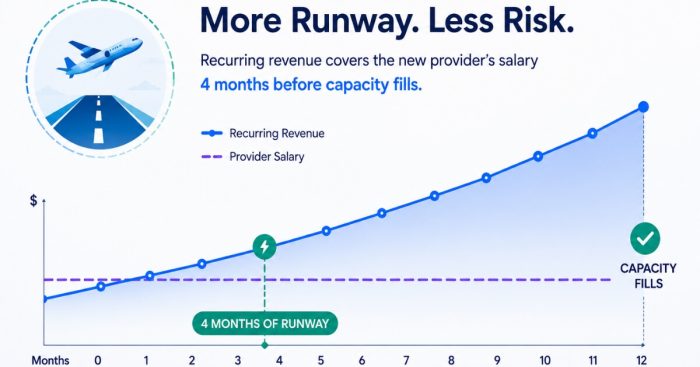
It lets you hire ahead of demand instead of behind it — the new provider is funded by the membership base before their schedule fills.
The hardest hire in any clinic is the one made too late:
- The owner waits for capacity to be bursting.
- Recruiting starts too late.
- Patients wait weeks for appointments.
- Referrals leak away.
The membership base removes the fear that forces that delay.
When you know within a few percent what next quarter’s revenue will be, a provider salary is a calculable runway item, not a leap of faith.
The mechanism is simple:
Predictable revenue → Confident hiring → More capacity → More members → More predictable revenue
Eternity Health Partners rode exactly that loop from $1M to $4M a year, building a base of 250 members paying $1,000 a month — and the recurring base is what let the owners step out of the day-to-day without the revenue stepping out with them.
What does a membership base do to the value of the business?
It’s the difference between selling a business and selling a job — buyers pay multiples for revenue that continues without the owner.
A practice built on one-off treatments is valued on the owner’s ability to keep generating patients.
A practice built on memberships is valued on:
- a contracted recurring book
- predictable cash flow
- revenue that transfers with the sale
The same logic that lets the owner sleep at night lets a buyer underwrite the deal:
the revenue doesn’t depend on next month’s marketing performance.
The stability story also applies before any exit.
Practices that shift from volatile reimbursement or one-off procedures toward recurring cash-pay revenue change their own risk profile — the way Dr. Groysman’s pain practice grew monthly revenue by $40K+ while cutting insurance dependence in half, trading payer volatility for revenue the practice controls.
How does a transactional clinic start converting to memberships?
Find the recurring core inside what you already sell, package it as a monthly membership, and put every new patient on the ladder from day one.
Almost every cash-pay vertical has a recurring spine:
- hormone optimization and TRT
- weight-loss programs with maintenance phases
- DPC and concierge primary care
- regenerative medicine follow-up care
- aesthetic maintenance programs
- wellness monitoring and labs
The membership isn’t a new service.
It’s the continuity of care you already deliver, priced as a relationship instead of a series of invoices.
Execution then follows the playbooks we’ve covered across this library:
- Present the membership inside a tiered investment ladder.
- Anchor it with a consult-and-labs checkpoint cadence.
- Keep members seeing measurable results.
- Wire refill and renewal systems into the CRM.
- Prevent the base from quietly leaking.
Stability isn’t won at the sale.
It’s kept in the delivery system.
FAQ’s About Memberships and Scaling a Healthcare Business
Why do memberships make a clinic easier to scale?
Because recurring revenue carries forward month to month.
Growth investments:
- providers
- locations
- ad spend
are underwritten by a predictable base instead of by next month’s sales performance.
What’s wrong with growing on one-off treatments?
You inherit the acquisition treadmill.
Every month starts at zero.
Marketing spend maintains revenue instead of compounding it.
Any soft month threatens payroll rather than just the growth rate.
How does a membership base change hiring?
It lets you hire providers ahead of demand.
When next quarter’s revenue is predictable within a few percent, a new salary is a runway calculation — not a bet that keeps the owner up at night.
Do memberships increase what the practice is worth?
Substantially.
Buyers pay multiples for contracted recurring revenue that transfers with the business.
One-off treatment revenue is discounted because it depends on the owner’s continued marketing performance.
Which services convert best into memberships?
Anything with ongoing care built in:
- hormone optimization and TRT
- weight-loss maintenance
- DPC and concierge primary care
- follow-up-heavy specialties
- monitoring programs
- labs and wellness services
Anything that naturally creates an ongoing relationship can be packaged into a monthly membership.
What’s the next step?
If your clinic’s growth plan is:
“do last month again, plus 10%”
you’re scaling effort, not the business.
Find the recurring core in your service menu.
Then:
- Package the membership.
- Start every new patient on it.
- Build the recurring base.
Because the provider you’ll need to hire next year is funded by the members you sign this quarter.
If you want the membership model designed for your practice — the offer, the pricing ladder, the retention machinery, and the acquisition engine that feeds it — book a strategy call.
We’ll map your recurring-revenue architecture on the call and connect it to your medical practice marketing and patient acquisition systems.