
Should a MedSpa Lead Its Ads With Botox and Filler — or With HRT, Weight Loss, and Hair Restoration?
Most medspas default to advertising Botox and filler because that is what they think of as their product. It is also the worst front door they could pick for paid ads. Botox is a price-shopped commodity — everyone runs the same offer, the margins get squeezed, and organically you are buried under Maps, AI answers, and sponsored slots. The clinics that scale lead with something else entirely: hormones, weight loss, and hair restoration — higher-value, repeat-purchase services that bring in cheaper leads and then feed the aesthetic chairs anyway. Here is the FAQ on which services a cash-pay medspa should actually advertise, and the HRT funnel that converts them.
Should a medspa lead its ads with Botox and filler, or with HRT and weight loss?
Lead with HRT, weight loss, and hair restoration. Botox and filler are commodity front doors — everyone competes on the same offer and price, so they make the most expensive, least loyal leads you can buy.
The logic is about lifetime value, not service margin.
A Botox patient comes in for a discounted vial, shops you against three medspas down the street, and may never return at the price you need.
A hormone patient signs up for a recurring membership.
A weight-loss patient runs a multi-month program.
A hair-restoration patient buys a five-figure case.
Those are the services worth paying to acquire, because the patient is worth something after the first visit.
And here is the part most owners miss: the hormone and weight-loss patient you acquire cheaply becomes a Botox and skin patient later, inside your own ecosystem, at no additional ad cost.
The high-LTV service is not competing with your aesthetics — it is the cheaper front door that fills your aesthetic chairs.
This is the strategic advantage behind leading med spa ads with HRT, weight loss, and hair: instead of competing for one-time cosmetic purchases, you’re acquiring patients through recurring-revenue and high-LTV services that naturally cross-sell into injectables, skin treatments, and body-contouring programs over time.
Why is Botox a bad front-door offer for paid ads?
Because it is a commodity — undifferentiated, offer-driven, and price-competitive — so you are bidding against every other medspa for a patient who is choosing on price.
When a service is identical everywhere, the only lever left is the offer, and the only direction an offer goes in a commodity market is down.
You discount to win the click, the patient compares you to the next discounted offer, and your acquisition cost climbs while your margin shrinks.
Organically it is no better — search for Botox in a saturated market and the practice’s own page is often on page two, behind the map pack, AI overviews, and sponsored listings.
The fix is not to advertise the commodity harder.
It is to take a service, find its unique mechanism, and rebrand it as a named, exclusive protocol you own — so you are no longer selling the generic thing everyone sells.
That is how you justify cash pricing and absorb rising ad costs instead of racing competitors to the bottom.
What does a high-converting HRT landing page actually look like?
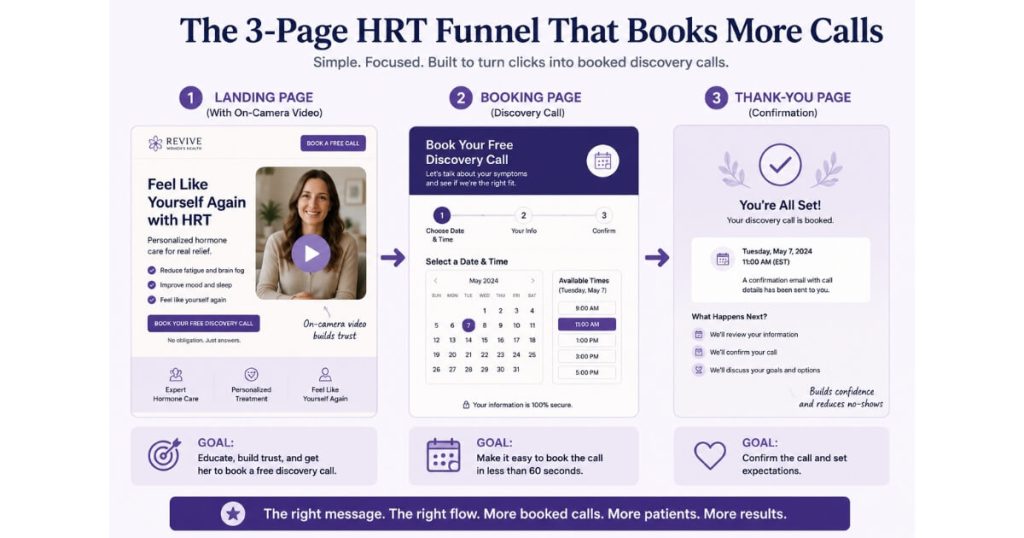
A simple three-page funnel — a landing page, a discovery-call booking page, and a thank-you page — with a short, real, on-camera video on the landing page, because the version with the video outperforms the identical version without it.
Do not overbuild it.
- Page one introduces the offer and carries the video.
- Page two is the booking page with a calendar plugged in for a telehealth or in-office consult.
- Page three is the thank-you page that confirms and sets expectations.
Model the structure on a proven women’s-hormone company rather than designing from a blank canvas.
The video is the single highest-leverage element.
The same funnel converts measurably better with a real person on camera than without one, and the best-performing creative is not a polished brand spot — it is a roughly one-minute “mock consultation” walking through real symptoms, the kind of relatable, dismissed-then-relieved story that makes a viewer think “that’s me.”
Shoot it with your actual provider and a camera-comfortable staff member.
How do I price an HRT membership offer so patients actually enroll?
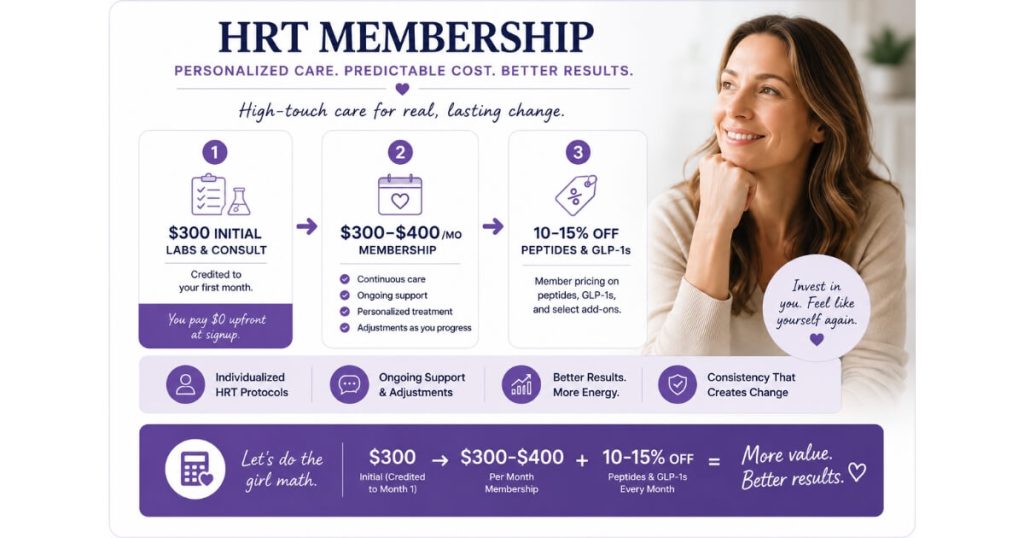
Charge $300 up front for initial labs and the consult, then credit that $300 toward the first month if the patient enrolls — so it feels like a gift, not a sunk fee.
That credit is the conversion lever.
The patient pays $300 to find out what is going on, and if hormone therapy is a fit, the $300 rolls into month one — “girl math” that feels like getting the money back.
If it is not a fit, she keeps the labs and supplement guidance and you keep a clean reputation.
Set the monthly membership at $300 to $400, bundling follow-up labs, follow-up consults, and the hormone medication itself.
Then make the membership stickier with adjacent discounts:
- 10 to 15% off peptides
- 10 to 15% off GLP-1s for members
Drop-ship the medications to the patient from a pharmacy and run the campaign statewide rather than national, because hormone offers are hard to make work across state lines.
A blended telehealth-and-in-person model lets a part-time or multi-location provider see patients in the office on clinic days and handle the rest virtually.
How cheap can hormone leads actually be compared to aesthetic leads?
Hormone leads can run around $4 each on TikTok — dramatically cheaper than Meta medspa leads — and in a recent month that traffic produced 40 hormone-patient purchases out of 300 leads.
That is the entire economic argument in two numbers.
A four-dollar lead that converts at better than one in ten into a recurring membership is a fundamentally different business than a Botox lead you fought to win on price.
Higher-ticket services like hair restoration sit at the other end — plan for an $800 to $1,200 cost per acquisition there — but those cases run $8,000 to $12,000, so the math still works when the offer and follow-up are dialed in.
The discipline is to watch acquisition cost across services and let the numbers route your budget.
If hormone and weight-loss leads come in cheaper than aesthetic leads — and they usually do — shift spend there and let those patients feed the rest of the practice.
We watched exactly this multi-channel compounding play out at a weight-loss and medspa clinic where we added $6.7M in revenue in one year across 3,727 new patients, where the weight-loss and hormone demand pulled patients in and the aesthetic services captured them on the back end.
Do hormone and weight-loss ads really bring in MedSpa patients anyway?
Yes — the hormone and weight-loss patient you acquire cheaply is an ideal long-term aesthetics buyer, so the high-LTV front door fills your Botox and skin chairs without a separate ad campaign.
A menopausal or weight-loss patient is exactly the person who later wants the skin treatment, the injectable, the body service.
Once she is inside your ecosystem on a recurring hormone membership, every other service you offer is a cross-sell instead of a cold acquisition.
You paid four dollars for the lead once and you monetize her across years and services.
This is why the front-door choice matters so much.
Lead with the commodity and you fight for one-off, price-shopping visits.
Lead with the high-LTV service and you build a membership base that buys aesthetics on top.
Recurring, research-driven hormone and longevity patients are the ones who compound — the same pattern behind an HRT clinic we grew from $1M to $4M a year on a membership model.
FAQ’s About Whether a MedSpa Should Lead With Botox or HRT
What services should a cash-pay medspa actually advertise?
Lead with HRT, weight loss, and hair restoration rather than Botox and filler.
Those services produce recurring or high-ticket revenue and cheaper leads, while Botox is a price-shopped commodity that competes on discounts.
The hormone and weight-loss patients you acquire become aesthetics patients later inside your own ecosystem.
Why does a video on an HRT landing page matter so much?
Because the same funnel converts measurably better with a real person on camera than without one.
The best-performing creative is a roughly one-minute mock consultation that walks through relatable symptoms, not a polished brand spot.
Shoot it with your actual provider so it reads as authentic.
How should I structure an HRT membership offer?
Charge $300 up front for initial labs and the consult, then credit that $300 toward the first month if the patient enrolls so it feels like a gift.
Set the monthly membership at $300 to $400, bundling follow-up labs, consults, and the medication, and add 10–15% off peptides and GLP-1s for members.
How much do hormone leads cost versus aesthetic leads?
Hormone leads can run around $4 each on TikTok, far cheaper than Meta medspa leads, and a recent month produced 40 purchases out of 300 leads.
Higher-ticket services like hair restoration cost more to acquire — roughly $800 to $1,200 per case — but those cases are large enough that the math still works.
Should I run my hormone campaign nationally or statewide?
Keep it statewide.
National targeting is hard to make work for hormone offers, and a blended telehealth-plus-in-person model lets a part-time or multi-location provider handle in-office and virtual patients efficiently.
Drop-ship medications from a pharmacy to support the virtual side.
What’s the next step?
If your medspa has been pouring ad budget into Botox and filler and wondering why the leads are expensive and disloyal, the problem is the front door, not the ad account.
Lead with HRT, weight loss, and hair restoration — the cheaper, higher-LTV services — build the three-page HRT funnel with a real on-camera video, and let those patients feed your aesthetic chairs.
If you want someone to map which services to advertise, build the HRT funnel and offer, and set the acquisition-cost targets that route your budget, that is the conversation to book.
We will pull your treatment menu apart and find the cheaper front door on the call.