
How Do You Build an HRT Med Spa Campaign With Landing Pages That Convert?
An HRT med spa campaign lives or dies on one thing most clinics get wrong: the page the ad sends traffic to.
You can buy cheap, high-intent hormone clicks all day.
But if they land on a homepage built for surgical patients and Botox shoppers, the money leaks out before anyone books.
This is the field playbook for the full flow — the hormone ad, the landing page, the booking step, and the offer that ties them together.
It is also the answer to how to build an HRT med spa marketing campaign with landing pages that convert.
Why does an HRT med spa campaign need a dedicated landing page instead of just sending ad traffic to the website?
Because a dedicated landing page lets you control the offer, the message match, and the conversion tracking.
Those are three things a general website homepage cannot do.
A homepage serves every visitor at once:
- Surgical patients
- Botox patients
- Weight-loss patients
- Hormone patients
A hormone landing page does one job.
It turns a woman who clicked a hormone ad into a booked consult.
Message match matters more here than anywhere.
If the ad says “feeling off, irregular periods, exhausted — get your hormones checked,” the page must repeat that exact promise in the headline.
It cannot bury it under a menu of fifteen services.
Every extra link is a chance to leave.
There is one real exception.
If the practice already has a recognizable name — a surgeon whose reputation carries weight locally — branded traffic to the established site can pull more inquiries than a cold landing page.
That is because credibility does the converting.
We saw exactly that with a hair-restoration campaign.
The dedicated page underperformed, and routing traffic to the known surgical site produced more inquiries.
But that is not scalable.
For a repeatable, trackable campaign, you want a dedicated page.
A homepage gives you almost no conversion signal to optimize against.
For the bigger picture on where each cash-pay service should be marketed, our med spa marketing agency overview maps channels to treatments.
What does the ad-to-landing-page-to-booking flow look like for a hormone med spa?
It is a three-page funnel.
A hormone ad drives to a landing page.
The landing page sends to a discovery-call or consult scheduler.
A thank-you page confirms the booking.
The ad does the targeting and the hook.
The best-performing hormone ad we run is not a polished brand spot.
It is a mock consultation, about a minute long, where an employee and the provider walk through real symptoms the way a patient would describe them.
It feels like eavesdropping on a conversation rather than watching a commercial.
On TikTok, that creative has produced leads at roughly four dollars each.
The landing page repeats the ad’s promise, carries proof, and offers one clear action.
Page two is the scheduler.
That can be a discovery call, telehealth consult, or in-office booking, wired to whatever calendar the clinic uses.
For a clinic with a part-time provider at a satellite location, the flexibility matters.
Patients book in-office for the days the doctor is there.
Or they book telehealth for the days he is not.
Page three confirms.
Each page has one job and hands off cleanly.
Run to a bare lead form for raw volume.
Run to the landing page for quality.
Run to a scheduler with a card hold when you only want people ready to book today.
For a hormone med spa, the landing-page-to-scheduler path is the default.
That is because hormone buyers are high-intent and high-lifetime-value.
What does a high-converting HRT landing page actually contain?
A symptom-led headline, a short video, a clear offer, and one booking action.
In that order.
With nothing competing for attention.
The headline speaks to how the patient feels, not the chemistry:
- Irregular periods
- Low energy
- Brain fog
- Feeling “off”
- Being told your labs are fine
The single most important element is the video.
The same landing page with a video converts measurably better than the identical page without one.
That is because video builds trust before the patient talks to anyone.
The video should not be the doctor reciting credentials.
The best ones are a relatable story.
Ours came from a true story about a 34-year-old mother of three who felt off, was told her levels were fine, and was offered birth control.
Then she got proper functional labs and felt better in a week.
A co-owner retold that story to camera, and that is the version that converts.
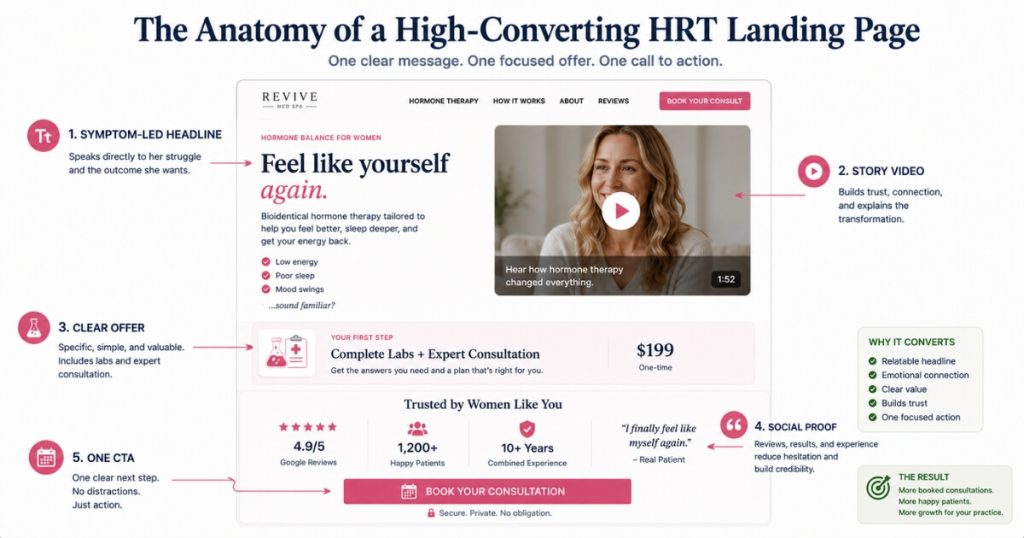
Below the video sits the offer.
State it plainly so it matches the ad and the website:
A lab-and-consult entry point, then a monthly membership.
Then add proof:
- Reviews
- Before-and-afters where appropriate
- A credible provider bio
Then add one call to action to the scheduler.
The page must not contain a navigation bar full of escape routes.
It must not contain multiple competing offers.
It must not contain a wall of clinical jargon.
We modeled our women’s hormone page on a menopause-focused telehealth company called Midi.
That is because they strip the page to symptoms, story, and the single next step.
What offer should an HRT med spa put on the landing page?
A paid lab-and-consult entry point that credits toward the first month of a membership.
That structure converts and protects margin at the same time.
The patient pays around three hundred dollars for an initial lab and consult.
The clinic orders the labs.
The patient gets them drawn at a national lab.
Then the provider reviews everything and makes recommendations.
If hormone therapy is a fit, the clinic prorates that initial fee against the first month of membership.
If not, the patient still got real value and supplement recommendations.
Either way, the clinic captures the consult revenue.
Membership then runs roughly three to four hundred dollars a month and includes:
- Follow-up labs
- Follow-up consults
- The hormone medications themselves
- Creams, troches, injectables, or pellets
- Pharmacy drop-shipping when appropriate
- Discounts on peptides and GLP-1s
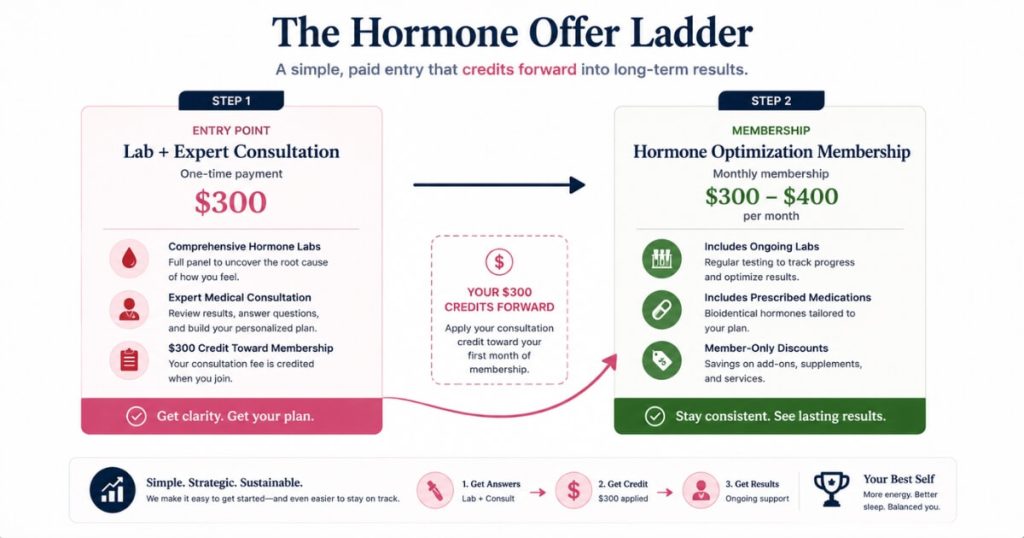
The reason this offer converts is what one of our clients calls “girl math.”
The patient feels she is getting a three-hundred-dollar credit as a gift.
So signing up reads as a deal rather than a cost.
Critically, the offer on the landing page must match the offer on the website.
It must also match the offer the front-desk staff knows by heart.
Pick one program and standardize it everywhere before a single ad goes live.
Otherwise, the funnel leaks at the handoff when a patient calls and hears something different from what the page promised.
Should an HRT med spa run TikTok, Google, or Meta — and how do they fit the landing page?
Run TikTok for cheap high-intent volume into the landing page.
Lean on Google and SEO for the search demand.
Be very cautious with Meta unless your economics and follow-up are dialed in.
TikTok has become the standout paid channel for hormone offers right now.
The mock-consultation creative pulls leads at around four dollars.
A recent month produced forty purchased hormone patients out of three hundred leads.
That is more than enough to move a clinic’s monthly numbers.
The same landing page serves TikTok and Google traffic, so you are not rebuilding for each platform.
Google captures people already searching for hormone help by name.
For a less-saturated suburb or shore town, strong local SEO can rank a clinic for HRT in markets where the aesthetics space is brutally crowded but nobody is seriously advertising hormones.
In saturated areas, organic Botox listings sit on page two behind maps, AI answers, and sponsored ads.
HRT is often wide open.
Meta is the cautionary tale.
It can work, but the math is unforgiving.
A clinic spending forty thousand dollars a month to generate two hundred thousand in revenue needs a sophisticated lead-management operation.
It also needs a provider who can close five-figure cash cases.
“Groupon-style” offer-offer-offer lead-form ads on Facebook generate cheap leads that rarely convert into real hormone patients.
The agency playbook is to market to the problem and position the hormone service as a distinct protocol rather than a commodity.
When should an HRT med spa hire an agency to build the campaign?
Hire an agency when you need a proven landing page, the tracking to optimize it, and the channel expertise to avoid burning cash.
This is especially true when getting ad accounts approved for hormones and Botox is blocking you.
Three signals tell you it is time.
First, you are sending paid traffic to your homepage because you do not have a converting page.
You also have no way to see which clicks turn into booked patients.
A good agency hands you a page that already works.
Ours is built in a funnel builder you can clone in minutes.
Second, platform approvals are stalling you.
Hormone and Botox campaigns routinely get held up on Google without the right healthcare authorization or LegitScript clearance.
A partner who already holds those approvals gets you live in days instead of months.
Third, you are watching ad spend nervously without knowing whether it works.
The right partner watches cost-per-lead, cost-per-acquisition, and close rate together.
Then they kill what does not pay.
The other tell is the offer itself.
Building the lab-consult-membership ladder so the page, website, and staff all sell the same thing is the pre-launch work an agency does before a dollar of spend goes out.
The proof is what this builds over time.
A weight-loss and med spa clinic where we added $6.7M in revenue across 3,727 new patients in a year ran on this channel-to-page-to-offer discipline.
And a hormone-focused practice that grew to 250 members on 40 website leads a month shows what a tight HRT funnel compounds into.
FAQ’s About HRT Med Spa Campaign Landing Pages
Why does an HRT med spa campaign need a dedicated landing page instead of just sending ad traffic to the website?
Because a dedicated landing page lets you control the offer, the message match, and the conversion tracking.
Those are three things a general website homepage cannot do.
A homepage serves every visitor at once.
A hormone landing page does one job: turning a woman who clicked a hormone ad into a booked consult.
Message match matters more here than anywhere.
The page must repeat the ad’s exact promise in the headline, not bury it under a service menu.
The one exception is a practice with a recognizable name, where branded traffic to the established site can convert on credibility alone.
But that is not scalable and usually depends on a specific person selling in the consult.
For a repeatable, trackable campaign, you want a dedicated page.
A homepage gives you almost no conversion signal to optimize against.
What does the ad-to-landing-page-to-booking flow look like for a hormone med spa?
It is a three-page funnel.
A hormone ad drives to a landing page.
The landing page sends to a discovery-call or consult scheduler.
A thank-you page confirms the booking.
The best-performing hormone ad is a one-minute mock consultation where an employee and the provider walk through real symptoms.
On TikTok, that creative produces leads at roughly four dollars each.
The landing page repeats the promise and offers one action.
Page two is the scheduler wired to the clinic’s calendar for discovery calls, telehealth, or in-office visits.
Page three confirms.
Each page has one job and hands off cleanly.
Run to a lead form for volume.
Run to the landing page for quality.
Run to a scheduler with a card hold for only the ready-to-book.
What does a high-converting HRT landing page actually contain?
A symptom-led headline, a short video, a clear offer, and one booking action.
In that order.
With nothing competing for attention.
The headline speaks to how the patient feels, not the chemistry.
The single most important element is the video.
The same page with a video converts better than the identical page without one.
The best videos are a relatable story, not a doctor reciting credentials.
Below it sits a plainly stated offer that matches the ad and the website.
Then proof.
Then one call to action to the scheduler.
It must not contain a distracting nav bar, multiple competing offers, or clinical jargon.
We modeled ours on the menopause telehealth company Midi because they strip the page to symptoms, story, and a single next step.
What offer should an HRT med spa put on the landing page?
A paid lab-and-consult entry point — around three hundred dollars — that credits toward the first month of a membership.
The clinic orders the labs.
The provider reviews them.
If hormone therapy fits, the initial fee prorates against month one.
If not, the patient still gets value and the clinic keeps the consult revenue.
Membership then runs three to four hundred dollars a month and includes follow-up labs, consults, the hormone medications, and discounts on peptides and GLP-1s.
It converts on “girl math.”
The patient feels she is getting a credit as a gift.
The offer on the page must match the website and what the front desk knows.
Otherwise, the funnel leaks at the handoff.
Should an HRT med spa run TikTok, Google, or Meta?
Run TikTok for cheap high-intent volume into the landing page.
Lean on Google and SEO for search demand.
Be cautious with Meta unless your economics and follow-up are dialed in.
TikTok pulls hormone leads at around four dollars.
A recent month produced forty purchased patients out of three hundred leads.
The same page serves TikTok and Google traffic.
For less-saturated towns, local HRT SEO can rank where aesthetics is impossibly crowded.
Meta can work but is unforgiving.
It takes heavy spend, a real follow-up operation, and a provider who closes five-figure cash cases.
“Groupon-style” offer-offer-offer lead-form ads on Facebook rarely convert into real hormone patients.
When should an HRT med spa hire an agency to build the campaign?
Hire an agency when you need a proven landing page, the tracking to optimize it, and the channel expertise to avoid burning cash.
This is especially true when ad-account approvals for hormones and Botox are blocking you.
Three signals:
- You are sending paid traffic to your homepage with no conversion visibility.
- Platform approvals are stalling because you lack healthcare authorization or LegitScript clearance.
- You are watching spend nervously without knowing if it pays.
An agency hands you a page that already works.
It also holds the approvals to get live in days and watches cost-per-lead, cost-per-acquisition, and close rate together.
Building the lab-consult-membership offer so the page, site, and staff all sell the same thing is the pre-launch work an agency does first.