
What Marketing Metrics Should a Regenerative or Pain Management Clinic Track Every Month?
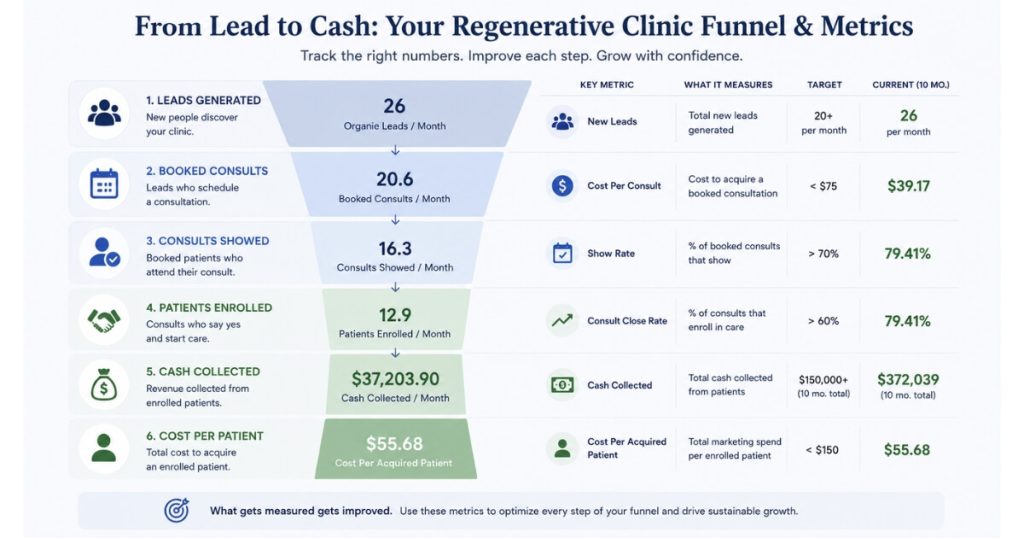
Most regenerative and pain management clinic owners track the wrong numbers. They watch clicks, impressions, likes, and ad spend — vanity metrics that go up and down without telling you whether the practice is actually growing. The owners who scale watch six numbers a month, and every one of them ends in a dollar figure or a patient. This is the FAQ on which marketing metrics a high-ticket regenerative or pain clinic should track, why each one matters, and the numbers a real clinic hit when those metrics were dialed in.
What are the most important marketing metrics for a regenerative or pain management clinic?
Six:
- Qualified leads per month
- Cost per consult booked
- Consult show rate
- Consult-to-treatment close rate
- Cash collected
- Cost per acquired patient
Those six tell you everything. The rest is noise.
Each one sits at a different point in the path from a stranger to a paying patient.
Together, they show you exactly where money is being made or lost.
Qualified leads tells you if marketing is producing demand.
Cost per consult booked tells you if that demand is affordable.
Show rate tells you if the people who book actually arrive.
Close rate tells you if your consult converts.
Cash collected tells you the real revenue, not the promised revenue.
Cost per acquired patient tells you whether the whole machine is profitable given your ticket size.
Clicks, impressions, likes, and reach are not on this list because none of them end in a patient or a dollar.
A regenerative clinic can have a viral month on social and a terrible month in the bank.
Track the six that move with revenue and review them monthly.
The clinics that scale run their pain management marketing as a measured system instead of a hope.
How do I measure cost per acquired patient for high-ticket regenerative treatment?
Divide your total marketing spend for the period by the number of new patients who actually paid for treatment in that period.
Not leads. Not consults. Paying patients.
This is the number most clinics get wrong because they measure cost per lead and stop there.
A $90 lead looks great until you learn it takes 20 of them to produce one paying patient.
That makes your real acquisition cost $1,800.
For a high-ticket regenerative practice, that’s often still excellent.
When the treatment is $8,000 and the patient may return for additional joints or maintenance, an $1,800 acquisition cost is a strong investment.
But you can only make that judgment if you’re measuring cost per acquired patient, not cost per lead.
The reason high-ticket regenerative and pain practices can afford acquisition costs that would bankrupt a low-ticket clinic is lifetime value.
A single patient who treats a knee, comes back for the other knee, and enters a maintenance protocol is worth multiples of the first transaction.
Measure the real cost against the real value.
Then you’ll spend confidently where most competitors are too scared to.
Why is cash collected more important than revenue booked at a regenerative clinic?
Because booked revenue is a promise and cash collected is a fact.
High-ticket regenerative treatment often involves financing, payment plans, and deposits that make the two numbers very different.
A clinic can “book” $300,000 in a month and collect $120,000 of it.
The rest may be on payment plans, pending financing approval, or simply never paid.
If you run your marketing decisions off booked revenue, you’ll overestimate what you can reinvest.
You’ll also misjudge which campaigns are actually working.
Cash collected is the number that pays your team and funds your ad budget.
Tracking both numbers side by side is what let the practice see the difference between what was sold and what was banked.
It also let them run the business off the bank number.
What’s a good consult show rate and close rate for a high-ticket regenerative clinic?
Show rate and close rate vary by market and offer.
But the rule is simple:
If either one is low, fix it before you spend another dollar on marketing.
More leads into a leaky funnel just wastes money faster.
Show rate — the percentage of booked consults who actually arrive — is usually a follow-up and reminder problem, not a marketing problem.
If patients book and ghost, the issue is the gap between booking and the appointment.
No confirmation calls.
No reminders.
Too long a wait.
Close rate — the percentage of consults who enroll in treatment — is a consult-process problem.
It’s about candidacy framing, proof, value-building, and objection handling on the visit.
One regenerative clinic converted leads to booked appointments at 79.4%.
That only happens when both the booking process and the consult are tight.
Track both monthly because they tell you where to invest.
A clinic with great leads and a 40% show rate doesn’t need more ads.
It needs a confirmation sequence.
A clinic with great shows and a low close rate doesn’t need more ads either.
It needs a better consult.
Marketing metrics exist to tell you which lever to pull.
How often should a regenerative or pain clinic review its marketing numbers?
Monthly for the full six-metric review.
Watch leads and cost per consult weekly so you can catch a problem before it costs you a month.
A monthly review is the right cadence for the full picture because high-ticket regenerative decisions have a longer sales cycle.
A patient may take weeks to move from lead to paid treatment.
A single week’s numbers are too noisy to judge.
Once a month, sit with all six metrics together and ask which stage of the funnel is the constraint this month.
That’s the question that drives the next decision.
The leading indicators — qualified leads and cost per consult — deserve a weekly glance.
They move fast and they’re your early warning.
If leads dry up or cost per consult spikes in week two, you want to know then.
Not at the monthly review when the damage is done.
This is the same discipline behind every scaled clinic’s medical practice marketing:
Review on a rhythm. Act on the constraint.
What marketing metrics are a waste of time for a regenerative clinic to track?
Impressions, reach, clicks, likes, follower count, and even cost per click.
None of them end in a patient.
None of them end in a dollar.
Chasing them pulls attention away from the numbers that pay the bills.
These metrics feel productive because they move every day and they’re easy to screenshot.
But a regenerative clinic doesn’t deposit impressions.
You can double your reach and halve your revenue in the same month.
The danger isn’t that these numbers are useless.
A marketer may watch click-through rate to optimize a campaign.
The danger is that owners mistake them for results and make budget decisions off them.
The discipline is to let your marketing team use the diagnostic metrics to optimize.
You, the owner, should run the business off the six that end in dollars and patients.
When those six are healthy, the practice is healthy.
No matter what the vanity dashboard says.
FAQ’s About Regenerative & Pain Clinic Marketing Metrics
What is the single most important marketing metric for a regenerative clinic?
Cost per acquired patient measured against patient lifetime value.
It’s the metric that tells you whether the entire marketing machine is profitable.
For a high-ticket regenerative practice, a seemingly high cost per patient is often an excellent investment.
One patient may treat multiple joints and enter a maintenance protocol.
But you can only make that call if you measure cost against real paying patients, not leads.
How is cost per acquired patient different from cost per lead?
Cost per lead is total spend divided by leads generated.
Cost per acquired patient is total spend divided by patients who actually paid for treatment.
The second number is the one that matters.
A cheap lead that never converts costs you money.
Regenerative clinics that only track cost per lead routinely misjudge which campaigns are profitable.
Should a regenerative clinic track revenue or cash collected?
Both.
But run the business off cash collected.
Booked revenue is a promise that includes financing, payment plans, and deposits that may not all materialize.
Cash collected is what actually funds payroll and ad budget.
One pain and regenerative clinic added over $2 million in revenue across 10 months while tracking $372,039 in cash collected separately.
The gap is exactly why you watch both.
How often should I review my clinic’s marketing performance?
Do a full six-metric review monthly because high-ticket regenerative sales cycles are too long to judge weekly.
Watch your leading indicators — qualified leads and cost per consult booked — weekly so you can catch a drop early.
Monthly for the full picture.
Weekly for the early warning.
Are social media likes and followers worth tracking for a regenerative clinic?
Not as success metrics.
Likes, followers, reach, and impressions don’t end in a patient or a dollar.
Owners who make budget decisions off them get burned.
Let your marketing team use engagement metrics to optimize content.
Judge the practice by qualified leads, cost per consult, show rate, close rate, cash collected, and cost per acquired patient.
What’s the next step?
If you’re running a regenerative or pain management practice off clicks, impressions, and ad spend, you don’t actually know whether your marketing is working.
The six metrics that end in patients and dollars tell you the truth:
- Qualified leads
- Cost per consult
- Show rate
- Close rate
- Cash collected
- Cost per acquired patient
They also tell you which lever to pull next.
On a strategy call we’ll build the monthly six-metric dashboard for your practice and benchmark it against the numbers we hit at Elite Pain Doctors, where we added $2,095,039 in revenue in 10 months with $372,039 cash collected from just 26 organic leads a month.