
How Do You Combine Local SEO With GLP-1 and TRT Offers to Get a Cash-Pay Clinic Found on Google?
GLP-1 and TRT are two of the best cash-pay offers a clinic can run right now — recurring revenue, healthy margins, and patients who already know exactly what they want.
The problem is almost never the offer.
It is that nobody can find the clinic.
A brand-new website can start producing leads within weeks, and the thing holding most clinics back from ranking is not some exotic strategy.
It is usually a messy Google Business Profile, a pile of conflicting citations, no real service pages, and not enough reviews.
This is the field-tested local SEO playbook for getting a cash-pay GLP-1 and TRT clinic found on Google, pulled straight from the work we do with clinics in exactly this position.
What is the first thing a cash-pay GLP-1 and TRT clinic should fix to rank in local search?
Fix your Google Business Profile and your citations before you do anything else.
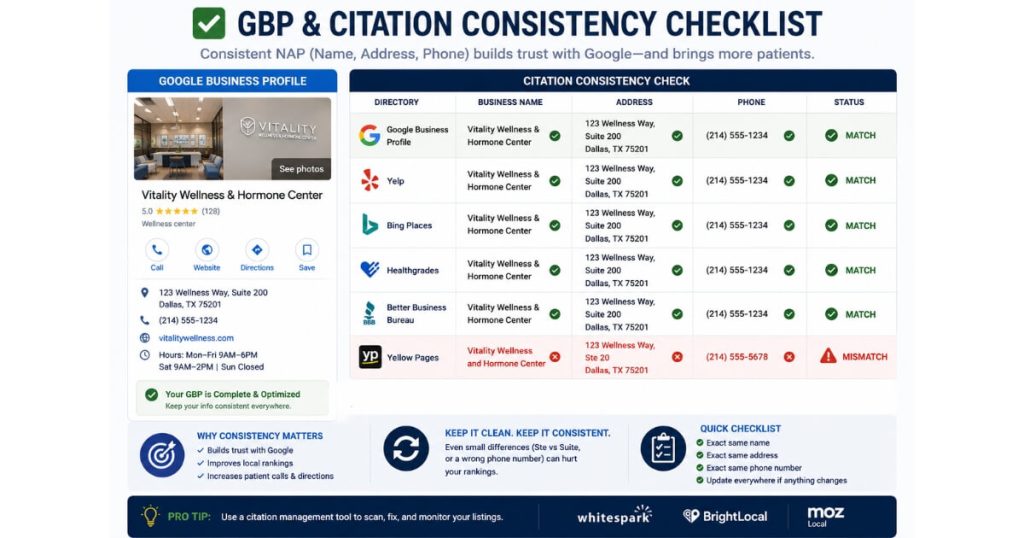
Inconsistent name, address, and phone data is the single most common reason a clinic sits right below the local pack and never breaks through.
Most cash-pay clinics have a messy history baked into the internet.
They may have:
- Bounced between phone numbers for a couple of years
- Used a mailing address that was never the real treatment location
- Operated under two or three slightly different business names
For example:
- Awaken IV Therapy
- Awaken IV Therapy Denver
- The same name with a Thornton mailing address attached
Every one of those variations creates a citation somewhere.
Many of those citations end up:
- Wrong
- Duplicated
- Claimed by someone else
Sometimes, a stranger has claimed the listing on directories like Brown Book, forcing you to file disputes just to regain access to your own listings.
Google reads all of that as conflicting signals.
As a result, it quietly holds the profile back.
That is how a clinic can go from six calls one month to three the next without changing anything else.
The fix is unglamorous but decisive:
- Pick one exact name, address, and phone number.
- Audit every directory.
- Dispute and reclaim the listings someone else grabbed.
- Make every citation match to the character.
When the data finally lines up, a profile that was stuck just below the threshold tends to push over the cusp on its own.
If you want the broader context for how this fits patient growth, our patient acquisition strategy for cash-pay clinics lays out where local SEO sits in the full funnel.
How does local SEO actually get a cash-pay clinic found for GLP-1 and TRT specifically?
It works because GLP-1 and TRT buyers are product aware.
They already know they want:
- Semaglutide
- Tirzepatide
- Testosterone
And they are searching by name plus a location.
The clinic that shows up for those exact searches with a real service page, a matching Google Business Profile, and reviews gets the call.
The mechanics are concrete and repeatable.
On your website, build a dedicated service page for each offer:
- One for medical weight loss and GLP-1
- One for TRT and hormone optimization
Put the search terms patients actually type into:
- Page titles
- Headers
- Body copy
Give each page real depth about:
- Dosing
- Labs
- Pricing tiers
- What the program includes
Then link the page internally to your other pages and keep the URL clean.
A patient comparing a $400-a-month tirzepatide program or a $300-a-month concierge testosterone membership wants to see those details before they call.
The page that answers their questions is the page that ranks and converts.
On your Google Business Profile, list those exact services.
Write a description using the words patients search for.
Post regularly about GLP-1 and TRT.
Then earn reviews that mention weight loss and testosterone by name.
Google connects:
- The page
- The profile
- The reviews
Then you start surfacing for searches like:
- “TRT clinic near me”
- “GLP-1 weight loss [city]”
These are the product-aware searches that turn into cash-pay bookings.
That is the same compounding-organic engine that took Eternity Health Partners to roughly $1.7M a year in membership revenue from SEO alone as traffic grew from about 80 to over 1,000 visits a month.
Do I need neighborhood and city pages to rank locally, or is one service page enough?
You need both.
Build a strong core service page for each offer.
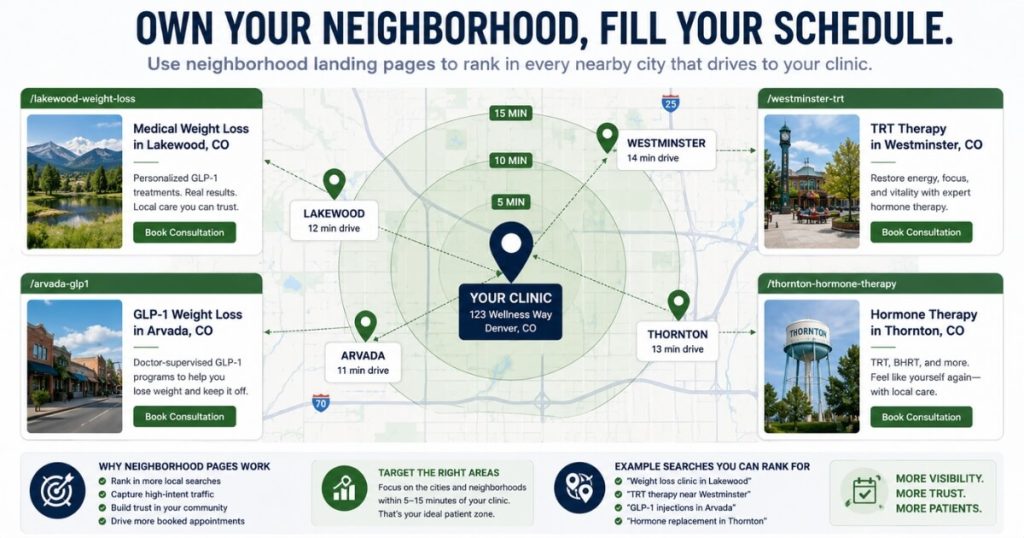
Then build neighborhood and city pages for the towns within real driving distance of your clinic.
A single service page can only rank so far before geography limits it.
If your clinic sits in Denver, a patient in Lakewood, Westminster, Arvada, or Thornton is searching with their own town in the query.
A page built specifically for that area can win where a generic citywide page does not.
The way to scale this without writing each page from scratch is simple.
Build one clean neighborhood-page template.
Then publish a page per real city and neighborhood off of it.
The discipline that matters most is honesty about distance.
It is tempting to grab a statewide list and target everything, including:
- Colorado Springs
- Fort Collins
- Loveland
- Greeley
But if nobody is realistically driving ninety minutes for a B12 shot or a hormone follow-up, those pages are wasted effort.
Map the genuine catchment area.
Confirm which cities patients will actually drive from.
Then build for those.
Paired with the citation cleanup above, neighborhood pages are frequently the exact lever that pushes a stalled profile to its next level of visibility.
Why do reviews matter so much for a cash-pay clinic, and how do they tie into GLP-1 and TRT?
Reviews do double duty.
They are a top-three local ranking signal.
They are also the trust proof that converts a skeptical cash-pay buyer who is paying out of pocket and worried about getting scammed.
Cash-pay patients are cautious by nature.
It is common for a prospect to balk at a deposit and say outright that there are too many scam artists out there.
The single fastest way to answer that objection is to point them to a wall of recent, specific Google reviews.
Strong ratings turn:
“Is this real?”
into:
“Okay, I’ll show up.”
Reviews are also why taking a deposit works at all.
Clinics that skip the deposit consistently see more no-shows.
Clinics with social proof and a small commitment at booking protect their show rate.
For ranking, the content of the review matters as much as the star count.
Reviews that name:
- “Weight loss”
- “GLP-1”
- “Testosterone”
- “TRT”
tell Google precisely which services you should surface for.
So build a simple post-visit review ask into your process.
A trained VA or front-desk team member can own this.
Gently steer happy GLP-1 and TRT patients to name the treatment they came in for.
Done consistently, reviews become both your ranking engine and your show-rate insurance at the same time.
Why is organic local SEO worth it when paid ads bring leads faster?
Because paid ads stop the moment you stop paying.
Local SEO compounds.
Every fixed citation, new service page, neighborhood page, and review keeps working for years.
Over time, that steadily lowers your effective cost per patient.
Paid has a real role, especially early when you need to fill the calendar this week.
But the economics tell the long-term story.
A clinic running a single IV ad at a thirty-dollar cost per lead is renting attention.
The day the budget turns off, the leads vanish.
So does the pipeline.
The same clinic that fixes its Google Business Profile, ships service pages, and stacks reviews starts producing inbound calls and website leads with no per-click cost.
Those assets do not depreciate.
They appreciate.
That compounding is exactly what carried VYVE Wellness to a 900% lead increase and over 100 inbound calls a month within four months.
It is also what makes organic the foundation rather than a nice-to-have.
The smart sequence is not paid versus organic.
It is paid to bridge the gap today while you build the organic foundation that makes paid optional tomorrow.
For a GLP-1 and TRT clinic with recurring revenue and strong margins, that compounding is the difference between renting patients forever and owning a search presence that pays you back for years.
FAQ’s About Local SEO for GLP-1 and TRT Clinics
What is the first thing a cash-pay GLP-1 and TRT clinic should fix to rank in local search?
Fix your Google Business Profile and your citations before you do anything else.
Inconsistent name, address, and phone data is the single most common reason a clinic sits right below the local pack and never breaks through.
Most cash-pay clinics have bounced between:
- Phone numbers
- Mailing addresses
- Slightly different business names
Every variation creates citations somewhere.
Many of those citations end up wrong or claimed by someone else.
Google reads that as conflicting information and holds the profile back.
The fix is to pick one exact name, address, and phone number.
Then audit, dispute, reclaim, and correct every citation until they match exactly.
When the data lines up, the profile that was stuck at three or six calls a month often pushes over the cusp on its own.
How does local SEO actually get a cash-pay clinic found for GLP-1 and TRT specifically?
It works because GLP-1 and TRT buyers are product aware.
They already know they want semaglutide, tirzepatide, or testosterone.
They search by treatment name plus location.
To capture those searches, build a dedicated service page for each offer.
That means:
- One page for medical weight loss and GLP-1
- One page for TRT and hormone optimization
Use search terms in the title and headers.
Add depth about dosing, labs, pricing, and program details.
Then match your Google Business Profile to those same services.
Post regularly about GLP-1 and TRT.
Finally, earn reviews that mention weight loss and testosterone by name.
Google connects the page, profile, and reviews.
That is how you start surfacing for searches like “TRT clinic near me” and “GLP-1 weight loss [city].”
Do I need neighborhood and city pages to rank locally, or is one service page enough?
You need both.
A strong core service page helps you rank for the offer.
Neighborhood and city pages help you rank where patients are actually searching from.
If your clinic is in Denver, patients in Lakewood, Westminster, Arvada, or Thornton may search using their own town.
A page built for that area can win where a general city page does not.
Build pages only for cities people will realistically drive from.
Do not target the whole state just because a list says you can.
Map the genuine catchment area.
Then build a clean template and publish pages for real nearby cities and neighborhoods.
Why do reviews matter so much for a cash-pay clinic, and how do they tie into GLP-1 and TRT?
Reviews do two jobs.
They help you rank locally.
They also help cash-pay patients trust you enough to book.
A patient paying out of pocket is cautious.
They want proof that the clinic is real and credible.
A wall of recent, specific Google reviews answers that concern quickly.
For ranking, the words inside the reviews matter.
Reviews that mention:
- Weight loss
- GLP-1
- Testosterone
- TRT
help Google understand which services to show you for.
Build a simple review ask into your process.
Then gently encourage happy patients to mention the treatment they came in for.
That makes reviews both a ranking engine and show-rate insurance.
Why is organic local SEO worth it when paid ads bring leads faster?
Because paid ads stop when the budget stops.
Local SEO keeps working.
Every citation you fix, service page you publish, neighborhood page you build, and review you earn becomes a long-term asset.
Paid ads are useful when you need leads now.
But organic search lowers your cost per patient over time.
That is why the smart play is not paid versus organic.
It is paid to fill the calendar today while you build the organic foundation that makes paid optional tomorrow.