
How Do You Launch a Google Ads Campaign for a Regenerative / Joint-Pain Clinic?
Launching Google Ads for a regenerative or joint-pain clinic is not the same as launching ads for a medspa or a weight-loss offer.
The buyer is in pain, the ticket is high, the regulatory line around stem-cell language is real, and the leads go cold faster than almost any other vertical.
This is the concrete launch playbook — pulled straight from building and turning on a live joint-pain campaign for a regenerative clinic.
It covers which keywords to bid on, how to build a compliant landing page that converts, why your speed-to-lead is the whole game, how to manufacture urgency, and what budget and timeline to actually expect.
If you sell PRP, prolotherapy, shockwave, peptides, or regenerative cell therapy and want to know exactly how to get a Google campaign live, this is the answer.
Which keywords should a regenerative or joint-pain clinic actually bid on in Google Ads?
Bid on treatment-specific and condition-specific terms.
Lean on the surgery-alternative angle.
But be careful with stem-cell language because Google restricts unapproved cell-therapy claims.
Build the campaign as a set of ad groups.
Each ad group should be a tight cluster of keywords around a single theme.
Treatment-specific keywords
On the treatment side, use terms like:
- PRP
- Peptides for joints
- Alternatives to surgery
- Regenerative medicine treatment
- Stem cell treatment
- Prolozone
- Shockwave therapy
Condition-specific keywords
On the condition side, use terms like:
- Hip pain
- Shoulder pain
- Knee pain
- Arthritis
- Osteoarthritis
Keeping the groups themed lets you bid more aggressively on the keywords closest to a buying decision.
It also lets you hold back on broader terms.
The surgery-alternative ad group is one of the strongest because the keywords carry buying intent.
Examples include:
- Avoid knee replacement
- Avoid joint surgery
- Alternative to hip surgery
People typing those phrases have already decided they do not want the operation.
They are actively looking for another path.
That is exactly the patient you want walking in.
That intent is why regenerative pain is fundamentally a search-first behavior.
It is also why a tightly structured Google campaign sits at the core of any serious stem cell clinic marketing plan.
Stem cell terms convert, but the regulatory line matters.
Not every regenerative treatment is FDA approved.
So you cannot run ad copy or a landing page that implies stem cells cure a condition.
Bid on the term where it is genuinely part of your service.
Route those clicks to a compliant page.
Let your safer treatment and surgery-alternative groups carry the volume.
The practical move is to launch the treatment-specific, bottom-of-funnel groups first.
They are closest to ready-to-buy.
Then add the broader condition keywords once the campaign has data.
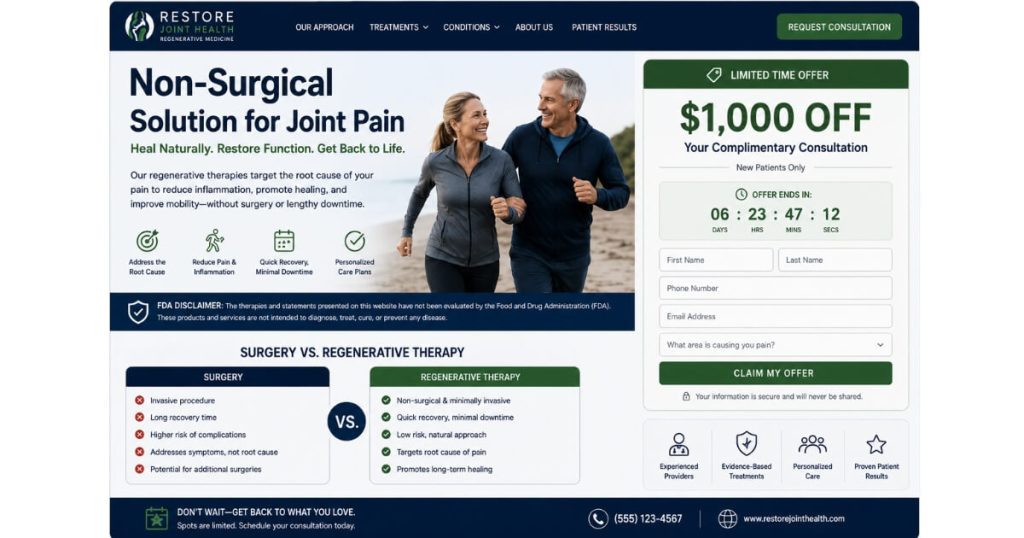
What does a compliant, high-converting landing page look like for a joint-pain offer?
It leads with the surgery-alternative angle.
In addition, it makes a real offer with a deadline.
It stays inside the FDA line.
That means no claims that unapproved regenerative treatments are proven cures.
The headline should do the persuading.
A “Non-Surgical Solution for Joint Pain” framing works because it tells the visitor there is another path.
It is not another cortisone shot.
It is not another operation.
The strongest emotional angle is cancel your joint surgery.
You want people to give up on the idea that surgery is their only option.
The page should reinforce:
- Stop getting cortisone shots
- Stop getting surgeries that are unnecessary
Position the clinic on authority.
Use claims like:
- Top-rated non-surgical joint-pain specialists
- Treated by a doctor, not a technician
- Clear joint-surgery-versus-our-approach comparison
List the actual modalities you offer so the page matches the keyword the visitor typed.
Those may include:
- PRP
- Prolotherapy
- Shockwave
- Peptides
- Regenerative cell therapy
This keeps the message consistent from click to conversion.
The non-negotiable compliance step is the disclaimer.
Because not all of these solutions are FDA approved, the page must say so plainly.
It also must not promise a cure.
Put financing on the page.
Make a concrete offer, such as $1,000 off a complimentary consultation.
Attach a termination date so the offer creates urgency instead of sitting there as a vague discount.
This kind of dialed-in page and offer is what produced $2,095,039 in 10 months for a pain-management and regenerative-medicine clinic, alongside 26 organic leads a month.
Why do good joint-pain leads go cold, and how fast do you actually have to call them?
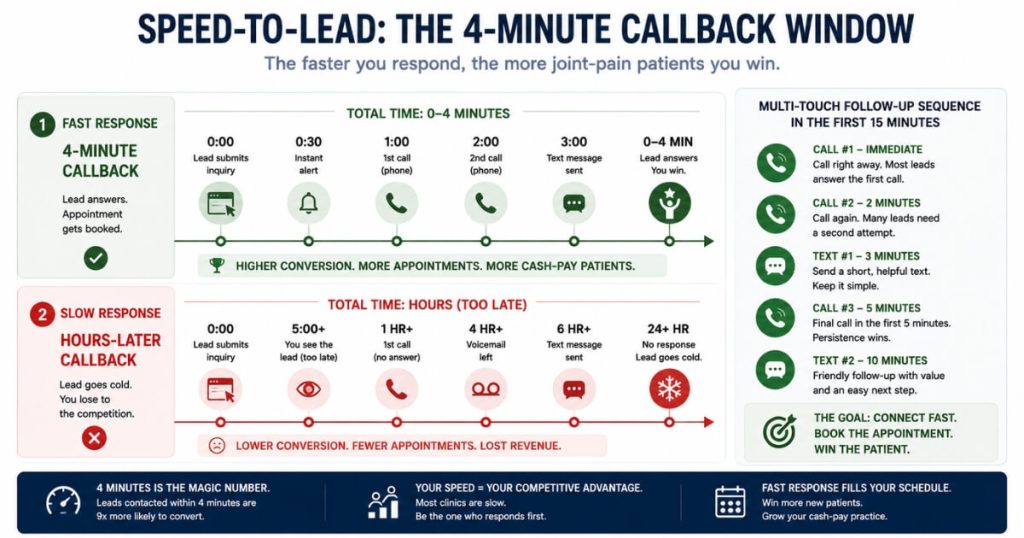
Leads go cold because of speed and urgency, not lead quality.
You have to call within minutes, not hours.
Google leads are almost always good leads.
You can see the exact keyword that triggered the conversion.
That means you know the person sought out a solution for that specific problem.
Someone searching “fat removal without surgery” or a stem-cell term is telling you exactly what they want.
When they do not answer, it is rarely because the lead was bad.
The pattern is consistent.
Calling within about four minutes gets people on the phone far more often than waiting.
The longer the gap, the colder the lead.
A big share of leads also arrive:
- Right after the office closes
- Over the weekend
That is exactly when a slow follow-up process loses them.
The deeper problem is that the patient feels the process is incomplete.
They searched, found a solution, submitted their info, and are now passively waiting to be called.
Also, they do not perceive urgency to pick up.
They assume this is something they can do whenever.
The fix is speed-to-lead plus manufactured urgency.
That means:
- Call immediately
- Leave a voicemail
- Send a text right after
The initial automated message has to read like a real human.
It should reference the offer with a deadline.
A bland, robotic auto-reply gets ignored, and the response rate stays low.
When the follow-up operation is tight, the conversion math changes completely.
Orthobiologics Associates booked 79.4% of leads and generated $309,590 in cash-pay revenue in 10 months, which is what fast, human follow-up on good search leads looks like.
How do you build urgency into the offer so joint-pain leads actually book?
Tie the urgency to money and a deadline.
The cleanest lever is a dollar-off offer that expires, communicated directly in the first message.
The most reliable motivator is financial.
Claim your $1,000 off works when it has a termination date attached.
A discount with no expiry gives the patient no reason to act today.
Pair the dollar amount with a time limit on the complimentary consultation.
For example:
- Claim the offer
- Book within 30 days
That gives the patient a concrete reason to pick up the phone now instead of someday.
Scarcity can stack on top.
For example, tell a genuinely interested patient there are only a couple of availabilities before a certain date.
That pushes the ones who already want it.
The patient who is on the fence and the patient who is eager respond to scarcity differently.
But for the eager buyer, it tips them into action.
The urgency has to live in the verbiage, not just on the landing page.
A message like this converts better than a generic auto-reply:
“It’s Tabby, we’d love to get you in for a limited-time offer — $1,000 off plus a complimentary consult.”
It works because it is:
- Direct
- Human
- In service of the patient
The mistake is assuming the patient saw the offer once and remembers it.
You have to:
- Restate it
- Make it sound personal
- Give it a deadline
every single time you reach out.
They are seeing a million things a day, and yours has to feel both urgent and human.
What budget and time frame should you expect when launching a regenerative Google Ads campaign?
Plan for roughly $50 a day to start.
Expect about 21 days to gather meaningful data.
Judge the campaign against patient lifetime value, not the first thousand dollars of spend.
The right way to think about budget is lifetime value first.
You will get a thousand dollars into spend and it will feel uncomfortable.
But a regenerative or joint-pain patient will often spend $5,000 to $7,000 with the clinic over time.
So the math works long before the daily ad cost suggests it does.
Going in with the patient’s lifetime value in mind keeps you from killing a campaign while it is still learning.
A practical starting point is around $50 per day on the treatment-specific, bottom-of-funnel ad groups.
That is enough to buy data quickly while the campaign learns.
Over the first 21 days at that spend, you should accumulate enough conversions at the ad level to optimize.
You should also book a few new consultations along the way.
How long you test depends on how fast you are willing to buy data.
A higher daily budget compresses the learning period because you are simply purchasing more clicks per day.
Because a regenerative clinic has many things it can sell each new patient, even a modest number of booked consults usually pays the test back.
Launch the treatment-specific groups first.
Get conversions.
Then graduate the broader condition keywords once the campaign has a baseline.
That sequencing keeps your early spend on the highest-intent traffic.
It also gives the algorithm clean data to optimize against.
Why launch a new joint-pain campaign instead of just scaling the campaign that already works?
Because the new campaign covers demand the existing one does not.
The right sequence is:
- Do more of what works.
- Do it better.
- Add the new thing.
When one campaign is already producing, it is reasonable to question why you would launch a different one.
The honest answer is that you do not abandon the winner.
The discipline is the Hormozi sequence:
Maximize the channel that is working before you add a new one.
Swapping campaigns every time something feels stale is how clinics keep restarting the learning curve instead of letting a winner compound.
A joint-pain campaign earns its place when it fills a seasonal or category gap the current offer cannot.
For example, a clinic whose aesthetic or body-contouring demand dies down over summer can use regenerative joint-pain volume to keep the calendar full year-round.
The pain patient does not disappear with the seasons the way an aesthetic buyer does.
Treat the new campaign as a test, not a replacement.
Launch the treatment-specific groups at a modest budget.
See what happens over the first few weeks.
Then go from there.
Keep the proven campaign running at full strength the entire time.
The clinics that grow steadily add new demand on top of a working foundation.
The ones that stall keep swapping campaigns and never let any single one compound.
FAQ’s About Google Ads for Regenerative Joint-Pain Clinics
Which keywords should a regenerative or joint-pain clinic actually bid on in Google Ads?
Bid on treatment-specific and condition-specific terms.
Lean on the surgery-alternative angle.
Be careful with stem-cell language because Google restricts unapproved cell-therapy claims.
Build themed ad groups around:
- PRP
- Peptides for joints
- Alternatives to surgery
- Regenerative medicine treatment
- Stem cell treatment
- Prolozone
- Shockwave therapy
Also build condition groups around:
- Hip pain
- Shoulder pain
- Knee pain
- Arthritis
- Osteoarthritis
The surgery-alternative group carries the most buying intent.
Examples include:
- Avoid knee replacement
- Avoid joint surgery
- Alternative to hip surgery
Launch treatment-specific, bottom-of-funnel groups first.
Add broader condition keywords once you have data.
What does a compliant, high-converting landing page look like for a joint-pain offer?
It leads with the surgery-alternative angle.
Also, it makes a real offer with a deadline.
It stays inside the FDA line.
Use a “Non-Surgical Solution for Joint Pain” headline.
Use the cancel-your-joint-surgery angle.
Add authority framing such as:
- Treated by a doctor, not a technician
- Top-rated non-surgical joint-pain specialists
List the actual modalities you offer.
Because not all solutions are FDA approved, the page must say so plainly.
It must not promise a cure.
Add financing.
Add a concrete offer, such as $1,000 off a complimentary consultation, with a termination date.
Why do good joint-pain leads go cold, and how fast do you actually have to call them?
Leads go cold because of speed and urgency, not lead quality.
You have to call within minutes, not hours.
Google leads are almost always good because you can see the exact keyword that triggered the conversion.
Calling within about four minutes gets people on the phone far more often than waiting.
Many leads arrive after hours or on weekends.
That is when slow follow-up loses them.
Call immediately.
Leave a voicemail.
Then send a human-sounding text that references the offer.
How do you build urgency into the offer so joint-pain leads actually book?
Tie the urgency to money and a deadline.
The cleanest lever is a dollar-off offer that expires.
A discount with no expiry gives the patient no reason to act today.
Attach a termination date to the $1,000 off.
Add a time limit to the complimentary consultation.
Scarcity can also help eager buyers.
The urgency must live in the message verbiage.
It should sound human and personal.
It should be restated every time you reach out.
What budget and time frame should you expect when launching a regenerative Google Ads campaign?
Plan for roughly $50 a day to start.
Expect about 21 days to gather meaningful data.
Judge performance against patient lifetime value, not the first thousand dollars of spend.
A regenerative patient often spends $5,000 to $7,000 over time.
So the math works long before the daily cost feels comfortable.
Spend on treatment-specific groups first to buy clean data.
A higher daily budget compresses the learning period.
Graduate broader keywords once you have a baseline.
Why launch a new joint-pain campaign instead of just scaling the campaign that already works?
Because the new campaign covers demand the existing one does not.
The right sequence is:
- Do more of what works.
- Do it better.
- Add the new thing.
Never abandon a winner.
Maximize it before adding a new campaign.
A joint-pain campaign can fill seasonal or category gaps, such as keeping the calendar full when aesthetic demand slows in summer.
Treat it as a test at a modest budget while the proven campaign keeps running at full strength.