
How Do You Keep GLP-1 Patients Engaged Through the Whole Weight-Loss Journey?
Getting a GLP-1 patient to buy is the easy part.
Keeping them past the first 90 days is where the real money and the real outcomes live.
That means keeping them engaged through the side effects, the plateaus, and the moment motivation dips.
Most cash-pay weight-loss clinics pour budget into acquisition and then go silent the day after the first injection. That silence is exactly why patients quit early.
The clinics that win treat the patient journey as a designed system: expectations set hard at the sale, a comms cadence that never goes quiet, milestone checkpoints at 90 days, 6 months, and 9 months, and a ladder of downstream offers that turns a short program into a multi-year relationship.
This is the retention playbook, pulled from the field.
Why do GLP-1 patients drop off so early in the weight-loss journey?
They drop off because the early weeks are the hardest part of the program.
Most clinics do nothing to carry the patient through them.
The first 30 to 60 days are when side effects peak.
It is also when the scale moves slowest compared to the patient’s expectation.
The novelty of starting wears off, too.
And that is exactly the window where the average clinic goes silent after the first injection.
The patient who was excited at the sale is now nauseous, three weeks in, watching a stalled scale, hearing nothing, and quietly deciding this isn’t working.
That decision almost never gets made because the medication failed.
It gets made because nobody was there for the messy middle.
There are three drivers underneath it:
- The expectation gap. The expectations you set at the sale are everything. A patient who was warned about week-one nausea and a week-three stall stays the course. A patient who expected the scale to drop every morning quits the moment it doesn’t.
- A missing communication cadence. If the patient hears from you only when it is time to rebill, the relationship feels transactional. They churn the first time motivation dips.
- No system. You cannot keep hundreds of GLP-1 patients engaged manually. Without automated check-ins and milestone triggers, the patients in the messy middle fall through the cracks.
This is a core discipline of med spa marketing that most clinics never operationalize.
What does a good GLP-1 patient onboarding look like?
A good onboarding sets expectations hard, captures everything in a CRM, and starts the relationship before the first injection.
Not after it.
The expectations conversation is the single most important sales and retention moment in the entire journey.
It has to happen at the initial sale.
Do not bury it in a consent form the patient skims.
Tell the patient exactly what the first 90 days will feel like:
- Which side effects to expect and when
- Which stalls are completely normal
- What the dosing schedule and step-ups look like
- What realistic monthly weight loss actually looks like
Patients who know a plateau is coming do not panic when it arrives.
Patients who were sold a fantasy quit the first time reality disagrees with the brochure.
Operationally, your intake forms should all live in your CRM.
We build ours in GoHighLevel.
That way, every patient is tagged, scheduled, and dropped into the right automated journey from day one.
Build the intake, the welcome sequence, the dosing reminders, and the first side-effect check-in before the patient ever walks out the door.
If your team is small, have the front desk own the onboarding and the transaction.
Back them with scripts so the expectation-setting is consistent across every patient.
Onboarding is not paperwork.
It is the moment you decide whether this patient stays for nine months or vanishes in three weeks.
What is the right communication cadence to keep GLP-1 patients engaged?
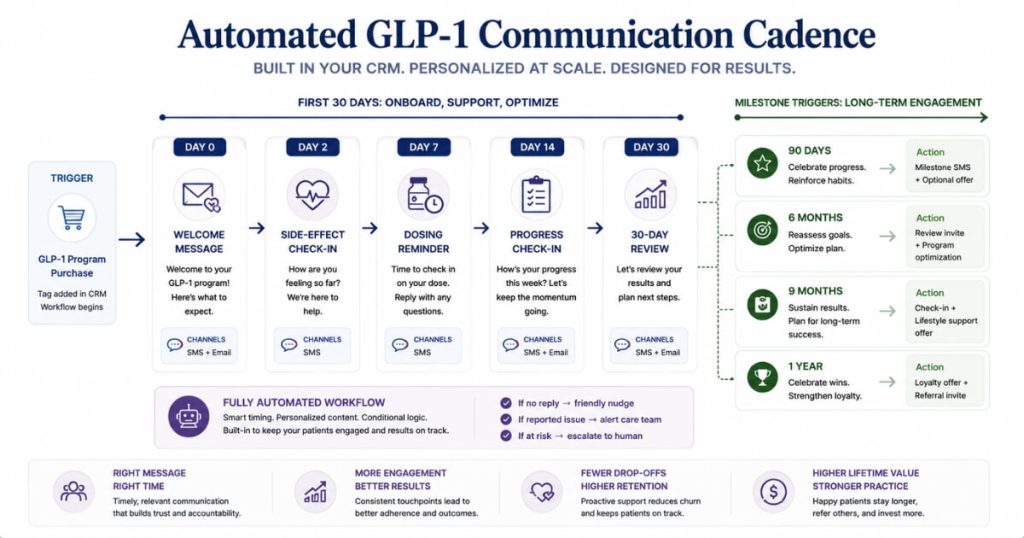
The right cadence is frequent and automated early.
Then it becomes milestone-driven through the middle and proactive around every rebill.
It should never go silent.
The first 30 days need the heaviest touch because they are the most fragile.
That means:
- A welcome message
- A side-effect check-in inside the first week
- A dosing reminder before each step-up
- A quick acknowledgment when the first pounds come off
Those early touches do two jobs.
They keep the patient compliant.
They also prove that the practice is present, which is the exact opposite of the silence that drives early drop-off.
Through the messy middle, anchor your communication to milestones instead of the calendar.
That makes each message feel like progress instead of marketing.
Build a structured check-in at the 90-day mark.
Then do it again at 6 months and again at 9 months.
Each check-in should celebrate what the patient has achieved and reset expectations for the next phase.
Around every rebill, reach out before the charge.
Do not wait until after the card declines.
The patient should renew because they feel supported, not churn because they felt ambushed.
The cadence runs on automation through the CRM.
Human touches are layered on at the milestones and any time a check-in flags a struggling patient.
The clinics that retain GLP-1 patients are the ones whose patients hear from them between visits.
Not only when it is time to pay again.
What milestones should you build into the GLP-1 patient journey?
Build four anchor milestones:
- The initial sale
- The 90-day mark
- The 6-month mark
- The 9-month mark
Then design a specific conversation and offer for each one.
The initial sale is where expectations are set.
It is also where the patient enters the CRM journey.
The 90-day mark is your first true retention checkpoint.
By then, side effects have settled.
Real results are finally visible.
This is where you reinforce the win, address any plateau head-on, and confirm commitment to the next quarter.
Handled well, the 90-day conversation is where a wavering patient recommits.
Skipped, it is where they quietly disappear.
The 6-month mark is where you introduce maintenance thinking and downstream offers.
The patient is seeing real transformation.
Trust is at its peak.
They are ready to hear about hormone optimization, aesthetics, body contouring, or a maintenance membership.
The 9-month mark is the transition checkpoint.
You move the patient from active weight loss toward maintenance and a long-term relationship.
That is what turns a 6-month GLP-1 buyer into a multi-year, multi-service patient.
Each milestone needs:
- A CRM trigger
- A script
- A defined next offer
That way, the patient always has a reason to stay rather than a reason to graduate and walk.
This milestone architecture is exactly how NuLevel Wellness Medspa added 3,727 new patients across its GLP-1 and weight-loss program.
The front end pulled the demand, and the journey behind it kept them.
How do downstream offers improve GLP-1 retention and lifetime value?
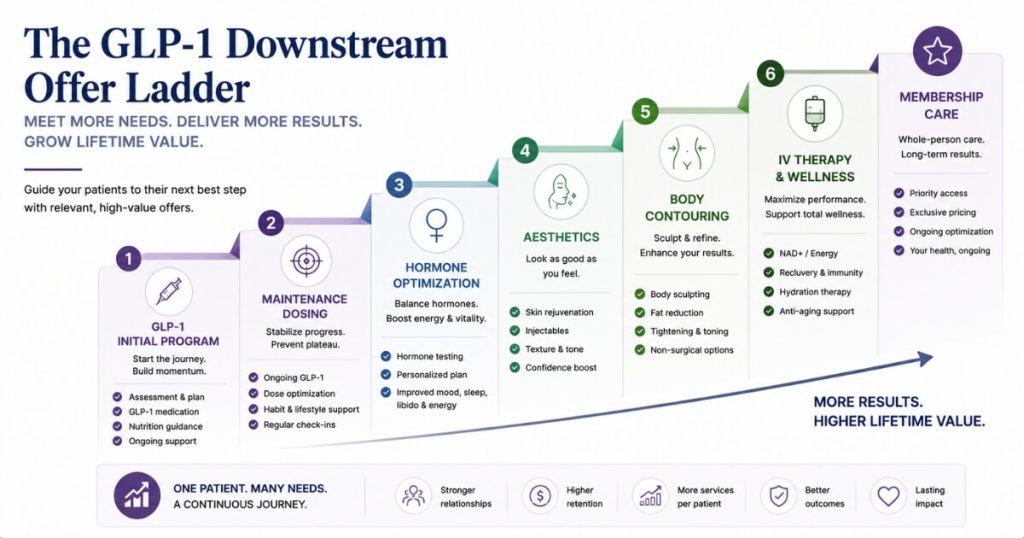
Downstream offers turn a finite weight-loss program into an open-ended relationship.
That is the difference between a 6-month patient and a multi-year one.
A patient who hits their goal and has nowhere else to go simply leaves.
Lifetime value caps out at the length of the injection program.
But a patient offered the logical next step at the right milestone stays inside the practice and keeps spending.
The natural ladder runs from GLP-1 into:
- Maintenance dosing
- Hormone optimization
- Aesthetics and skin tightening after weight loss
- Body contouring
- IV therapy and nutrition support
- A recurring membership
The 6-month and 9-month milestones are where these offers land best.
The patient has already seen results.
They already trust the clinic.
They are already wondering what comes after the weight is gone.
Membership is the retention multiplier.
A recurring program gives the patient a reason to stay engaged long after active weight loss.
It also gives the clinic predictable revenue.
That is the model behind Eternity Health Partners building a membership base of 250 retained members.
The downstream offer, not the front-end ad, is what compounds.
The clinics with the highest GLP-1 lifetime value are never the ones with the best ads.
They are the ones with the best service ladder built behind the first sale.
What systems do you need to run a GLP-1 retention program at scale?
You absolutely need a CRM.
This does not work without one.
You also need templated intake and communication, defined scripts, and a team or front desk that owns the journey.
The CRM is non-negotiable because GLP-1 retention is a high-volume, multi-touch, multi-month operation.
You are running:
- Onboarding sequences
- Side-effect check-ins
- Dosing reminders
- Milestone triggers at 90 days, 6 months, and 9 months
- Rebill outreach
- Downstream-offer prompts
And you are doing that across hundreds of patients at once.
No human team can hold that in a spreadsheet without patients slipping through the cracks.
Every patient who slips is a churned subscription.
We build the entire journey in GoHighLevel, with intake forms, automated sequences, and milestone triggers in one place.
On top of the system, you need standardized scripts.
That keeps every expectation-setting conversation and milestone check-in consistent.
You also need a clear owner.
If you do not have a large team yet, have your front desk run the work and the transaction.
Support them with the scripts so quality does not depend on who is at the desk.
Get the CRM, the templates, and the scripts in place, and the program largely runs itself.
Skip them, and you will keep losing patients in the first 90 days no matter how good your marketing is.
FAQ’s About the GLP-1 Patient Journey and Retention
Why do GLP-1 patients drop off so early in the weight-loss journey?
They drop off because the early weeks are the hardest part of the program.
Most clinics do nothing to carry the patient through them.
The first 30 to 60 days are when side effects peak, the scale moves slowest compared to the patient’s expectation, and the novelty of starting wears off.
That is exactly when the average clinic goes silent after the first injection.
The single biggest driver of early drop-off is an expectation gap.
The expectations you set at the point of sale are everything.
A patient who was told to expect nausea in week one, a stall around week three, and meaningful results by month two stays the course.
A patient who expected the scale to drop every single morning quits the moment it doesn’t.
The second driver is a missing communication cadence.
If the patient hears from you only when it is time to rebill, the relationship feels transactional.
The third is no CRM.
You cannot keep hundreds of GLP-1 patients engaged manually.
You need automated check-ins, milestone triggers, and side-effect support firing on a schedule.
Fix the expectations, the cadence, and the system, and the early drop-off problem largely solves itself.
What does a good GLP-1 patient onboarding look like?
A good onboarding sets expectations hard, captures everything in a CRM, and starts the relationship before the first injection.
The expectations conversation is the most important sales and retention moment in the entire journey.
It has to happen at the initial sale, not buried in a consent form.
Tell the patient exactly what the first 90 days will feel like:
- The side effects to expect and when
- The stalls that are normal
- The dosing schedule
- What realistic monthly weight loss actually looks like
Patients who know a plateau is coming do not panic when it arrives.
Operationally, your intake forms should all live in your CRM.
We build ours in GoHighLevel.
That way, every patient is tagged, scheduled, and entered into the right automated journey from day one.
Build the intake forms, welcome sequence, dosing reminders, and first check-in before the patient ever walks out the door.
If your team is small, have the front desk own the onboarding work and the transaction.
Support them with scripts so the expectation-setting is consistent across every patient.
Onboarding is not paperwork.
It is the moment you decide whether this patient stays for nine months or quits in three weeks.
What is the right communication cadence to keep GLP-1 patients engaged?
The right cadence is frequent and automated early, milestone-driven through the middle, and proactive around every rebill.
Never silent.
The first 30 days need the heaviest touch:
- A welcome message
- A side-effect check-in within the first week
- A dosing reminder before each step-up
- A quick win acknowledgment when the first pounds come off
Through the messy middle, anchor your communication to milestones rather than the calendar.
That makes it feel like progress instead of marketing.
Create a structured check-in at the 90-day mark, again at 6 months, and again at 9 months.
Each one should celebrate what the patient has achieved and reset expectations for the next phase.
Around every rebill, reach out before the charge, not after the card declines.
The whole cadence should run on automation through your CRM.
Personal human touches should be layered on at the milestones and any time a check-in flags a struggling patient.
The clinics that retain GLP-1 patients are the ones whose patients hear from them between visits.
Not just when it is time to pay again.
What milestones should you build into the GLP-1 patient journey?
Build four anchor milestones:
- The initial sale
- The 90-day mark
- The 6-month mark
- The 9-month mark
Then design a specific conversation and offer for each one.
The initial sale is where expectations are set and the patient enters the CRM journey.
The 90-day mark is the first retention checkpoint.
Side effects have settled, real results are visible, and this is where you reinforce the win.
It is also where you address any plateau and confirm the patient is committed to the next quarter.
The 6-month mark is where you introduce maintenance thinking and downstream offers.
Patients are seeing transformation, trust is high, and they are ready to hear about hormone optimization, aesthetics, body contouring, IV therapy, or a maintenance membership.
The 9-month mark is the transition checkpoint.
You move the patient from active weight loss toward maintenance and a long-term relationship with the clinic.
Each milestone needs a trigger in your CRM, a script for the team, and a defined next offer.
That way, the patient always has a reason to stay rather than a reason to graduate and disappear.
How do downstream offers improve GLP-1 retention and lifetime value?
Downstream offers turn a finite weight-loss program into an open-ended relationship.
That is the difference between a 6-month patient and a multi-year one.
A GLP-1 patient who hits their goal and has nowhere else to go simply leaves.
The LTV caps out at the length of the injection program.
But a patient who is offered the logical next step at the right milestone stays inside the practice.
The natural ladder runs from GLP-1 into maintenance dosing.
Then it can move into hormone optimization, aesthetics and skin tightening after weight loss, body contouring, IV therapy, nutrition support, and a recurring membership.
The 6-month and 9-month milestones are where these offers land best.
The patient has already seen results.
They already trust the clinic.
They are already thinking about what comes after the weight comes off.
Membership is the retention multiplier.
A recurring program gives the patient a reason to stay engaged long after the active weight-loss phase.
It also gives the clinic predictable revenue.
The clinics with the highest GLP-1 lifetime value are not the ones with the best ads.
They are the ones with the best service ladder built behind the first sale.
What systems do you need to run a GLP-1 retention program at scale?
You absolutely need a CRM.
This does not work without one.
You also need templated intake and communication, defined scripts, and a team or front desk that owns the journey.
The CRM is non-negotiable because GLP-1 retention is a high-volume, multi-touch, multi-month operation.
You are managing onboarding sequences, side-effect check-ins, dosing reminders, milestone triggers, rebill outreach, and downstream-offer prompts across hundreds of patients at once.
No human team can do that manually without patients slipping through the cracks.
We build the entire journey in GoHighLevel.
Intake forms, automated sequences, and milestone triggers all live there.
On top of the system, you need standardized scripts so every expectation-setting conversation and milestone check-in is consistent.
You also need a clear owner.
If you do not have a large team yet, have your front desk run the work.
Support them with the scripts and the transaction process.
Get the CRM, the templates, and the scripts in place, and the retention program runs itself.
Skip them, and you will keep losing patients in the first 90 days no matter how good your marketing is.