
How Do I Structure Pricing That Builds Patient Loyalty at a Cash-Pay Clinic? (Tiered Investment Levels, Consult Checkpoints, and Diagnostic Proof)
Most cash-pay clinics price their services to win the first sale. The clinics that scale price their services to win the tenth month. The difference is not the number on the page — it is the structure around it: tiered investment levels the patient can self-select, consultation checkpoints placed at months one, two, three, six, and twelve, and diagnostic testing run as often as the patient will allow so they can see their own results. That structure is what turns a one-time buyer into a loyal, recurring member. This is how to build it.
How should I structure pricing so patients stay loyal instead of buying once and leaving?
Structure pricing as tiered investment levels with built-in consultation checkpoints and diagnostic testing, so the patient keeps choosing to continue rather than buying a one-time service and disappearing.
The structure that builds loyalty has three moving parts.
First, present pricing in tiers aligned to different levels of investment.
For example:
- A natural protocol at the lowest investment.
- A combination protocol at the highest investment.
- Graduated options in between.
This allows the patient to self-select a commitment level instead of facing a single take-it-or-leave-it price.
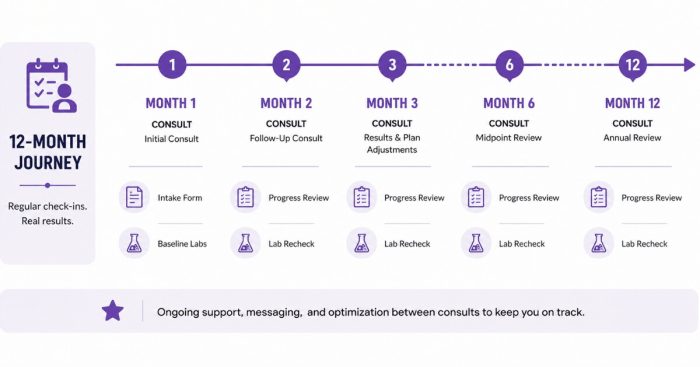
Second, place consultation checkpoints across the relationship at:
- Month one.
- Month two.
- Month three.
- Month six.
- Month twelve.
Have intake forms completed at every step along the way.
Third, run diagnostic testing as often as the patient will allow so you can show measurable results in each of the areas they care about.
Each consultation and each lab result becomes a natural opportunity for the patient to recommit.
Because patients see data showing their own improvement, they sell themselves on staying.
Loyalty is not a discount you bolt on.
It is a structure that keeps proving value at regular intervals.
This is the same recurring-revenue engine behind Eternity Health Partners, the hormone clinic we grew from $1M to $4M a year with 250 active members paying $1,000/month.
The structure is what makes the membership stick.
Why are tiered investment levels better than a single price for a cash-pay clinic?
Because tiers let every patient buy at the level they’re ready for instead of forcing a yes-or-no decision on one number.
That captures patients who would otherwise walk away and gives committed patients somewhere to move up.
Present a natural protocol as the lowest investment.
Present a combination protocol as the highest investment.
Then offer graduated options between them.
Doing this aligns pricing with how much the patient is ready to invest in their own outcome today.
The patient who is not ready for the full program still becomes a patient at a lower tier.
Once they begin seeing results, the higher tier becomes the obvious next step instead of a cold upsell.
A single price does the opposite.
It turns the buying decision into a binary choice that loses everyone who is not a perfect fit on day one.
Tiers convert more patients at the front.
They also create a natural upgrade path that compounds lifetime value across the relationship.
The art is in the presentation.
Present the pricing in alignment with the levels of investment so the patient understands exactly what more investment buys them and chooses the tier that matches their goals, not the one that simply looks cheapest.
How do consultation checkpoints keep patients on a program longer?
Consultation checkpoints keep patients longer because each one is a scheduled moment to review progress, reinforce why they started, and let the patient recommit.
That turns a passive subscription into an active relationship.
The cadence that works includes consultations at:
- Month one.
- Month two.
- Month three.
- Month six.
- Month twelve.
Complete intake forms at every step along the way.
The intake forms are not paperwork for their own sake.
The more feedback you collect from the patient, the more material you have to remind them why they wanted this in the first place.
The more the patient articulates their own reasons for continuing, the more they sell themselves on staying.
A clinic that simply bills a card every month and never checks in is one bad month away from a cancellation.
A clinic that sits the patient down at regular checkpoints, reviews the data, and adjusts the plan builds a relationship the patient does not want to leave.
The checkpoints are where retention is actually earned.
Between them, the patient is on autopilot.
At them, the patient is reminded, re-engaged, and re-sold.
This consultative cadence is one of the most underused levers in functional medicine & longevity clinic marketing.
It converts the clinical relationship itself into the retention engine.
What role does diagnostic testing play in building patient loyalty?
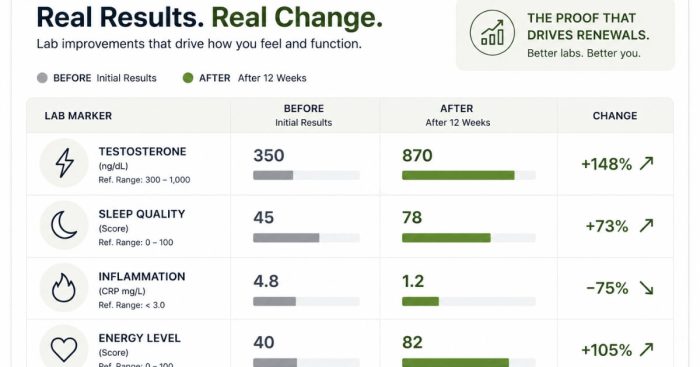
Diagnostic testing builds loyalty by giving the patient measurable, undeniable proof that the program is working.
That is the most powerful retention tool a cash-pay clinic has.
Run labs and diagnostics as often as the patient will allow.
Tie each result back to the specific areas the patient told you they cared about.
When patients can see their own numbers moving in the direction they wanted, the question stops being:
“Is this worth the money?”
Instead, it becomes:
“I can see this is working.”
Data converts a subjective how-do-I-feel judgment into an objective proof point that you control and the patient cannot argue with.
This is especially powerful in functional medicine and longevity.
The entire value proposition is measurable optimization over time.
Testing is not a cost center.
It is the engine that justifies continued investment and makes the next tier feel earned rather than sold.
Diagnostic testing allows you to show measurable results in each of the different areas the patient is invested in.
That evidence is exactly what makes a renewal feel automatic instead of optional.
How do I use intake forms and patient feedback to drive retention?
Use intake forms at every checkpoint to capture the patient’s own words about what they want and how they’re doing.
Then reflect those words back to them so they re-sell themselves on continuing.
The principle is simple.
The more intake forms and feedback you collect, the more you can either sell the patient on continuing or — better — get them to sell themselves.
When a patient writes down at month one that they want more energy and better sleep, and at month three you hand them their own words alongside the lab data showing movement, the conversation about staying writes itself.
Patient feedback is also your early-warning system.
It surfaces dissatisfaction while there is still time to fix it.
That happens before it hardens into a silent cancellation that you only notice when the card declines.
Build the intake forms into every consultation checkpoint.
That way, feedback collection becomes automatic instead of something a busy front desk forgets between billing cycles.
The clinics that retain best are not the ones with the best memory.
They are the ones whose intake-and-feedback loop is systematized into the same cadence as the consultations and the labs.
What turns a cash-pay pricing structure into recurring, predictable revenue?
Recurring, predictable revenue comes from combining tiered pricing, checkpoint consultations, and diagnostic proof into a membership-style relationship the patient renews because they keep seeing value.
They do not renew because they are locked in.
The mechanics stack together:
- Tiered pricing gets more patients in the door and creates an upgrade path.
- Consultation checkpoints at months one, two, three, six, and twelve keep the relationship active and give the patient repeated reasons to recommit.
- Diagnostic testing proves the value with hard data at each step.
Stacked together, these turn one-time buyers into long-term members.
They also turn lumpy, acquire-or-die revenue into a predictable base you can plan and hire against.
That predictability is the whole game in cash-pay.
A clinic with most of its patients on a structured, proof-backed membership does not have to win 40 new patients every single month just to stay flat.
Instead, it builds on a stable foundation rather than starting from zero each month.
That stability is exactly what let Eternity Health Partners build $1.7M a year in membership revenue from SEO alone on top of a 250-member recurring base.
Structure first.
Then scale.
FAQ’s About Structuring Tiered Pricing That Builds Patient Loyalty
How should I structure pricing so patients stay loyal instead of buying once and leaving?
Structure pricing as tiered investment levels with built-in consultation checkpoints and diagnostic testing.
That way, the patient keeps choosing to continue instead of buying a one-time service and disappearing.
The structure has three moving parts.
Present pricing in tiers aligned to different levels of investment.
Place consultation checkpoints at months one, two, three, six, and twelve.
Run diagnostic testing as often as the patient will allow to show measurable progress.
Each consultation and each lab result becomes a natural opportunity for the patient to recommit.
Because they see measurable improvement, they sell themselves on staying.
Loyalty is not a discount.
It is a structure that proves value at regular intervals.
Why are tiered investment levels better than a single price for a cash-pay clinic?
Tiered pricing lets every patient buy at the level they are ready for instead of forcing a yes-or-no decision on one number.
Present a natural protocol as the lowest investment, a combination protocol as the highest investment, and graduated options in between.
Patients who are not ready for the full program can still begin at a lower tier.
Once they experience results, the higher tier becomes the natural next step instead of a cold upsell.
A single price creates a binary decision.
Tiered pricing captures more patients and creates a natural upgrade path that increases lifetime value.
How do consultation checkpoints keep patients on a program longer?
Consultation checkpoints provide scheduled opportunities to review progress, reinforce why the patient started, and encourage them to recommit.
The recommended cadence is month one, month two, month three, month six, and month twelve.
Complete intake forms at every consultation.
The more feedback patients provide, the easier it becomes to remind them of their original goals.
A clinic that never checks in is one bad month away from a cancellation.
A clinic that reviews progress regularly builds a relationship patients do not want to leave.
What role does diagnostic testing play in building patient loyalty?
Diagnostic testing gives patients measurable proof that the program is working.
Run labs and diagnostics as often as the patient will allow.
Connect every result to the goals the patient originally shared.
When patients see their own numbers improving, they stop asking whether the program is worth the investment.
Instead, they see objective evidence that it is working.
That proof makes continued investment and renewal feel natural.
How do I use intake forms and patient feedback to drive retention?
Use intake forms at every consultation checkpoint to capture the patient’s own goals and progress.
Then reflect those goals back alongside their diagnostic results.
That combination helps patients reinforce their own reasons for continuing.
Patient feedback also identifies dissatisfaction early enough to correct it before it becomes a cancellation.
Build feedback collection into every checkpoint so it happens consistently.
What turns a cash-pay pricing structure into recurring, predictable revenue?
Recurring revenue comes from combining tiered pricing, consultation checkpoints, and diagnostic proof into a membership relationship patients continue because they keep seeing value.
Tiered pricing creates an upgrade path.
Consultation checkpoints keep patients engaged.
Diagnostic testing provides measurable proof.
Together, those three elements create long-term members instead of one-time buyers and build a stable revenue base that supports sustainable growth.
What’s the next step?
If your cash-pay clinic is selling one-time services and watching patients drift away after the first purchase, the problem is almost never the price.
It is the structure around the price.
Create tiered investment levels so every patient buys at the level they are ready for.
Schedule consultation checkpoints at months one, two, three, six, and twelve so the relationship stays active.
Run diagnostic testing as often as the patient allows so the value is proven instead of promised.
Build that structure and loyalty becomes the default instead of the exception.
If you want help designing the tiers, the consultation cadence, and the diagnostic-proof loop for your specific clinic — and turning it into predictable recurring revenue — that is the conversation to book.
We have built this for clinics like Eternity Health Partners, which we grew from $1M to $4M a year on a 250-member recurring base.