
How Do You Stop GLP-1 / Weight-Loss Membership Churn at a Cash-Pay Medical Practice?
The first time a cash-pay weight-loss clinic sees membership go down month-over-month instead of up, the instinct is to throw more ad spend at the top of the funnel. That is almost always the wrong move. The two fixes that actually stop GLP-1 / semaglutide / weight-loss membership churn live on the back end: a refill form that catches dose and progress drift, and a maintenance program that converts “I hit my goal weight” into a continued membership instead of a churn event. Below is exactly how to install both.
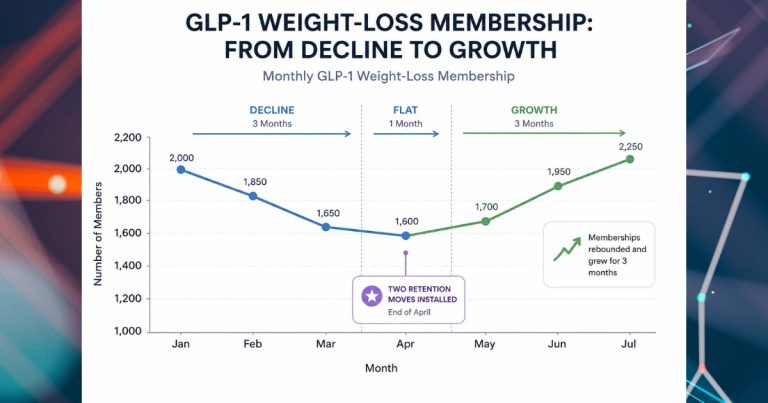
Why are members leaving my GLP-1 / weight-loss program?
Two reasons, in roughly equal weight. The first is silent dose and progress drift: the patient stops responding to their current dose, gets discouraged, and disappears without ever raising the issue with the clinic. The second is the “I hit my goal weight” problem: the patient hit their target, has no protocol for what comes next, and exits because the clinic implicitly framed the program as time-limited.
Both of these are operational problems, not marketing problems. The patient does not need to be re-acquired; they need to be properly handled on the back end so they never leave in the first place. The strongest weight loss clinic marketing strategies recognize that sustainable growth comes from improving retention and lifetime value—not simply replacing every patient who leaves. The two fixes below address both directly.
What questions should the refill form ask to reduce GLP-1 churn?
The refill form should ask exactly two questions that the patient answers before every refill:
- “How many pounds have you lost in the last 30 days?”
- “How many more pounds do you want to lose?”
Those two answers, paired with the patient’s current dose in the clinic record, give the team everything they need to make a real clinical decision: stay at current dose, increase, decrease, or trigger a maintenance conversation. Without that data, the clinic is refilling blind — and patients who are not progressing silently churn out of the program.
This is the first move that a cash-pay weight-loss medspa we work with installed when monthly memberships started dropping. The same clinic added $6.7 million in revenue in one year on the strength of a tightly run GLP-1 funnel — the back-end refill-form fix was a meaningful part of the retention engine that made that revenue compound.
How do I keep patients on the program after they hit their weight-loss goal?
By pre-selling the expectation that hitting goal weight is the doorway into a maintenance program, not the exit door. The patient signs up for the program already knowing that maintaining the result requires a continuing protocol — either a reduced GLP-1 dose, a lifestyle-medicine container, or a hybrid of both.
The framing the medspa above uses:
“If we were not getting you to feel good enough that you felt like you had to stay on this stuff, we didn’t do our job.”
That sentence does two things. It tells the patient that staying is the expected outcome of a successful program. And it tells the clinical team that retention is on them, not on the patient.
Operationally: the maintenance program is introduced at the very first consult, not at the moment the patient hits goal weight. By the time they hit goal, they have heard about maintenance four or five times and the transition is automatic, not a new buying decision.

What is a maintenance program and how does it stop weight-loss membership churn?
A maintenance program is a reduced-cost, reduced-intensity continuation of the original weight-loss membership designed to keep the patient inside the clinic’s ecosystem after they hit their initial goal. Typical structure: lower monthly fee, lower-frequency provider visits, smaller GLP-1 dose or different maintenance med, and ongoing lifestyle-medicine programming.
The mechanic that stops churn is the “pre-sold expectation” piece. The patient is told from day one that maintenance is part of the program. When goal weight arrives, the conversation is not “do you want to stay?” — it is “great, now we move you onto maintenance like we talked about.”
This approach is one of the most effective methods for stopping GLP-1 membership churn because it removes the moment where patients feel they have to make a brand-new purchasing decision. Instead of viewing goal weight as the finish line, they see it as the transition into the next phase of care, which preserves continuity, improves outcomes, and extends patient lifetime value.
That single framing change converts what used to be a churn event into a downsell that compounds LTV.
Should weight-loss patients be told to “graduate” off GLP-1?
No — not unless they are clinically required to. The “graduate off” framing is the single biggest retention killer at cash-pay GLP-1 clinics. It tells the patient that the program has a natural endpoint, which directly engineers churn at the most vulnerable moment (the patient feels great and is happy to stop spending money).
The clinical truth is closer to this: weight regain is the default outcome for the vast majority of patients who stop GLP-1 without a maintenance plan. A clinic that pretends otherwise is setting the patient up for failure and setting itself up for repeat acquisitions instead of compounding LTV.
The maintenance program reframes the long-term relationship as the standard of care.
How do I know if my clinic’s GLP-1 protocol is working for retention?
Three numbers tell the story:
- Monthly active members — is it growing, flat, or shrinking month-over-month?
- Average tenure in months — how long does the average member stay before churn?
- Percentage of patients who transition to maintenance after hitting goal — the headline retention metric for a weight-loss program.
If monthly active members is shrinking, the refill-form fix is the first lever to pull. If average tenure is short, the maintenance program is the bigger lever. Both are usually broken at the same time in clinics that have not deliberately engineered for retention.
What’s the biggest mistake cash-pay weight-loss clinics make on the back end?
Treating the refill as a transactional event instead of a clinical and retention event. Most clinics let a refill happen on autopilot if the patient’s card runs successfully. That misses the entire signal of how the patient is actually doing, and a patient who is not progressing slips out the back door silently.
The two-move playbook installs the refill as the central clinical check-in:
- Two questions on the form
- A team review of every refill
- A trigger for a maintenance conversation when the patient’s goal is in sight
Ready to install this GLP-1 churn fix in your weight-loss clinic?
If you are running a cash-pay weight-loss, GLP-1, or semaglutide membership program and your monthly active members has gone flat or started shrinking, the refill form plus maintenance program is the first thing to install. We help cash-pay weight-loss clinics build both without disrupting active patients.