
How Do You Retarget Regenerative Medicine Leads Who Don’t Book Right Away?
Nobody decides to spend fifteen thousand dollars on stem cell therapy the same afternoon they first hear about it. A regenerative or pain patient researches for weeks, asks their spouse, prices out the alternative surgery, and circles back two or three times before they book. Most clinics treat that gap as a dead lead. The clinics that win treat it as a window — and they fill that window with retargeting. This is the system that keeps your practice in front of a high-ticket lead from the first click to the day they finally pick up the phone.
Why do regenerative medicine leads take so long to book — and what does that mean for retargeting?
They take a long time because a five-figure cash-pay decision sits at the intersection of money, fear, and skepticism — and retargeting exists specifically to keep you present while the patient works through all three.
A regenerative patient is usually weighing your treatment against a surgery their insurance would partially cover.
Therefore, the cash price feels like a luxury until they convince themselves it isn’t.
On top of the money, there is real fear.
They have been let down by injections or physical therapy before, and they are quietly afraid this is one more thing that won’t work.
That is why the consideration window for high-ticket regenerative care routinely runs two to eight weeks.
If your marketing is a one-shot ad that they either act on instantly or never see again, you lose almost everyone who needed time.
Retargeting flips that math.
Instead of paying to find the same patient over and over, you pay a few cents to stay visible to the people who already found you.
The job of retargeting is not to convince a stranger.
It is to be the clinic that keeps gently showing up while a warm prospect finishes deciding.
So when the timing is finally right, yours is the name they call.
For a deeper look at how this fits into a complete patient acquisition system, the retargeting layer is the part that recovers the leads every other clinic lets slip away.
What is retargeting, and why does it matter more for high-ticket stem cell and PRP than for low-ticket treatments?
Retargeting is showing ads only to people who have already interacted with your clinic — and it matters more for regenerative care because the ticket is high, the decision is slow, and the warm audience is small enough to reach affordably.
With a $99 aesthetic offer, speed-to-purchase is fast and the margin is thin.
Therefore, an elaborate follow-up sequence rarely pays off.
Regenerative medicine is the opposite.
A single PRP or stem cell case can be worth more than a year of med-spa visits.
Meanwhile, the patient needs weeks to commit.
That means the lifetime value easily justifies staying in front of them the entire time.
The economics actually reward patience here in a way they don’t for cheaper treatments.
The audience is also perfectly sized for it.
You are not retargeting millions of people.
Instead, you are reaching:
- The few hundred who watched your knee-pain video
- The dozens who visited your stem cell page
- The handful who became a lead but haven’t booked
Because that pool is tiny and warm, the cost to stay in front of them is a rounding error against the value of one converted case.
We watched this compound at a regenerative clinic we grew to $309,590 in cash-pay revenue in ten months with a 79.4% lead-to-appointment conversion rate — when the leads are warm and you keep showing up, the conversion math gets extraordinary.
Which platforms should a regenerative clinic run retargeting ads on?
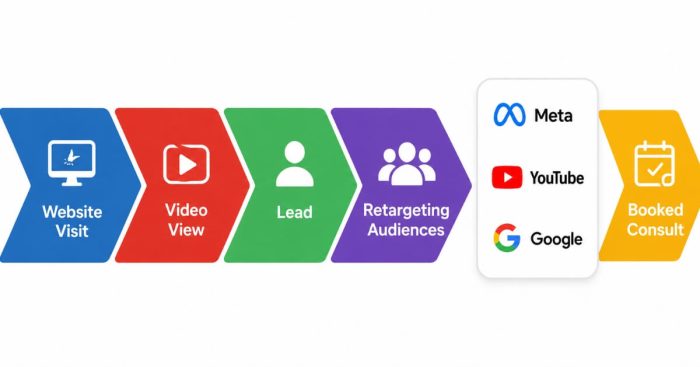
Run retargeting where your prospect already spends time and where you already have a pixel collecting data.
For most regenerative and pain clinics that means:
- Meta (Facebook and Instagram)
- YouTube
- SMS
Meta is the workhorse for retargeting joint-pain, neuropathy, and regenerative prospects because the audience skews older and the platform makes it easy to rebuild custom audiences from video views and page visits.
YouTube retargeting is underrated for this category.
A patient who watched your doctor explain a procedure on YouTube can be served a follow-up video that handles the next objection.
Video is the format that builds trust for a treatment people are skeptical of.
Google search and display retargeting catches them in the moment they go back to comparison-shop, which a serious regenerative buyer always does.
The mistake is treating these as separate islands.
The pixel on your website should feed all of them at once.
As a result, a single warm prospect sees:
- A YouTube reminder
- A Facebook testimonial
- A Google ad when they search a competitor
Three touches that feel like the clinic is everywhere, on a budget that is almost nothing because the audience is so small.
What should retargeting ads for regenerative patients actually say?
Retargeting creative should answer the specific objection that stops a regenerative patient from booking — proof that it works, the cost of waiting, and the safety of the procedure — not just repeat your brand name.
Because these are warm prospects, you are no longer introducing the treatment.
Instead, you are removing the last doubt.
The highest-converting retargeting ads in this category are patient testimonial videos.
A real person describing:
- The knee or back pain they had
- The surgery they avoided
- How they feel now
Nothing handles “does this actually work” like another patient saying it did.
Likewise, rotate in:
- A short clip of the physician explaining why the treatment is safe
- A piece addressing the cost of waiting
- A simple “still thinking about it?” booking prompt
Sequence the message to the stage.
Someone who only watched a video gets an educational follow-up.
Someone who became a lead but ghosted gets proof and a direct booking nudge.
The point is to map each ad to where the doubt actually lives.
That is the same discipline behind effective pain management marketing — meet the objection, don’t just chase the click.

How long should a regenerative clinic keep retargeting a lead before giving up?
Keep an engaged lead in the retargeting pool for at least 60 to 90 days, and keep video viewers and site visitors in a lighter rotation for up to six months, because regenerative decisions genuinely take that long.
The instinct to cut a lead loose after a week comes from low-ticket thinking.
For a five-figure treatment that a patient is weighing against surgery, two months of consideration is normal, not a red flag.
The right setup keeps a hand-raiser in active retargeting for the full 60-to-90-day window.
Specifically, frequency should be capped so you stay present without becoming annoying.
A few impressions a week, not a few an hour.
Past 90 days, move them to a low-frequency “stay aware” pool.
Then let email and SMS carry the relationship.
Plenty of regenerative patients book five or six months after their first visit to your site.
Often because:
- The pain finally got bad enough
- The surgery quote finally came in
The clinic still showing up at that moment wins the case the others wrote off.
Patience is not wasted budget here.
It is the entire strategy.
How do you combine retargeting with email, SMS, and SEO so leads actually convert?
Retargeting works best as the paid reinforcement layer on top of an owned-channel follow-up system.
Email and SMS do the direct outreach.
SEO catches them when they search.
Retargeting makes sure they never forget you between those touches.
Think of it as surround sound.
When a lead comes in:
- Phone and text follow-up start in the first hour.
- Email nurture sequences educate them over the following weeks.
- SEO content answers their questions.
- Retargeting reinforces all of it across Facebook, YouTube, and Google.
No single channel carries the whole load.
However, together they make a hesitant patient feel like your clinic is simply the obvious, ever-present choice.
SEO matters especially here because regenerative patients are search-first.
They will Google:
- The treatment
- The condition
- Your competitors
Repeatedly during their consideration window.
The clinic that owns both the search result and the retargeting ad on that journey looks dominant.
Building that owned-channel foundation is exactly the kind of compounding asset that drives durable stem cell clinic marketing, with retargeting as the paid multiplier that keeps the warm audience moving toward a booking.
How do you measure whether retargeting is actually working for a regenerative clinic?
Measure retargeting by cost per booked consult and by the conversion rate of retargeted leads versus cold leads — not by clicks, impressions, or vanity reach numbers.
The honest metric is simple:
- Of the patients who booked a consult this month, how many had been touched by retargeting?
- What did it cost to produce those bookings?
Because the retargeting audience is warm, the cost per booked consult should be dramatically lower than your cold prospecting.
Likewise, retargeted leads should convert at a higher rate.
If they don’t, the creative or the audience setup is wrong, not the channel.
Set up your tracking so you can see assisted conversions, not just last-click.
Retargeting rarely gets the final credit because the patient often books by phone.
However, it is frequently the reason they finally called.
We have seen this pattern across the fastest-growing cash-pay regenerative and pain practices, including one where we added $2,095,039 in revenue in ten months — the booked cases trace back to a system where warm leads were never allowed to go cold, and retargeting was the layer that kept them warm.
FAQ’s About Retargeting Regenerative Medicine Leads
How much should a regenerative medicine clinic budget for retargeting?
Retargeting is the cheapest media you will ever buy because the audience is tiny and already warm.
Therefore, it should be a small slice of total spend, not a separate big budget.
A practical rule is to carve out 10 to 20 percent of your prospecting ad budget for retargeting.
For example:
- $5,000/month prospecting budget
- $500–$1,000/month retargeting budget
Because a single regenerative case can be worth five figures, even one extra booked consult per month from retargeting pays for the entire program many times over.
Is retargeting HIPAA-compliant for a regenerative or pain management practice?
Retargeting based on website visits and ad engagement is generally fine.
However, you must avoid building audiences from anything that ties a specific person to a specific medical condition or treatment in a way that exposes protected health information.
The safe approach is to retarget broad behavior:
- Website visitors
- Video viewers
- Social media engagers
Rather than uploading lists that identify patients by condition.
When in doubt:
- Retarget by general interest
- Keep creative educational
- Have your compliance person review the setup
Can you retarget people who only watched a video or visited the website but never became a lead?
Yes.
Those two audiences are often the highest-value retargeting pools a regenerative clinic has.
You can build audiences from:
- 25% video viewers
- 50% video viewers
- 75% video viewers
- Service page visitors
The deeper the engagement, the warmer the audience.
Therefore, segment by engagement depth and spend more on the warmest tiers.
How soon after someone becomes a lead should retargeting ads start?
Immediately.
The pixel should already be firing so that the moment someone becomes a lead or visits a key page, they enter the retargeting audience that same day.
Retargeting is not a campaign you launch later.
It is an always-on safety net running underneath all of your prospecting.
The first 72 hours after someone raises a hand is when intent is highest.
Therefore, your phone, text, and retargeting should all be working together immediately.
What’s the next step?
If your regenerative or pain practice is generating leads and consults but watching too many of them stall in the “I need to think about it” window, the leak is almost never the offer — it is the absence of a system that keeps you in front of warm prospects until they are ready.
Retargeting is the cheapest, highest-leverage layer you can add.
And it only works when it is wired into your phone follow-up, your email and SMS, and your SEO so the whole thing feels like one coordinated presence.
That is the exact system we build for high-ticket regenerative and pain practices — the same approach behind a regenerative clinic that produced $309,590 in cash-pay revenue from organic leads with a 79.4% conversion rate.
If you want us to map where your warm leads are leaking and how retargeting plugs the gap, that is the conversation to book.