
How Do I Recruit a Rockstar New Patient Coordinator at My Cash-Pay Medical Practice?
The New Patient Coordinator (NPC) role is the single highest-leverage hire at most cash-pay medical practices. The right NPC turns inbound inquiries into booked, paying patients. The wrong NPC quietly leaks six figures a year. Below is the exact hiring framework we use with our clients – candidate ranking, job ad, interview script, red flags, and pay structure.
What is a New Patient Coordinator and why does my cash-pay clinic need one?
A New Patient Coordinator is the frontline person who answers phones, manages new patient inquiries, calls back website leads, follows up with prospects, books appointments, runs the CRM, and educates patients on the clinic’s process. The job is part sales, part operations, part patient experience. At a cash-pay clinic, this role is where leads either become members or vanish.
Most cash-pay practices try to staff this position with a front-desk receptionist mindset. That is the mistake that makes most clinics underperform on conversion. The role requires real sales ability paired with a friendly, organized, customer-service personality. When we grew an HRT clinic from $1M to $4M a year with 250 active members and 60 inbound calls per month, the conversion rate on those calls was driven by the NPC bench more than any other operational variable.
What’s the right pay structure for a New Patient Coordinator at a cash-pay clinic?
Hourly for the first 90 days, then salary in the $40-$60k range, plus commission. The hourly window lets the clinic validate that the new hire can actually do the job before locking in a salary. The salary-plus-commission structure attracts people with real sales hunger while protecting the clinic from underperformers riding 100% commission risk.
Comp plans should be tied to the metrics the clinic actually cares about:
- Booked consults
- Completed consults
- Program enrollments
—not just “calls answered.” A pure activity-based comp produces an NPC who is busy but not effective.
How do I find the ideal New Patient Coordinator candidate?
Start in this order:
- Facebook post first
- Referrals from your existing customer base second
- Referrals from your team third
- Indeed ads fourth
- Recruiters last
Most clinics jump straight to Indeed ads and skip the warm sources. That is backwards. The best NPC hires almost always come through warm channels because they self-select for alignment with your offer and market.
The ideal candidate has prior medical reception, office administration, medical assistant, or hotel experience. Hotel experience is a quiet edge – high-touch customer service translates directly to a premium cash-pay clinic. They do not change jobs often (job-hopping is a red flag). Their resume is proofread and free of errors.
When screening incoming applications, sort into four buckets immediately:
- Blatantly not a fit (remove)
- Maybe (some boxes checked but not all)
- Check mark (most criteria but in an unusual way that could still work)
- Send a message right away (most or all marks)
Treat the applicant pool like a sales pipeline.
What’s the right interview process for hiring a New Patient Coordinator?
Five steps.
Step 1
First, send a message on Indeed asking the candidate to text your number to schedule a video interview – this filters for follow-instructions ability.
A good text response:
“Hi, this is (name), I received a message on Indeed to contact this number to set up a video interview.”
A bad response:
“I want to schedule interview”
(if you have to ask them for their name, they are not a good fit).
Step 2
Second, the Zoom interview.
Five minutes of rapport, then the question set:
- What have they been doing for the last five years
- What are their professional and personal goals
- What stuck out about this position
- Why are they a good fit
- What resonates with them about the company
- What excites them about selling to this industry
Explain the role, ask if they would feel comfortable doing all of it, ask their monthly income target, explain the pay structure.
Step 3
Third, the Tony Robbins DISC personality test. Free, quick, gives clinical insight into whether the candidate’s personality is a fit for the conversion role. If they don’t complete it, they don’t move forward.
Step 4
Fourth, a second interview with the clinic owner or decision maker.
Step 5
Fifth, an in-person interview if everything aligns.
For high-volume applicant pools, you can add a pre-interview step: a brief recorded video of the candidate saying:
- Their name
- Their passions and goals
- Why they would be a good fit
If they don’t record it, they don’t get the interview.

What are the biggest red flags when interviewing a New Patient Coordinator?
Seven red flags to watch for:
- The candidate doesn’t mention any past failures – everyone has failures; refusing to acknowledge them signals dishonesty or low self-awareness.
- Exaggerating accomplishments.
- Speaking poorly of past bosses or positions.
- Both no experience in your market AND no sales experience (one or the other is workable, both is not).
- Cannot explain past job moves or why they want to transition into high-ticket selling.
- Bad attitude or self-absorption in casual conversation.
- Only motivated by money – the right hire wants a balance of money, growth, and company culture/mission.
Critical: avoid candidates with medical experience from veterinary clinics or rehab/recovery clinics – their conversion instincts rarely transfer to a cash-pay medical practice.
Should I hire someone with sales experience or someone who knows my offer?
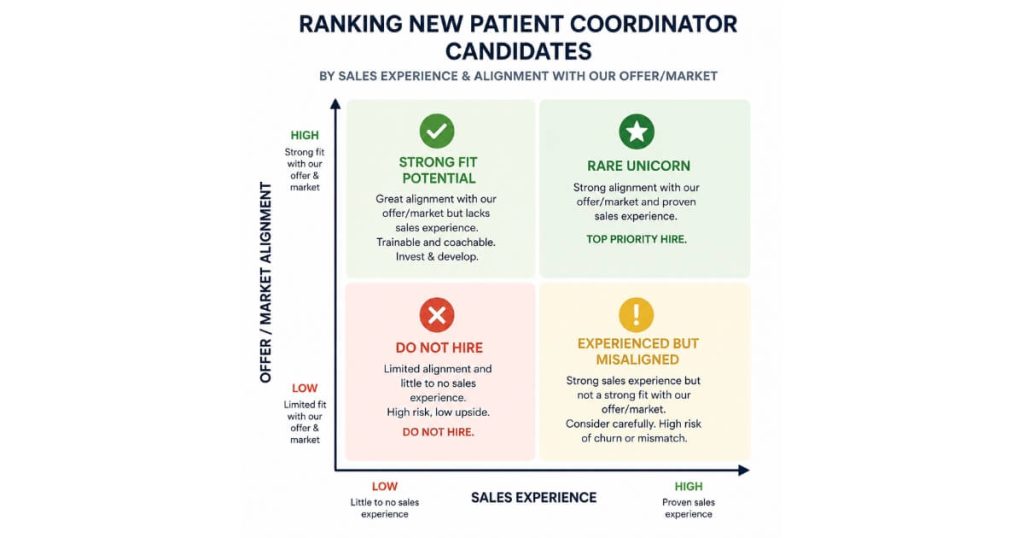
If you can find both in one person, hire them yesterday. That candidate is rare. If you have to choose one, choose offer and market alignment over raw sales experience.
The four candidate types, ranked:
- Experienced in sales AND aligned with your offer and market (the unicorn)
- Aligned with offer and market AND inexperienced with sales (the second-best option – usually someone who has had HRT, aesthetics, or similar work themselves)
- Experienced in sales but no history with your offer or market (third)
- Inexperienced with both (only hire if every other option is exhausted)
The reason offer alignment beats raw sales experience: an NPC who has personally been a patient of your category – HRT, aesthetics, peptides, GLP-1, longevity – speaks to incoming inquiries with credibility that no amount of sales training can manufacture.
What are the most common mistakes when hiring a New Patient Coordinator?
Four big ones.
1. Rushing the hire
First, rushing the hire because the phone is ringing and nobody is converting – a bad NPC is more expensive than an unfilled seat.
2. Treating the role as inherently high-churn
Second, treating the role as inherently high-churn and accepting mediocrity – the right NPC stays for years if you hire and pay correctly.
3. Only recruiting for the NPC role itself
Third, only recruiting for the NPC role itself instead of looking for someone who can graduate into a clinic manager, sales manager, or operations role over time – we saw this dynamic at Dr. Joy Kong’s practice, where building out the team and creating room for growth was a critical piece of the owner being able to scale herself out of the day-to-day.
4. Ugly job ads
Fourth, ugly job ads. The job ad is the candidate’s first signal about the clinic’s culture and standards. A formatted, well-written job description with a clear pay range, clear duties, and clear growth path produces a meaningfully better applicant pool than a copy-pasted Indeed template.
Ready to install this New Patient Coordinator hiring framework?
If you are running a cash-pay HRT, longevity, functional medicine, regenerative, GLP-1, or aesthetics practice and your inbound-call-to-booked-consult conversion is below 60%, hiring the right NPC is usually the highest-leverage move you can make this quarter. We help cash-pay practices build the job ad, run the interview process, and install scorecards that retain the right hire.