
How Should a Cash-Pay Medical Practice Quote Price on a New Patient Call? (Stack the Value, Anchor the Full Price, Present the Monthly Payment)
Most cash-pay clinics quote price the wrong way around. They open with the bottom-line monthly number, or worse, lead with discounts and payment plans. Both moves crater perceived value before the patient has any context for what they are buying.
The Dan Kennedy framing — the same framing that makes a $2.99-a-month truck ad work during the Super Bowl — applies to cash-pay medicine too.
This FAQ explains the three-step pricing script that cash-pay clinics with 60+ percent first-visit close rates actually use, along with a cleaner way to walk new patients through program pricing without eroding the clinical trust built during the consult.
How should a cash-pay medical practice quote price on a new patient call?
Three steps, in order, on every pricing conversation.
Step 1: Stack the Value
Stack the value first.
List everything the patient receives inside the program.
Examples include:
- Labs
- Consults
- Supplements
- Follow-ups
- Team access
- The intended outcome
Step 2: Anchor the Full Price
Next, anchor the full retail-equivalent value.
Explain what each component would cost if purchased separately.
This creates context before the pricing discussion begins.
Step 3: Present the Monthly Payment
Only after the value stack and anchor should the monthly payment appear.
The goal is to introduce the payment as the mechanism that allows the patient to start without dramatically changing their household budget.
Why Most Clinics Get This Wrong
Many cash-pay clinics reverse the process.
Some open with the monthly fee.
Others lead with discounts.
Still others start with financing options.
As a result, patients hear a number before they understand what they are buying.
The Dan Kennedy Framework
The same pricing framework used in direct response marketing applies here.
First, get the patient excited about the value.
Second, anchor the full retail cost.
Finally, present the monthly payment as the easiest path forward.
Why does stacking value before quoting price increase the close rate at a cash-pay clinic?
Because the patient does not have a reference frame for the price until you give them one.
The Difference Between Price and Context
A $899-per-month functional medicine program sounds expensive when quoted without context.
However, the same program sounds very different after the patient hears everything included.
For example:
- Comprehensive labs (would cost $300 through Quest)
- 60-minute consult with a board-certified provider
- Functional saliva testing
- Live blood analysis
- Three months of supplements
- Hormones and peptides
- Weekly check-ins
- Six-month protocol
The number did not change.
The frame did.
Why Value Stacking Works
Value stacking is not manipulation.
Instead, it is patient-side accounting.
The patient is genuinely receiving those services.
Without the explanation, the patient assumes they are paying for a doctor visit.
With the explanation, they understand they are enrolling in a comprehensive program.
The Result
The clinic that stacks value before quoting price sells the actual program.
Consequently, the patient leaves the conversation feeling they received a deal.
A regenerative medicine clinic we worked with hit a 79.4 percent conversion rate from lead to booked appointment running this discipline across every pricing conversation.
What’s the right way to anchor full price before presenting a monthly payment at a cash-pay clinic?
Say the full retail-equivalent number out loud, ideally with the math behind it.
Example of an Anchor Conversation
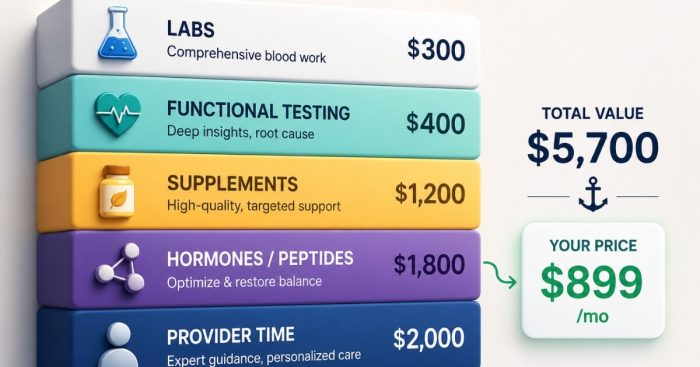
“If you bought the labs separately from Quest, that’s $300. The functional testing is $400. Six months of supplements is $1,200. Six months of hormones and peptides is $1,800. The provider time and team access at our normal hourly rate is roughly $2,000.”
“So you’re looking at about $5,700 of clinical value across six months — and we package it at $899 a month, which is $5,394 total, and you can also pay it in full for $5,000 if you want to save a few hundred.”
Why the Anchor Works
The anchor number performs the heavy lifting.
Patients hear $5,700 first.
Then they hear $899 per month.
As a result, the monthly payment feels structured and reasonable.
Without the anchor, the same $899 often feels expensive.
With the anchor, it feels like a value-based decision.
Should a cash-pay clinic lead with discounts or payment plans when quoting price?
No.
Why Discount-Led Pricing Hurts Conversion
Discount-led pricing creates a dangerous signal.
Patients often conclude:
- The program is overpriced.
- The clinic is willing to negotiate.
- The listed price is not real.
As a result, perceived value drops.
Why Financing Should Come Later
Payment-plan-led pricing creates a different problem.
Patients may assume:
- The program is unaffordable.
- The clinic expects sticker shock.
- Financing is the primary selling point.
Neither of those perceptions helps the close rate.
The Correct Sequence
Instead:
- Stack value.
- Anchor full price.
- Present pricing.
- Introduce discounts or financing if needed.
A Better Example
“If you want to pay the six months in full instead of monthly, we can take $400 off the top — but most of our patients pay monthly because it matches the cadence of the program.”
That approach protects value while still offering flexibility.
The Long-Term Risk of Discounting
Clinics that lead with discounts often train patients to wait for discounts.
Eventually, renewals become negotiations.
It is better to train patients to value the program rather than chase deals.
What language should a cash-pay clinic use to present the monthly payment without sounding cheap?
Frame the monthly payment as the operational mechanism, not the price tag.
Example Script
“The $899 a month is how we structure it so the program is affordable, doesn’t take food off the table, and lets you keep the other things in your life that matter to you while we get you the result you came in for.”
Why This Language Works
The statement accomplishes three goals:
- It normalizes the payment.
- It acknowledges the patient’s budget.
- It keeps the focus on outcomes.
Most importantly, it preserves the clinical trust built earlier in the conversation.
What to Avoid
Avoid language such as:
“It’s only $899 a month.”
“It’s less than a daily coffee.”
“You can definitely afford it.”
Those statements sound transactional.
They also undermine credibility.
What High-Converting Clinics Do Differently
Cash-pay clinics closing 60+ percent of first-visit consults tend to use outcome-focused language naturally.
By contrast, clinics closing closer to 25 percent often lead with:
“It’s $899 a month. Would that work for you?”
The difference is subtle.
The impact is not.
How does the pricing script change for a higher-ticket cash-pay program ($5K-$20K)?
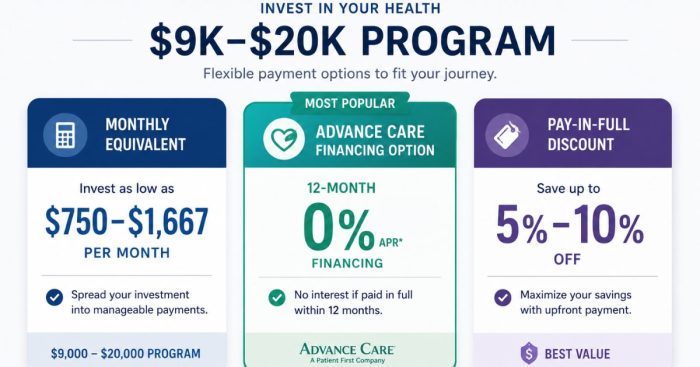
Same three steps, longer value stack, deeper anchor, and a financing layer presented after the monthly equivalent.
What Changes at Higher Price Points?
The framework remains the same:
- Stack value.
- Anchor price.
- Present payment.
However, the conversation becomes more detailed.
Expand the Value Stack
For programs priced at:
- $9,000
- $15,000
- $20,000
The value stack should include not only services but also long-term outcomes.
Expand the Anchor
The anchor becomes larger as well.
Instead of focusing only on services, discuss:
- Future medications
- Future lab work
- Future complications
- Quality-of-life costs
In other words, patients should understand the cost of not solving the problem.
Present Financing Last
After the value and anchor are established, financing can enter the conversation.
Options may include:
- Advance Care
- CareCredit
These programs often spread payments across:
- 12 months
- 24 months
In some cases, 0% interest may be available.
Why Financing Helps Both Sides
The clinic receives payment upfront.
Meanwhile, the patient receives a manageable payment schedule.
This structure also reduces chargeback risk on large transactions.
Real-World Example
A pain management and regenerative clinic we worked with added $2,095,039 in revenue in 10 months using this exact pricing-conversation discipline on $5K-$20K programs.
Many higher-ticket programs also offer a 10 percent pay-in-full discount for patients who prefer to avoid financing.
What’s the next step?
If your provider or patient coordinator is closing fewer than 60 percent of first-visit consults on membership or program enrollment — and the clinical case is strong — the issue is almost certainly the pricing conversation, not the clinical work.
Audit the Script
Book a strategy call.
On the call we:
- Listen to a recorded pricing conversation
- Score it against the stack-anchor-monthly framework
- Identify conversion leaks
- Rewrite the script in the provider’s voice
Apply the Framework Across Offers
The framework can be adapted for:
- Standard $899 programs
- $5K–$20K premium programs
- Maintenance-plan down-sells
Why This Matters
Many cash-pay clinics lose 20–40 percent of potential enrollments because of pricing presentation alone.
The clinical case may be strong.
The patient may be motivated.
However, the pricing conversation still breaks trust.
The Opportunity
Pricing is often the most coachable conversion lever inside the practice.
As a result, refining this script can become one of the highest-ROI activities for both providers and patient coordinators.