
What’s the Best Way to Price and Sell Hormone Memberships at a Cash-Pay Clinic?
The single biggest lever a cash-pay HRT clinic can pull this quarter is not more ads. It is the way the consult is priced and presented. After testing this across dozens of cash-pay hormone practices, the same three-line offer keeps winning: $300 for labs, $300 for the consult, $350/month for membership – with the consult fee credited back when the patient commits to a 12-month lifestyle change. Below is exactly how it works and why it converts.
What’s the best way to price a hormone membership for a cash-pay clinic?
The best-performing structure we have ever tested is three separate line items: $300 for labs, $300 for the initial consult, and $350 per month for the ongoing membership – with one twist. If the patient commits to staying with the clinic for a full year and making a real lifestyle change, the $300 consult fee gets credited toward the first month of membership.
The math the patient sees on the day of the consult is simple. They were already going to pay $300 for the consultation. Now that $300 rolls into month one, so month one is effectively $50 out of pocket instead of $350. They feel like they were gifted $300 at checkout. Same revenue for the clinic, dramatically lower psychological friction at the point of decision.
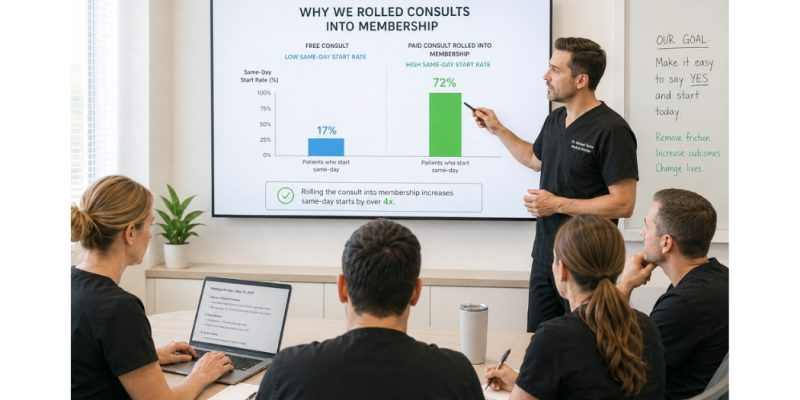
Cash-pay HRT clinics that move to this structure typically see same-day membership starts jump because the patient is no longer asked to make a separate “buy” decision after the consult – they are asked to make a “commit” decision, which is a different psychological action. This approach also aligns with effective men’s hormone clinic marketing, where every stage of the patient journey is designed to build long-term membership rather than maximize one-time consults.
Should I offer a free consultation for hormone replacement therapy?
No. A free consult is the single most common mistake we see at cash-pay hormone clinics. When the consult is free, the patient unconsciously prices the doctor’s time at zero. That makes everything downstream – the lab fee, the membership, the lifestyle commitment – feel more expensive than it actually is, because there is no anchor of value in front of it.
Paying $300 for the consult does the opposite. It tells the patient that the physician’s expertise is worth something, and it filters out tire-kickers who would never have converted anyway. The clinics we work with that switched away from the free consult almost always reported higher membership conversion within 30 days of the change.
How do I get more same-day membership starts after the consult?
Three things move same-day starts the most:
First, the consult fee rolls into the membership only if the patient signs up the same day (or at the very least, before they leave the clinic). This is the friction-killer. The patient is mentally already $300 in, so closing the loop today rather than “thinking about it” is the obvious choice.
Second, the offer is positioned as a 12-month lifestyle commitment, not a month-to-month subscription. Hormone optimization is a lifestyle medicine product, not a quick fix, and pricing it as a real commitment attracts patients who are ready to do the work. We learned this the hard way working with “an HRT clinic that we grew from $1M to $4M a year by leaning hard into a 12-month membership model with 250 active members“.
Third, labs and consult are scheduled together. Patients leave the first visit with lab work drawn and the consult booked, then return for the consult with the results in hand. There is no third decision-point – results, plan, and membership decision all happen in the same conversation.
How much should I charge for labs and the consultation?
$300 for labs and $300 for the consult is the price point that produces the strongest conversions across the highest number of clinics we have tested. The reason it works is balance: it is high enough to anchor the doctor’s time as valuable, low enough that the patient does not feel gouged before they have met the provider, and it makes the math on the rollover credit clean.
If your local market supports a higher price – some longevity-skewed markets do $400 labs and $400 consult – you can scale this proportionally as long as the consult fee is at least one full month of membership. That is the rule that makes the rollover credit feel like a real benefit instead of a coupon.
How do I get patients to commit to a 12-month hormone membership?
The commitment is not sold, it is framed. You are not asking the patient to commit to spending money. You are asking them to commit to a real lifestyle change – sleep, training, nutrition, hormone optimization – that takes 12 months to produce results. The 12-month membership is just the operational container for that commitment.
Three lines that work in this conversation: “Hormone optimization is a 12-month protocol, not a 30-day fix.” “We only work with patients who are committed to the lifestyle change because anything less than that will not produce the results you want.” “If you are not ready to do this for a full year, this is not the right time.”
The clinics that close the most 12-month memberships are also the ones most willing to walk a patient away who is not ready. Counterintuitively, walking patients away raises close rate on the patients who stay.
What is wrong with the typical “free consult” hormone clinic funnel?
The free-consult funnel has three failure modes baked in. It attracts shoppers instead of patients, because anything free attracts shoppers. It under-prices the doctor’s time, so the patient never psychologically values what they are buying. And it adds a second decision after the consult (“now do you want to pay $350 a month?”) that the patient has not been primed for, which kills same-day starts.
The $300 + $300 + $350 structure inverts all three. The paid consult filters for serious patients. The price tag anchors the doctor’s expertise. And the rollover credit means the membership decision is already implicit in the consult booking, which is why same-day starts go up.
How does this membership mechanic compare to a-la-carte hormone pricing?
A-la-carte pricing – $300 for a consult, then $200-400 per medication refill per visit – looks more flexible to the patient but produces a fraction of the lifetime value. The patient never feels owned by the clinic, churns every time their hormone levels stabilize, and the clinic has to re-acquire them on every cycle.
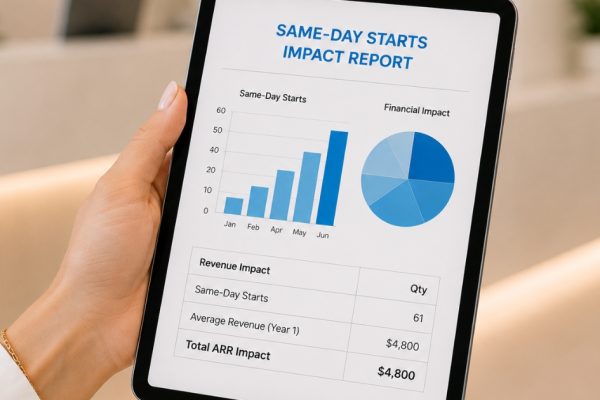
A 12-month membership at $350/month produces $4,200 in year-one membership revenue per patient, plus $300 labs and $300 consult on the front end. That is roughly $4,800 in year-one revenue per patient at the same acquisition cost. “When we built this structure for Eternity Health Partners, the clinic was generating $1.7 million per year in membership revenue from SEO alone” – a number that is only possible because the back-end LTV per patient justifies the front-end acquisition cost.
The other quiet win: a membership model converts your marketing from a lead-gen problem into a retention problem. That is a much easier problem to scale.
Ready to install this hormone membership mechanic in your clinic?
If you are running a cash-pay HRT, TRT, or hormone optimization practice and your same-day starts are below 50%, this is almost always the single highest-leverage change you can make this quarter. We have helped multiple cash-pay hormone clinics rebuild their consult offer using this framework.